


This is a place to share knowledge related to 1/12th scale racing. It is not to be used for conversations.
1/12th Scale Pan Car Kits:
Click links to go to manufacturer product page. If any are missing please add them!
Associated 12R6 (discontinued)
https://www.teamassociated.com/cars_.../Factory_Team/ Jul 2017 release
DISCUSSION THREAD - http://www.rctech.net/forum/electric...ated-12r6.html
Associated 12R5 (discontinued) https://www.teamassociated.com/cars_.../Factory_Team/
DISCUSSION THREAD - Associated RC 12 R5.2
Capricorn LAB P12
http://www.capricornrc.com/automodel...2-pan-car-112/ mid/late 2017 release
DISCUSSION THREAD - Capricorn P12 1/12 pan car
Corally SSX-12
http://corally.com/Car-Kits/Team-Cor...ctronics-8487/ Nov 2017 release
DISCUSSION THREAD - http://www.rctech.net/forum/electric...ming-soon.html
CRC Carpet Knife Twenty5
http://teamcrc.com/crc/modules.php?n...prodID=7719778 Sept 2017 release
DISCUSSION THREAD - in previous model thread http://www.rctech.net/forum/electric...2th-scale.html
CRC Carpet Knife 25 Japan Spec
http://translate.google.com/translat...Fgno%3DCRC3216 late Dec 2017 release
Destiny VD12
http://www.destinyracing.jp/ or http://www.destinyrcusa.com 2017 release shown and listed for sale at link below
http://www.rocherc.com/index.php?rou...product_id=634
DISCUSSION THREAD - http://www.rctech.net/forum/electric...tiny-vd12.html
Kawada M300 FX4 US Spec
https://sv80.wadax.ne.jp/~kawadamode...v.cgi?gno=M322 Dec 2016 release
DISCUSSION THREAD - (previous 300 model) http://www.rctech.net/forum/electric...-u-s-spec.html
Kyosho Plazma Ra 2.0
http://rc.kyosho.com/en/30423.html Sept 2015 release
DISCUSSION THREAD - http://www.rctech.net/forum/electric...n-chassis.html
RSD RR12 T2
http://www.reflexracing.net/RSD-RR12-T2-_p_2598.html late 2016 release
DISCUSSION THREAD - http://www.rctech.net/forum/electric...n-car-kit.html
Roche Rapide P12-2017 US Spec
http://www.rocherc.com/index.php?rou...ory&path=67_80 Nov 2017 release
DISCUSSION THREAD - http://www.rctech.net/forum/electric...n-car-kit.html
Schumacher Eclipse
http://www.racing-cars.com/pp/Car_Showroom/Eclipse.html late 2016 release
DISCUSSION THREAD - http://www.rctech.net/forum/electric...se-1-12th.html
Serpent S120 LTR
http://www.serpent.com/product/410006 mid 2015 release
DISCUSSION THREAD - http://www.rctech.net/forum/electric...h-scale-3.html
Speed Merchant Rev. 8.5
http://www.teamspeedmerchant.com/sho...l/smr1803.html Nov 2017 release
DISCUSSION THREAD - http://www.rctech.net/forum/electric...t-rev-8-a.html
TEAMSAXO GT-300W-V2 1:12
http://www.saxoracing.com/products/t...12-pan-car-kit early 2017 release
Top Rebel 12 (discontinued)
http://www.top-racing.jp/index.html Sept 2010 announced
DISCUSSION THREAD - http://www.rctech.net/forum/electric...2th-scale.html
VBC Lightning 12M
http://www.vbcracing.com/collections...-d-05-vbc-ck18 Mid 2016 release
DISCUSSION THREAD - http://www.rctech.net/forum/electric...ning-12-a.html
XRAY X12 2020 (US and EU)
https://teamxray.com/x12/2020/en/#1 Sept 1019 release
XRAY X12 2018 (US and EU)
https://teamxray.com/x12/2018/en/ Aug 2017 release
DISCUSSION THREAD - http://www.rctech.net/forum/electric...ming-soon.html
XRAY X12 2017
https://teamxray.com/x12/2017/en/
DISCUSSION THREAD - http://www.rctech.net/forum/electric...2-pan-car.html
Yokomo YR-X12
https://www.amainhobbies.com/yokomo-...-x1219/p793831 Amain (US Yokomo dist) late 2019 release
DISCUSSION THREAD - http://www.rctech.net/forum/electric...omo-yrx12.html 2019 version Aug 2018 announced
TIRES:
Pre-mounted tires readily available in the US:
BSR http://johnsbsrracing.com/foam-tires/12th-scale-foams
Contact (Schumacher) http://www.racing-cars.com/sp/catego...;_Circuit.html
Corally http://corally.com/Tires/1-12-Foam-Pan-Cars/
CRC http://teamcrc.com/crc/modules.php?n...category_id=63
Enneti (Xceed) http://www.xceedrc.com/product/Tyres/all/24
Jaco https://www.tqrcracing.com/forum/vie...=8&search_all=
JFT (Japan Foam Tire) http://japanfoamtire.com/ US seller, UK seller is Zen Racing
Pro One http://www.proonerc.com/collections/all also sells Team Gravity 1/12 tires
ULTI https://ultitires.com/index.php?rout...y&path=247_173
Pre-mounted tires readily available in the Europe:
HotRace Tyres http://hotracetyres.com/112-pan-car/ also sold by Capricorn and Zen Racing
Tire Truers:
CRC Ultimate Tire Truer Package http://www.teamcrc.com/crc/modules.p...prodID=7719719
CRC Auto-true - 12 volt tire machine http://www.teamcrc.com/crc/modules.p...prodID=7719718
Fastrax Tyre Truer http://www.cmldistribution.co.uk/pro...rax-tyre-truer
Hudy Tire Truers https://www.hudy.net/xhudy/products/...dy_Session=572 00268f0cd248c19a2a376e9115a4d
3Racing Automatic Tire Truer 2014 Tyre Grinding Machine (disc), still available also sold under various other names
MUMEISHA Tire Grinder k7 no official link, sold on various sites
YOKOMO Tire Truer still sold various sites
Gluing your own donuts:
https://www.youtube.com/watch?v=hm7z1rz-74s - Special thanks to Edward Pickering!
Truing tires:
https://www.youtube.com/watch?v=8wqHOLWq6Uc - Special thanks to Edward Pickering!
The following information came from http://www.reflexracing.net/12th-Sca...rt-of_b_7.html - with some editing and information added. Thanks Christian!
THIS MAY NEED UPDATING FOR THE NEW BLACK CRC CARPET
Brands:
BSR, CRC, Jaco and Pro One
the above are all mounted by BSR and use the same foam. The nomenclature of the BSR vs Jaco/CRC is a little different in a few instances but is otherwise the same. The BSR foam consists of three families, and can be identifed as synthetics, naturals, and blends.
Synthetics - The old school, light weight, easy to true "dry feeling" tires. These include tires like CRC/Jaco Yellow (BSR White), Black, Gray, etc. These tires offer the highest wear rate and lowest grip. Many racers continue to use these nder high bite conditions.
Naturals - These tires are usually the best alternative for low bite and asphalt. They include Pink, Magenta, Double Pink, Lilac (BSR Team Purple), Purple, and other tires. These tires provide a ton of grip, but tend to get sticky in high bite conditions. This rubber does not wear as easily, and the cars will pick up gunk and fibers from the carpet under most high bite conditions. This is especially bad if the humidity is high.
Blends - These are the tires most people run today. They were initially called JFT foam by some, as it was believed that the tires were the same as the JFT tires. We can divide the blends further into two groups: high rubber and low rubber content. The high rubber would be the new rear Orange and Red from the BSR family, and the low rubber would be the Green and Blue varieties. When, asked about the difference, John Foister from BSR Tires said they came from the same family of foam, but they offered different grip. According to John, the Green/Blue has more bite than Orange/Red, but from track testing Oranges offer more bite than Green (being equivalent to in hardness) when the grip is high and absolutely no grip when it is lower. The Orange foam has a denser pore structure and the tire is not as prone to chunking. It is also important to note is that BSR Blue rears are not the same as the BSR Blue fronts.
JFT:
JFT stands for Japan Foam Tire. They started the new wave of foam tires we are all using now (Blue/Blu, Green/Greene, Dbl Blue, etc). These tires are a little different than the BSR tire family, but work in very similar conditions. They currently offer four varieties - A, C, S, and R. See below for an explanation of the different varieties. Please note that JFT uses the same foam for fronts and rears, so a C35 front is the same as a C35 rear (for example.) This is different from other brands where a Blue front might be different from a Blue rear.
Most people reference JFT tires using a combination of the variety/family (A, C, R, or S) in conjunction with the shore (30, 32, 35, etc.) This is easier than using colours, as there are common colours across the different families (both C and S have a blue, for example.
JFT also does offer a stripe spec tire for 1/12 that uses a higher shore A foam with a blue stripe. This tire is comparable to the BSR purple stripe tire, although the JFT version can sometimes feel softer - primarily due to the wider blue stripe that is a softer foam than the BSR purple stripe (actual stripe, not the tire foam.
A foam = Pink/Magenta/Purple Family. Used on asphalt and black carpet, considered close to the natural rubber variety and are named consistently with other natural tires. A foam is very good on black carpet, although it will wear faster than other foam types. Common combinations (F/R) are A30/A30 or A32/A30.
C foam = C foam is very similar to the BSR Blue/Green foam, or the Ulti X foam. JFT C foam is what started the trend of Blue/Green with Naoto's win at worlds in 2012. This foam wears very well and is good on old grey carpet but can be used effectively on new carpet. Common combinations (F/R) include C35/C35 C35/C30 or A32/C30.
S Foam = Think of this as an evolution of C foam. Korey H likes to call them super blue/green. S tends to have better forward bite than C foam, but with better rotation at the same time. As such, S foam can feel a bit more aggressive to drive. S foam wears well, both on grey and black carpet. S, like R, is probably one of the best compounds on grey carpet. S foam can be good on black carpet, but has largely been overshadowed by R foam - since R is a bit easier to drive and has produced well in 13.5. Common combinations (F/R) include S35/S30 or S35/S35.
R Foam = These are similar to S foam, which means they are, in-turn, similar to C foam (both S and R are based on C foam.) R foam feels like S foam but just a little more mellow and stable than S foam. R foam does seem to wear a bit better than S foam. R foam has been very popular in 13.5 on black carpet for the past several years. Typical combinations (F/R) include R35/R35 or R35/R30.
For general setup, the JFT foam seem to generate more bite than the BSR, therefore the car tends to be a little more aggressive.
Ulti:
Ulti is another Japanese brand that offers an array of compounds. They have their own way of rating tires, and are difficult to equate to other brands. They have 4 different varieties, each in varying degrees of hardness. High rubber content tire, similar to Pink/ Magenta. Soft would be close to a pink.
J: High rubber content tire, similar to Pink/ Magenta. Soft would be close to a pink. These offer the most bite and are great for asphalt/carpet front tire. (J hard being very popular)
X: blend, similar to JFT Blue/ Green. Soft is equivalent to Green, medium to Blue in hardness. Great for carpet High synthetic blend with lower grip, and is not a very popular variety.
Z: A very expensive "special" foam that is supposed to be magic on asphalt. Only make it in soft shore.
G: Evolution of the X compound, for carpet high grip (not on chart below)
European tires:
There are many great European foam tire brands that use their own types of foam, as well as traditional foams. Someone with more knowledge about them will need to fill this in.
Tire Diameter:
If you are racing on carpet, you have to evaluate how much grip your track has. If your track is low to medium grip, you can run bigger tires. If you are on higher bite you have to cut them smaller, there is simply no way around it. Bigger tires are needed for asphalt, especially in the rear. The larger tires provide much needed lateral bite.
Carpet (mm):
Low - Medium Bite Front: 42.0 - 42.5 Rear: 42.5 - 43.00
Medium - High Bite Front: 40.5 - 41.0 Rear: 41.5 - 42.0
Big Race - Front: 39.5 - 40.0 Rear: 40.5 - 41.0
Asphalt (mm):
Parking Lot - Front: 43.0 - 44. Rear: 44.0 - 45.0
Prepped High Bite - Front: 42.0 - 43.0 Rear: 43.0 - 44.0
Tire Edge Preparation:
On high grip the profile and preparation of the edge of the tire can be CRITICAL to preventing the car from rolling up on the outside tire or traction rolling. The easiest and most repeatable process found so far is to put a beveled edge in the foam with a sanding paddle, about 45 degrees. A straight bevel not rounded or molded from the outer surface of the tire right to the plastic of the rim and even a little sanding into the rim. Do this to both the front and rear tires, then use a nail polish brush to apply a few layers of superglue to the outer edge of the fronts. This has shown to effectively prevent traction roll and tires prepared using this hard bevel method have good consistency during runs. Some good examples are available on thread page 3143 1/12 forum
Tire Saucing:
Most facilities have moved towards odorless traction additives such as SXT. Some of additives evaporate very quickly and some do not. This seems to be something that is also dependent on tire compound and ambient temperature. For example, saucing a Green compound seems like it never dries, especially when tjhe temperature is lower. We have found that wiping the tires off 15 minutes before we go run allows the sauce to cure, which makes the car come in much quicker with Green rears. Blue compounds on the other hand, do fine when wiped off right before hitting the track.
Saucing half front and full rear is a good initial starting point. If the front of the car is too aggressive you can sauce less than half, or for a shorter amount of time. On black carpet the car may be numb to sauce changes, either a long or short sauce can produce very similar handling.
Tire Fuzzing:
In conditions of increasing grip, foam tires will sometimes get sticky and pick up fuzz and debris from the track. This is highly dependent on the rubber sedan tire that is being run at your local track and the compound/ type of foam you are running on you car. The softer the sedan tire and the harder/higher rubber content in your foam tire, trouble with fuzzing seems more likely to occur.
There are ways to get around fuzzing under most conditions, and usually involves the selection of the correct foam compound. The more fuzz you get, the softer/lower rubber content you want to run.
Examples:
Problem: Car fuzzes with Lilac/Team Purple fronts and car starts pushing.
Solution: Use a softer front tire and or different family of foam. Replace it with Blue or Double Blue front. Alternatively you can sauce the front tires harder and tune the car for less front end bite.
Problem: Car loses rear bite 6 minutes into the run. Blue rear tires look almost clean but have small carpet hairs.
Solution: Use Green rear tires. The softer compound wears instead of getting sticky, minimizing fuzz. Possibly a longer sauce will prevent fuzzing.
Alternatively, mild tire fuzzing can be remedied with longer sauce soak times, particularly if you are using SXT3 as your house sauce.
Tire Selection:
Starting out, pick 2 tire compounds for the front and rear. The following should have you covered 99% of the time.
Rear - Green and Blue (BSR) or Green and Light Blue (JFT)
Front - Blue and Double Blue (BSR) or Blue and Dark Blue (JFT)
You may wonder about other compounds out there and if they might be better, trust me, they probably won't be. Even if there are other tires that can be as fast, the synthetic family wears out really fast and the high natural rubber will probably fuzz on you over an 8 minute run. The blends family seems to be the most versatile foam type available today. They last awhile, and sticking to them will make your process of tire selection simpler.
Tire Charts:
BSR/CRC/Jaco
https://farm5.staticflickr.com/4504/...834a4ce3_b.jpg
chart above shows BSR orange and red at high shores used in TC fronts, for 1/12 scale they are different shores. BSR site does not reflect this, below are available and being used by racers
F1222 ORANGE REAR 25 shore Asphalt tracks. Low wear / long lasting
F1228 RED REAR 30 shore High traction asphalt tracks. Lowest wear / longest lasting.
Contact
https://farm5.staticflickr.com/4347/...9d515027_z.jpg
Corally
https://farm5.staticflickr.com/4478/...c3955b7e_z.jpg
JFT (Japan Foam Tire)
https://farm5.staticflickr.com/4337/...a6482643_z.jpg
Ulti
https://farm5.staticflickr.com/4510/...6e37f6f62b.jpg
Ulti Compounds:
J: Natural rubber compounds similar to Pink and Purple of other brands. J foam is used for asphalt to all carpet and the condition of an especially high grip. This is the standard foam used all over the world for some time.
X: Synthetic blend similar to Blue / Green of other brands. Carpet tire.
Y: Synthetic blend similar to Blue / Green of other brands. Carpet tire. Less tacky and grippy than X compound.
G: Evolution of the X compound. G foam is often suitable mainly for carpet and the condition of an especially high grip.
V: Evolution of X compound, black carpet blend.
INV: Invincible compound. Designed for asphalt use, claim better consistency and improved grip.
Z: Very high grip on carpet. Only recommended when natural grip is very low.
Enneti (Xceed)
https://farm5.staticflickr.com/4481/...9a3e7b8a54.jpg
ELECTRONICS:
ESC:
As of now, ROAR is staying 1S (3.7V nominal; 4.2V fully charged) for 1/12. There are many 1S ESC's with a built in voltage booster for proper ESC, servo, and receiver function. so nothing else is required to power the receiver and servo.
If you don't want to lock yourself into a 1S specific ESC, you do have other options. It is possible on some ESC models to use your 2S ESC without a booster or receiver pack, and the ESC simply supplies the lower voltage to servo and receiver. If that does not appeal to you, you will need to use an Rx pack or booster. The Rx pack and booster will both supply the receiver with a higher voltage than the 1S pack.
(Note:Roar banned receiver packs in all 12th scale classes accept MOD)
If you decide to use an Rx pack, MAKE SURE TO REMOVE THE RED WIRE FROM THE ESC PLUG THAT GOES INTO THE RECEIVER!!!
If you choose to use a voltage booster, it works exactly how it sounds. Instead of plugging the ESC into the receiver, it plugs into the booster, and the booster plug goes to the ESC, supplying the higher voltage.
1S ESC:
If there are any missing please add them.
Hobbywing XR10 Pro 1S http://www.hobbywing.com/goods.php?id=538 No motor limit.
Hobbywing XR10 Pro STOCK SPEC http://www.hobbywing.com/goods.php?i...attr=5426.5473 10.5 turn motor limit
Cerix PRO 1S Esc 120A https://corally.com/Speed-Controller...s-Motors-120A/ 3.5 motor limit
SMC RF-170 1S https://www.smc-racing.net/index.php...product_id=406
Trackstar One Cell 120A https://hobbyking.com/en_us/tracksta...-approved.html no motor limit.
Team Powers XPS EL V2 1S http://team-powers.com/index.php?thi...sr=0&startrow= 9.5 turn motor limit
Team Powers Radon Pro V2 1S (140A) http://team-powers.com/index.php?thi...sr=0&startrow= 4T motor limit
Tekin RS Pro Black Edition BL 1S https://www.teamtekin.com/rspro.html
TEAM ORION Vortex R10 Pro V2 Brushless ESC (120A, 1S Only) https://teamorion.com/en/speed-contr...-120a-1s-only/ 3T motor limit, available outside US market only
CR173 - PACE 45 Brushless ESC 1s/2s http://www.racing-cars.com/pp/Manufa..._RC/CR173.html 10.5 motor limit
CR199 - PACE 60R Brushless ESC 1s/2s http://www.racing-cars.com/pp/Manufa..._RC/CR199.html 6.5 motor limit
DISCONTINUED 1S ESC:
If there are any missing please add them
Toro 1S120 http://www.skyrc.com/Power_System/ESC/TS120_Aluminum all newer TORO esc's show 2-3 cells
Muchmore ME-FL1SK FLETA 1S http://muchmoreracing.net/support_vi...N1cHBvcnQucGhw P3BhZ2U9Mg== no motor limit
Hobbywing V2.1 1S http://www.hobbypartz.com/07e-xerun-...-1s-black.html No motor limit with fan.
Hobbywing V3.1 1S http://www.hobbywing.com/goods.php?id=419&filter_attr= No motor limit with fan
LRP SXX Stock Spec V2 No motor limit with fan. website down
LRP SXX Comp V2 4.5 turn motor limit. website down
Gforce 1S 120A ESC http://www.gforce-hobby.jp/products-en/G0014.html 3.5T motor limit
TEAM ORION Vortex R10 Pro Brushless ESC (120A, 1-2S) 3.5 motor limit.
ORCA VRITRA VX3 1s http://www.orcarc.com/product/vritra-vx3-1s-112-esc/ No motor limit with fan. to be replaced by 2018 ORCA R32X 1S
If anyone would like a need for a chart comparing the ESC's specs PM fenton06 and I'll get one made and put in here
Voltage Boosters:
If there are any missing please add them
Hobbywing http://www.hobbywingdirect.com/produ...dc-dc-booster- 6V @ 3A cont, 6A burst
Trinity Motolyser DC 1S Booster https://www.teamtrinity.com/Motolyse...ter_p_133.html Output voltage 6.0v / 2.75 amps
Turnigy http://www.hobbyking.com/hobbyking/s...idproduct=7884 5V @ 1.5A max
Turnigy - naked http://www.hobbyking.com/hobbyking/s...to_5v_1A_.html 5V @ 1.5A max
RC Dynamics http://www.rcdynamics.co.uk/Booster.html 6V @ 1.5A max
TQ Booster http://www.tqcells.com/TQBOOSTER.htm
Servos:
Futaba:
BLS671SV S.Bus2 http://www.gpdealera.com/cgi-bin/wga...pgm?I=FUTM0160
BLS671SVi S.Bus2 http://www.gpdealera.com/cgi-bin/wga...pgm?I=FUTM0186
S9570SV S.Bus2 HV http://www.gpdealera.com/cgi-bin/wga...pgm?I=FUTM0724
S9650 http://www.gpdealera.com/cgi-bin/wga...pgm?I=FUTM0260
Goteck: http://www.hobbyking.com/hobbyking/s...g_0_05sec.html note has 21T spline, will have to order servo saver direct from kimbrough
Hitec:
HS-7235MH http://hitecrcd.com/products/servos/...-servo/product
HS-7245MH http://hitecrcd.com/products/servos/...-servo/product
JR:
3550 and 3650 are now discontinued
DS3717HV http://www.jramericas.com/130919/JRPS3717HV/?pcat=554
KO Propo:
RSx12 http://kopropo.com/america/box/rsx12/
MKS: http://www.mksservosusa.com/home.php?cat=5
DS9660A
DS9670A
DS8910A
Sanwa:
SRG-HS http://sanwa-denshi.com/rc/car/servo/srg-hs.html
SRG-HR http://sanwa-denshi.com/rc/car/servo/srg-hr.html
Savox:
SH-1250MG http://www.savoxusa.com/Savox_SH1250...avsh1250mg.htm
SH-1257MG http://www.savoxusa.com/Savox_SH1257...avsh1257mg.htm
SH-1350 http://www.savoxusa.com/Savox_SH1350.../savsh1350.htm
SH-1357 http://www.savoxusa.com/Savox_SH1357.../savsh1357.htm
Spektrum:
A5030 http://www.spektrumrc.com/Products/D...odID=SPMSA5030
A5040 http://www.spektrumrc.com/Products/D...odID=SPMSA5040
A5060 http://www.spektrumrc.com/Products/D...odID=SPMSA5060
Trackstar:
TS-P12S http://www.hobbyking.com/hobbyking/s...05sec_28g.html
Xpert:
MM-3301-HV(M1) http://xpert-rc.com/product/mm-3301-hv/
MI-3301-HV(M2) http://xpert-rc.com/product/mi-3301-hv/
MM-3302T-HV(M1T) http://xpert-rc.com/product/mm-3302t-hv/
If anyone would like a need for a chart comparing the servo specs PM fenton06 and I'll get one made and put in here
BODIES:
Audi R8C
http://www.teamcrc.com/crc/modules.p...prodID=7719024
http://www.teamcrc.com/crc/images/em...edia/52318.jpg
Toyota TS030
http://teamcrc.com/crc/modules.php?n...prodID=7719024
http://teamcrc.com/crc/images/empori...edia/52318.jpg
Lola B10
http://teamcrc.com/crc/modules.php?n...prodID=7719635
http://www.teamcrc.com/crc/images/em...edia/52752.jpg
AMR-12
http://racepf.com/on-road-1-10-1-12/...ht-clear-body/
http://racepf.com/on-road-1-10-1-12/...ht-clear-body/
http://racepf.com/images/products/1611-15.jpg
BMR-12
http://racepf.com/on-road-1-10-1-12/...ht-clear-body/
http://racepf.com/on-road-1-10-1-12/...ht-clear-body/
http://racepf.com/on-road-1-10-1-12/...ht-clear-body/
http://racepf.com/images/products/1615-20.jpg
BMR-12.1
http://racepf.com/on-road-1-10-1-12/...ht-clear-body/
http://racepf.com/on-road-1-10-1-12/...ht-clear-body/
http://racepf.com/on-road-1-10-1-12/...ht-clear-body/
http://racepf.com/images/products/1616-15.jpg
Strakka-12
http://racepf.com/on-road-1-10-1-12/...ht-clear-body/
http://racepf.com/on-road-1-10-1-12/...ht-clear-body/
http://racepf.com/images/products/1614-20.jpg
PFM-12 (GT12)
http://racepf.com/on-road-1-10-1-12/...ht-clear-body/
http://racepf.com/on-road-1-10-1-12/pfm-12-clear-body/
http://racepf.com/images/products/1613-25.jpg
RSD-R12SS
http://www.reflexracing.net/RSD-R12S...an_p_2464.html
http://www.reflexracing.net/assets/i...rsd12ss_01.jpg
PAN CAR TUNING:
Pan Car Front Suspension Tuning:
DISCLAIMER: The following tuning advice was written based on the tuning experience of the author and may not hold true for all cars, drivers, or surfaces. In the end the best tuning advice is to experiment and make changes one at a time so you can track your changes and find the car balance that works best for your driving style. One real world test is worth a million ‘expert’ opinions.
Front End Type:
All popular modern pan car front suspensions are very similar, with a few exceptions such as Speedmerchant New School but most of the info in this wiki applies to them as well. For the most part, they consist of a rigid bottom arm, an upper A-arm, and a kingpin with a spring. There are different flavors of this general design, such as the CRC Dynamic Strut that uses a threaded kingpin and upper pivot ball instead of the Associated style that uses a kingpin that goes through the entire steering knuckle assembly, but their operation is the same with the rigid lower arm and the upper arm controlling the arc of movement as the suspension is compressed.
Assembly:
More so than in almost any other part of the car, the front suspension of your 1/12 car must move absolutely free. Reamers and hobby knives are important here, as any binding will cause the car to corner unpredictably. A little play in the suspension is a good thing, and racers will often find that ‘worn in’ suspension pieces function a little better than new.
Springs:
Besides tires, spring rate is the most important part of deciding how your car will handle through corners, but can be complicated. As a general rule of thumb, a very hard front spring will have somewhat less steering grip than a softer spring with the same suspension setup and tires, but not as much as in other classes such as touring or offroad. On carpet, springs of different tension can be used to tune how your car will maintain or lose energy through corners with the following general rule of thumb:
Hard Spring (0.55mm or harder): Less overall steering, quick reaction to driver input, less on power steering, harder turn-in with potentially lazy mid-corner and exit.
Soft Spring (.45mm): More overall steering especially at low speed, slightly slower reaction to driver input, more on-power steering, less aggressive turn-in but can ‘hook’ and give better mid-corner and exit.
It is worth noting that front springs from different suppliers are often very different, in both height, wire thickness, and coils for a given spring height meaning that a “medium” spring from one manufacturer may be the “hard” spring for another. To make accurate changes you may want to use one spring maker and stick with their line.
Another aspect to pan car springs is that they can get “blown out” and collapse, no longer as stiff or as tall as they were. These should be replaced with fresh springs to ensure consistent handling.
Dampening:
This is generally a minor adjustment, but adding dampening tube fluid to the front kingpins of a 1/12 car can give it a little more initial steering. Often unusual compounds see use here, such as Losi Smart Diff Grease or Associated Green Slime being a popular front kingpin lube.
Caster and Reactive Caster:
Caster is the angle of the kingpin, almost always angling back to the rear of the car, with a typical range from 0-10 degrees. Increasing your caster will typically result in less turn-in but a little more control, more steering exiting the corner, and somewhat increased straight-line stability with less tendency to wander because a wheel running caster will tend to straighten itself.
Reactive caster can be inconsistent in its tuning effects from chassis to chassis. On CRC, more reactive caster = more initial turn in, but potentially less corner exit steering. This effect depends heavily on other tuning parameters like camber gain, but changes to reactive caster are generally easy to make and a little experimentation will give you your best combination. For some setups, maximum steering = 0dg Reactive.
When grip comes way up, sometimes more reactive is better, as it smooths the car out, keeps the car flatter, and can reduce hiking as it pulls caster out as you transition into and through the center of the corner.
Caster is what transfers weight in your car and pulls cross weight out when you turn the wheel.
Reactive Camber and Front Roll Center:
Reactive camber or camber gain is how much camber is added the front wheels as the suspension compresses. This can be increased or decreased by changing the angle and length of the top arm. Short, angled arm = more. Long, flat arm = less. More reactive camber will typically cause the car to “roll up” on the outer front wheel, transferring more weight in a turn and give more steering up to the point at which the tire is overloaded. This is generally more front grip and weight transfer than wanted on carpet, and as a result most cars run a flatter longer front arm.
Roll Center is the point on which the car will twist laterally or ‘roll’ during cornering. This can be raised or lowered by changing the angle and length of the top arm, with a short angled arm raising is slightly and a long flat arm lowering it. From what I have calculated most modern 1/12 cars meant for carpet have a roll center somewhere around the height of the chassis plate or just below it, but due to the lower arms being rigid and flat the roll center cannot be under the bottom of the tires like it often is on a touring car.
These two are inexorably linked in pan cars. Top arm length can be changed by moving the top arm mount in or out using shims or a CRC Long Arm kit, but is generally a minor tuning choice. Tuning of roll center with shims is usually a minor tuning choice in a pan car with a rigid bottom arm due to how the car cannot gain extra mechanical advantage on the lower arm as you can in a touring car, while reactive camber can be a significant driver of the car’s performance. In a modern car running on carpet the kit setup is usually perfectly fine.
Front End Alignment:
Static camber is the angle of your front wheels at rest, typically somewhere from 0 to 1.5 degrees on a pan car depending on surface, tire choice, and other factors, but a good starting point is usually somewhere around 0.5 degrees. More camber will typically give more steering, but many racers use static camber to ensure that their tires wear flat even if that means not having exactly equal camber on both sides of the car. This is adjusted by threading in and out the upper turnbuckle or pivot ball.
It is also worth noting that when running on high grip the flex and deformation of your chassis, suspension parts, and front wheels can become significant and cause uneven front tire wear. Some troubleshooting of the right combination of static camber, camber gain, caster, and tire/rim choice may be necessary to ensure even front tire wear.
Toe-In:
The front toe is one of the more easily adjusted aspects of the car and can have a significant effect on the attitude of the car due to it being a quick way to moderately adjust Ackerman without making significant other changes. With nothing else being adjusted, going from zero toe to toe-in will give a car a harder turn-in and will tend to scrub speed with the front end as opposed to using drag brake. This can be necessary when racing in Super Stock or higher power classes and will allow you to drive more aggressively, and can help the car track straighter under power. Toe-out will tend to make the car coast more through corners due to reducing the steering angle of the outer front tire. If a car has too much off-power steering but is otherwise stable, adding toe-out can calm the car but may the car to wander on the straights especially if the front end setup is very soft.
Ackerman:
Ackerman is the difference in steering angle between the two front tires during a turn. It is the result of how during a turn the inside of the car experiences a tighter circle and needs correspondingly more steering angle, but is also an important tuning tool. More Ackerman means having more inside wheel steering angle relative to the outer wheel, less means that the difference in steering angle is smaller.
To add or remove Ackerman, using a servo horn that spaces the links further apart (such as a Kimbrough Small Servo Saver, the outer holes on a Tamiya or Xray servo saver) will have more Ackerman than a servo that puts the links close together (Kimbrough Medium inner holes, Tamiya or Xray inner holes.) The rule of thumb is that a servo that puts the ball studs close together but spaced away from the servo horn will have less Ackerman than one that spaces them far apart and close to the servo horn. Ackerman changes will have the same effect as changing toe with more Ackerman being effectively toeing the wheels out and less toeing them in, but will not affect the straight-line attitude of the car.
Turning Circle / Steering Angle:
In offroad or even touring car you can set up the car to use the full angle of the steering 100% of the time. You will almost certainly not be able to do this in 1/12 scale. It goes without saying that as you turn up your steering angle you will gain steering often to the point of the car being undriveable. The quickest way to set the steering correctly is to set the sub-trim in your radio such that the car tracks straight and the servo horn is straight up and down, then set the endpoints equally such that they don't quite hit the steering bump-stops, then turn down the dual-rate or total throw from there. A typical starting point is somewhere between 45 and 60% of the total steering throw, or a 4-5' turning circle.
Pan Car Rear Pod Tuning:
Modern pan cars are all link cars with a center pivot ball and solid rear axle. This suspension system is required by ROAR rules and has the advantage of being simple, lightweight, and inexpensive compared to other more exotic methods of rear suspension, but it has some complicated movements that can be unintuitive.
Motion of the Rear Pod:
Due to how the rear pod is a solid axle, the only motion the pod itself sees is the main pivot up and down, but due to the main chassis being independently sprung it will feel the lean, dive, and squat of the main chassis as the car is driven. The lateral forces of the main chassis during cornering is transmitted through the main pivot ball and side links, the roll through the side springs and side dampeners, and the squat and dive through the main shock and spring. In addition, the torque of the motor against the pinion gear both during acceleration and braking is significant enough to cause a change in attitude even in low-powered classes. The motor pinion will try to “climb” the spur gear, lifting the center pivot of the car and countering the “squat” of the main chassis weight being transferred backward by the acceleration or the opposite under brakes.
Main Shock:
The adjustment of the main shock of a pan car is one of its more important tuning parameters. Spring, dampening oil, and pod droop are all controlled by the main shock.
Main Spring:
A soft main spring generally means more rear grip and more forgiving off-power, while a stiffer spring can mean more steering especially off-power, but the main spring must also be stiff enough to prevent the chassis from dragging when running on high grip. For most cars the kit spring is a medium weight spring that is a good starting point.
Also worth noting about the main shock is that if you like the feel of a soft main spring but it isn't hard enough to prevent the car from bottoming out, a bump-stop made from a piece of silicone fuel tubing can be a good solution.
Main Shock Spring Charts:
PETIT RC SOFT SPRING CHART
PETIT RC FIRM SPRING CHART
Main Shock Dampening:
The weight of the main shock oil will determine how fast the car will react off-power. 30wt or roughly 300cps shock oil is a good starting point, going up in weight will increase initial off-power turn-in, while going down will generally make initial turn-in softer. Often a heavier shock oil can make the car transition from entry to mid to corner exit smoother, where a car with light fluid may have a more pronounced ‘hook’ in the mid corner.
Side Springs:
The side springs transfer the roll motion of the main chassis to the rear plate via spring tension. Softer side springs give the car more rear grip and can make the car have a smoother steering feel. Springs that are more stiff promote the cars rotation and give more steering. You can either pre-load side springs or let them float, due to all side springs being progressive beehive shaped springs pre-load makes them effectively harder and will give more steering, but a small amount of pre-load can also make the car more predictable and forgiving. In conditions of extremely high grip, it may be possible to run no side springs at all due to the steering afforded by the tacky running surface and helps prevent traction-roll, likewise in extremely low grip when rear stability is absolutely necessary. Generally 1/12 cars run soft side springs but stiffer ones can be very common in Pro 10, WGT, or WGT-R.
Side Dampener Tubes:
Heavier tube lube will keep a car flatter at corner entry, initiating quicker. It may also make the car square off the corner entry when the grip gets beyond med-high. Going lighter will reduce steering initiation and maybe preferred on higher grip. This parameter is really unique to the driver preference, as some drivers are very fast and consistent with heavily dampened cars while others prefer softer setups.
Droop:
Controlled by the length of the shock, adjusting the rear pod droop is extremely important on high-grip surfaces. Reducing droop prevents the car from transferring weight during cornering and will give more rear stability and prevent traction-roll or problematic lifting of the inside rear tires during cornering, low droop can also give the car slightly more on-power steering. Increasing will allow the car to transfer more weight and dive harder into corners, but by allowing the center of the car to rise you will be more prone to traction roll issues. A typical starting point is 1-2mm of droop from ride height, but 0mm is often used on high grip.
Pan Car Differential Tuning:
This is officially where the Black Magic starts. Highly successful pan car racers can have very different ways of building diffs, but the following tips have helped multiple racers assemble consistent pan car diffs:
All modern pan cars are direct drive and use a ball-diff type solid axle. This is the lightest and most efficient manner of transferring power to the drive wheels, and by far the simplest drive system used in RC. In spite of its simplicity and low number of parts, pan car differentials are often miss-understood, particularly by those who have never raced pan cars before. This short guild will hopefully clear up any misconceptions about assembly, tuning, and troubleshooting of pan car differentials for beginners.
Assembly:
It is recommended that you use an electronics cleaner or plastic-safe motor spray to clean the dirt, oils or grease out of even fresh parts to ensure a good diff action. Some racers will blast new bearing grease out of bearings before re-oiling with light oil, but this may not be as beneficial as some believe and that light oil can get into the diff and cause slipping. The most important parts to get clean and dry are the diff rings, diff balls, and spur gear. Then assemble the diff according to the kit instructions, but refrain from adding grease until the next step.
When assembling your differential, pay attention to clearances between different moving surfaces, bearings should fit snug and spin free, including the bearing on which the spur gear is mounted because if the spur gear is not tight with its carrier bearing it will not spin true. With the diff assembled but not yet greased there should be a tick of side-to-side play in the spur gear when torqued side-to-side, indicating that the diff balls and not the gear are in contact with the diff rings. Check the action of the diff with it dry, as it will be easier to determine the source of binding or roughness than it would be before greasing the diff. If it turns smooth but with good ‘bite’ between the diff balls and ring gears without slipping, the spur gear and diff balls are ready for grease.
Almost without fail racers from other RC classes such as offroad or touring car assemble their first pan car diffs with far too much grease. It is important to understand that the point of grease in pan car diffs is not to smooth out the operation of the components as they mesh together as it is in a gear diff, but to lube the contact between spur gear spinning diff ball.
The type of grease to use is white silicone grease such as Team Associated Stealth grease. This is not “good grease” as it is not slippery and does not cushion metal surfaces well, but that is the point, you are counting on the friction between the diff ball and diff ring to transfer all of the power your motor makes to the axle. Using more slippery grease like black carbon/moly grease will make your differential slip.
To apply grease, remove the spur gear with the diff balls still in their pockets, and dab a tiny amount of grease to each diff ball, and by tiny I mean that the dot of grease should just barely cover the visible surface of the diff ball, steady hands will be necessary. With the dab of grease on each diff ball, use your thumb and forefinger to roll each diff ball in its pocket to evenly spread the grease on the inner surface of the spur gear. Most of the grease will wind up on your fingers, and that is intentional. This is the most reliable action the author has found to get an appropriate amount of grease into the diff.
The next step may be slightly controversial, as we have already removed most of this admittedly tiny amount of grease from the spur gear/diff ball assembly: Take a clean shop towel or rag and firmly wipe down both sides of the spur gear, with the objective of getting all of the grease off from both sides of the plastic gear except for what is in the diff ball pockets. This is necessary to ensure that excess grease does not get onto the ring gears. DO NOT GREASE THE DIFF RINGS, enough grease will get on them to ensure good operation just from the grease left in the diff balls. Re-assemble the diff.
Setting Differential Pre-Load:
A pan car will almost always benefit from the pre-load of the diff only being strong enough to prevent the diff from slipping. A tight or viscous diff like the oil-filled gear diffs now popular in touring car will lead to unpredictable handling and oversteer. Also, over-tightening the diff can damage either the thrust bearing assembly or outside bearing. As you tighten the diff, check how much force it takes to turn the slip the spur gear, if it takes some effort with your thumb, the diff is probably tight enough. Another way to measure if the diff is tight enough is on-track, if your car will spin the tires from a standing full-throttle start before slipping the diff it is tight enough to race.
A very common issue is that your diff requires excessive preload to prevent slipping, the most likely explanation is that you used too much grease or some other oil has gotten into the diff in which case a clean-out and re-greasing of the diff would be useful. If you assembled the diff dry and had it didn’t slip, but it slips after adding grease, you need to use less grease and try to keep that grease from getting onto the surface of the diff rings. One option would be to spin up the diff with the motor or by hand, then disassemble and clean the diff rings with motor spray before re-assembling and checking the tension by hand again. This can use the centrifugal force of spinning the diff to remove excess grease from the spur gear. DO NOT simply hold one tire to spin up the diff and other tire to full speed especially if running higher powered classes, this is far more RPM difference than the diff will ever see during racing and may damage your spur gear from the heat. Free-spinning the axle assembly is fine to remove excess grease, but don’t over-speed the diff action.
Final Assembly:
When assembling your diff with the pod, take care to not put pre-load on the pod bearings or this may cause binding. Some racers intentionally put a tick of side-to-side play between the pod bearings and the axle by placing a piece of paper between the hub and bearing before tightening it, this may be excessive but will ensure smooth action without a bind.
Spool:
It has become popular to run a spool, or locked differential, in 1/12 racing on black carpet in all power levels from stock through mod. The reason such a setup can and does work is due to the exact problem the spool is trying to prevent, where in a high-grip corner the inside rear tire can lift off the carpet and cause the car to 'diff out.' Running the spool is not as large of a tuning change as it sounds. Typically a spool will cause the car to be more rear-biased and require a more aggressive front end setup to carry steering. Spools are available from multiple manufacturers and unlike your differentials, you don't need to clean them out and re-grease it before the main.
General Tips:
1: Silicon Nitride diff balls are THE FIRST upgrade the author would recommend to new pan car racers. At under $1 each they are basically the same price as hardened steel and will never need to be replaced, and at nearly diamond-hardness will never flat spot or be the cause of a bad or crunchy diff. One set has lasted the author three different cars.
2: XENON Racing spur gears are the best pan car spur gears. Period. This is particularly true in low-powered classes that use smaller spurs. The plastic they use is distinctly stiffer and better cut than Kimbrough or other softer gears. They do have the ability to take 16 diff balls, but can be run with 8 or 12 and still be perfectly smooth.
3: A diff that uses a dedicated thrust bearing assembly instead of a ‘thrust washer’ that simply pushes against the outer hub bearing have a significant durability advantage. Standard ball bearings are not meant to hold the amount of axial load these diffs require, and when the diff takes a hit such as when you clip a corner with a back wheel that shock zaps right back through that bearing, bending a spot in the race and making the diff feel like it was assembled with diff rocks. The Slapmaster or Yokomo R12 thrust bearing can be adapted to other cars.
4: Unless they are damaged it is generally unnecessary to change diff rings or balls doing general maintenance. A quick clean out and rebuild will do a lot for your diff action. Many instances of diff rings lasting entire racing seasons without issue are commonplace, and haphazardly replacing components looking for smooth diff action is generally unnecessary.
Diff Troubleshooting:
1: Diff feels crunchy – Check your diff balls and rings, if they are clean and fresh check your bearings to ensure that they are smooth and undamaged. A bearing with a damaged race can still spin relatively smoothly, but cause a crunchy feel, especially when you are not running a thrust bearing in your diff.
2: Diff has a tight spot but otherwise smooth - Make sure that your diff rings are flat against the axle and hub, and that they are not bent or damaged. Also, a bent or damaged spur gear can make the diff have a tight spot due to the diff balls being forced into an oval-shaped path instead of a circle.
3: Diff feels smooth before the run but seems to tighten during use, causing the car to go loose -Disassemble, clean, and re-grease the diff. Going too long between rebuilds may cause your diff to go dry and under the heat of racing it will tighten and cause oversteer.
4: Car pulls under acceleration or braking – Check the pod bearings and axle for any bent or damaged components. Also many times a car that pulls under power will have a damaged wheel, make sure that they spin true.
Pan Weight Distribution:
In a pan car running a transverse battery layout, you may have the choice of running the battery forward in the chassis or back, changing the static distribution of weight. On low grip surfaces such as asphalt this typically coincides with grip, a front mounted battery will have more front grip and a rear mounted would have more rear grip, but this logic falls apart on carpet
On carpet, especially high-grip carpet, running your pack toward the back of the car can make you prone to traction roll or lifting of the inside rear tires in corners. It also will narrow the cars tuning window, amplifying the effects of setup changes and changes in conditions. The upside is that under the right circumstances such as a medium-grip carpet track and high-grip rear tires a rear-pack setup can carry a lot of corner speed by preventing the back from rotating and making it follow the front instead of pivoting on it.
Running the battery forward in the car or switching to an inline setup will usually make the car easier to drive on carpet. It takes side-load off the rear pivot and rear tires, which mellows the car and helps to prevent traction roll. The car will usually be less sensitive to tuning changes as well. The static weight distribution the author would recommend to start is about 60% rear, 40% front. A few % change is fine, but try not to have more than 60% on the rear to start as a heavily rear-biased car can begin to be hard to tune. 55%/45% may be easier to drive.

 12-31-1969, 04:00 PM
 2991Likes
1/12 forum
12-31-1969, 04:00 PM
Last edit by: nik77356
This is a place to share knowledge related to 1/12th scale racing. It is not to be used for conversations.
1/12th Scale Pan Car Kits:
Click links to go to manufacturer product page. If any are missing please add them!
Associated 12R6 (discontinued)
https://www.teamassociated.com/cars_.../Factory_Team/ Jul 2017 release
DISCUSSION THREAD - http://www.rctech.net/forum/electric...ated-12r6.html
Associated 12R5 (discontinued) https://www.teamassociated.com/cars_.../Factory_Team/
DISCUSSION THREAD - Associated RC 12 R5.2
Capricorn LAB P12
http://www.capricornrc.com/automodel...2-pan-car-112/ mid/late 2017 release
DISCUSSION THREAD - Capricorn P12 1/12 pan car
Corally SSX-12
http://corally.com/Car-Kits/Team-Cor...ctronics-8487/ Nov 2017 release
DISCUSSION THREAD - http://www.rctech.net/forum/electric...ming-soon.html
CRC Carpet Knife Twenty5
http://teamcrc.com/crc/modules.php?n...prodID=7719778 Sept 2017 release
DISCUSSION THREAD - in previous model thread http://www.rctech.net/forum/electric...2th-scale.html
CRC Carpet Knife 25 Japan Spec
http://translate.google.com/translat...Fgno%3DCRC3216 late Dec 2017 release
Destiny VD12
http://www.destinyracing.jp/ or http://www.destinyrcusa.com 2017 release shown and listed for sale at link below
http://www.rocherc.com/index.php?rou...product_id=634
DISCUSSION THREAD - http://www.rctech.net/forum/electric...tiny-vd12.html
Kawada M300 FX4 US Spec
https://sv80.wadax.ne.jp/~kawadamode...v.cgi?gno=M322 Dec 2016 release
DISCUSSION THREAD - (previous 300 model) http://www.rctech.net/forum/electric...-u-s-spec.html
Kyosho Plazma Ra 2.0
http://rc.kyosho.com/en/30423.html Sept 2015 release
DISCUSSION THREAD - http://www.rctech.net/forum/electric...n-chassis.html
RSD RR12 T2
http://www.reflexracing.net/RSD-RR12-T2-_p_2598.html late 2016 release
DISCUSSION THREAD - http://www.rctech.net/forum/electric...n-car-kit.html
Roche Rapide P12-2017 US Spec
http://www.rocherc.com/index.php?rou...ory&path=67_80 Nov 2017 release
DISCUSSION THREAD - http://www.rctech.net/forum/electric...n-car-kit.html
Schumacher Eclipse
http://www.racing-cars.com/pp/Car_Showroom/Eclipse.html late 2016 release
DISCUSSION THREAD - http://www.rctech.net/forum/electric...se-1-12th.html
Serpent S120 LTR
http://www.serpent.com/product/410006 mid 2015 release
DISCUSSION THREAD - http://www.rctech.net/forum/electric...h-scale-3.html
Speed Merchant Rev. 8.5
http://www.teamspeedmerchant.com/sho...l/smr1803.html Nov 2017 release
DISCUSSION THREAD - http://www.rctech.net/forum/electric...t-rev-8-a.html
TEAMSAXO GT-300W-V2 1:12
http://www.saxoracing.com/products/t...12-pan-car-kit early 2017 release
Top Rebel 12 (discontinued)
http://www.top-racing.jp/index.html Sept 2010 announced
DISCUSSION THREAD - http://www.rctech.net/forum/electric...2th-scale.html
VBC Lightning 12M
http://www.vbcracing.com/collections...-d-05-vbc-ck18 Mid 2016 release
DISCUSSION THREAD - http://www.rctech.net/forum/electric...ning-12-a.html
XRAY X12 2020 (US and EU)
https://teamxray.com/x12/2020/en/#1 Sept 1019 release
XRAY X12 2018 (US and EU)
https://teamxray.com/x12/2018/en/ Aug 2017 release
DISCUSSION THREAD - http://www.rctech.net/forum/electric...ming-soon.html
XRAY X12 2017
https://teamxray.com/x12/2017/en/
DISCUSSION THREAD - http://www.rctech.net/forum/electric...2-pan-car.html
Yokomo YR-X12
https://www.amainhobbies.com/yokomo-...-x1219/p793831 Amain (US Yokomo dist) late 2019 release
DISCUSSION THREAD - http://www.rctech.net/forum/electric...omo-yrx12.html 2019 version Aug 2018 announced
TIRES:
Pre-mounted tires readily available in the US:
BSR http://johnsbsrracing.com/foam-tires/12th-scale-foams
Contact (Schumacher) http://www.racing-cars.com/sp/catego...;_Circuit.html
Corally http://corally.com/Tires/1-12-Foam-Pan-Cars/
CRC http://teamcrc.com/crc/modules.php?n...category_id=63
Enneti (Xceed) http://www.xceedrc.com/product/Tyres/all/24
Jaco https://www.tqrcracing.com/forum/vie...=8&search_all=
JFT (Japan Foam Tire) http://japanfoamtire.com/ US seller, UK seller is Zen Racing
Pro One http://www.proonerc.com/collections/all also sells Team Gravity 1/12 tires
ULTI https://ultitires.com/index.php?rout...y&path=247_173
Pre-mounted tires readily available in the Europe:
HotRace Tyres http://hotracetyres.com/112-pan-car/ also sold by Capricorn and Zen Racing
Tire Truers:
CRC Ultimate Tire Truer Package http://www.teamcrc.com/crc/modules.p...prodID=7719719
CRC Auto-true - 12 volt tire machine http://www.teamcrc.com/crc/modules.p...prodID=7719718
Fastrax Tyre Truer http://www.cmldistribution.co.uk/pro...rax-tyre-truer
Hudy Tire Truers https://www.hudy.net/xhudy/products/...dy_Session=572 00268f0cd248c19a2a376e9115a4d
3Racing Automatic Tire Truer 2014 Tyre Grinding Machine (disc), still available also sold under various other names
MUMEISHA Tire Grinder k7 no official link, sold on various sites
YOKOMO Tire Truer still sold various sites
Gluing your own donuts:
https://www.youtube.com/watch?v=hm7z1rz-74s - Special thanks to Edward Pickering!
Truing tires:
https://www.youtube.com/watch?v=8wqHOLWq6Uc - Special thanks to Edward Pickering!
The following information came from http://www.reflexracing.net/12th-Sca...rt-of_b_7.html - with some editing and information added. Thanks Christian!
THIS MAY NEED UPDATING FOR THE NEW BLACK CRC CARPET
Brands:
BSR, CRC, Jaco and Pro One
the above are all mounted by BSR and use the same foam. The nomenclature of the BSR vs Jaco/CRC is a little different in a few instances but is otherwise the same. The BSR foam consists of three families, and can be identifed as synthetics, naturals, and blends.
Synthetics - The old school, light weight, easy to true "dry feeling" tires. These include tires like CRC/Jaco Yellow (BSR White), Black, Gray, etc. These tires offer the highest wear rate and lowest grip. Many racers continue to use these nder high bite conditions.
Naturals - These tires are usually the best alternative for low bite and asphalt. They include Pink, Magenta, Double Pink, Lilac (BSR Team Purple), Purple, and other tires. These tires provide a ton of grip, but tend to get sticky in high bite conditions. This rubber does not wear as easily, and the cars will pick up gunk and fibers from the carpet under most high bite conditions. This is especially bad if the humidity is high.
Blends - These are the tires most people run today. They were initially called JFT foam by some, as it was believed that the tires were the same as the JFT tires. We can divide the blends further into two groups: high rubber and low rubber content. The high rubber would be the new rear Orange and Red from the BSR family, and the low rubber would be the Green and Blue varieties. When, asked about the difference, John Foister from BSR Tires said they came from the same family of foam, but they offered different grip. According to John, the Green/Blue has more bite than Orange/Red, but from track testing Oranges offer more bite than Green (being equivalent to in hardness) when the grip is high and absolutely no grip when it is lower. The Orange foam has a denser pore structure and the tire is not as prone to chunking. It is also important to note is that BSR Blue rears are not the same as the BSR Blue fronts.
JFT:
JFT stands for Japan Foam Tire. They started the new wave of foam tires we are all using now (Blue/Blu, Green/Greene, Dbl Blue, etc). These tires are a little different than the BSR tire family, but work in very similar conditions. They currently offer four varieties - A, C, S, and R. See below for an explanation of the different varieties. Please note that JFT uses the same foam for fronts and rears, so a C35 front is the same as a C35 rear (for example.) This is different from other brands where a Blue front might be different from a Blue rear.
Most people reference JFT tires using a combination of the variety/family (A, C, R, or S) in conjunction with the shore (30, 32, 35, etc.) This is easier than using colours, as there are common colours across the different families (both C and S have a blue, for example.
JFT also does offer a stripe spec tire for 1/12 that uses a higher shore A foam with a blue stripe. This tire is comparable to the BSR purple stripe tire, although the JFT version can sometimes feel softer - primarily due to the wider blue stripe that is a softer foam than the BSR purple stripe (actual stripe, not the tire foam.
A foam = Pink/Magenta/Purple Family. Used on asphalt and black carpet, considered close to the natural rubber variety and are named consistently with other natural tires. A foam is very good on black carpet, although it will wear faster than other foam types. Common combinations (F/R) are A30/A30 or A32/A30.
C foam = C foam is very similar to the BSR Blue/Green foam, or the Ulti X foam. JFT C foam is what started the trend of Blue/Green with Naoto's win at worlds in 2012. This foam wears very well and is good on old grey carpet but can be used effectively on new carpet. Common combinations (F/R) include C35/C35 C35/C30 or A32/C30.
S Foam = Think of this as an evolution of C foam. Korey H likes to call them super blue/green. S tends to have better forward bite than C foam, but with better rotation at the same time. As such, S foam can feel a bit more aggressive to drive. S foam wears well, both on grey and black carpet. S, like R, is probably one of the best compounds on grey carpet. S foam can be good on black carpet, but has largely been overshadowed by R foam - since R is a bit easier to drive and has produced well in 13.5. Common combinations (F/R) include S35/S30 or S35/S35.
R Foam = These are similar to S foam, which means they are, in-turn, similar to C foam (both S and R are based on C foam.) R foam feels like S foam but just a little more mellow and stable than S foam. R foam does seem to wear a bit better than S foam. R foam has been very popular in 13.5 on black carpet for the past several years. Typical combinations (F/R) include R35/R35 or R35/R30.
For general setup, the JFT foam seem to generate more bite than the BSR, therefore the car tends to be a little more aggressive.
Ulti:
Ulti is another Japanese brand that offers an array of compounds. They have their own way of rating tires, and are difficult to equate to other brands. They have 4 different varieties, each in varying degrees of hardness. High rubber content tire, similar to Pink/ Magenta. Soft would be close to a pink.
J: High rubber content tire, similar to Pink/ Magenta. Soft would be close to a pink. These offer the most bite and are great for asphalt/carpet front tire. (J hard being very popular)
X: blend, similar to JFT Blue/ Green. Soft is equivalent to Green, medium to Blue in hardness. Great for carpet High synthetic blend with lower grip, and is not a very popular variety.
Z: A very expensive "special" foam that is supposed to be magic on asphalt. Only make it in soft shore.
G: Evolution of the X compound, for carpet high grip (not on chart below)
European tires:
There are many great European foam tire brands that use their own types of foam, as well as traditional foams. Someone with more knowledge about them will need to fill this in.
Tire Diameter:
If you are racing on carpet, you have to evaluate how much grip your track has. If your track is low to medium grip, you can run bigger tires. If you are on higher bite you have to cut them smaller, there is simply no way around it. Bigger tires are needed for asphalt, especially in the rear. The larger tires provide much needed lateral bite.
Carpet (mm):
Low - Medium Bite Front: 42.0 - 42.5 Rear: 42.5 - 43.00
Medium - High Bite Front: 40.5 - 41.0 Rear: 41.5 - 42.0
Big Race - Front: 39.5 - 40.0 Rear: 40.5 - 41.0
Asphalt (mm):
Parking Lot - Front: 43.0 - 44. Rear: 44.0 - 45.0
Prepped High Bite - Front: 42.0 - 43.0 Rear: 43.0 - 44.0
Tire Edge Preparation:
On high grip the profile and preparation of the edge of the tire can be CRITICAL to preventing the car from rolling up on the outside tire or traction rolling. The easiest and most repeatable process found so far is to put a beveled edge in the foam with a sanding paddle, about 45 degrees. A straight bevel not rounded or molded from the outer surface of the tire right to the plastic of the rim and even a little sanding into the rim. Do this to both the front and rear tires, then use a nail polish brush to apply a few layers of superglue to the outer edge of the fronts. This has shown to effectively prevent traction roll and tires prepared using this hard bevel method have good consistency during runs. Some good examples are available on thread page 3143 1/12 forum
Tire Saucing:
Most facilities have moved towards odorless traction additives such as SXT. Some of additives evaporate very quickly and some do not. This seems to be something that is also dependent on tire compound and ambient temperature. For example, saucing a Green compound seems like it never dries, especially when tjhe temperature is lower. We have found that wiping the tires off 15 minutes before we go run allows the sauce to cure, which makes the car come in much quicker with Green rears. Blue compounds on the other hand, do fine when wiped off right before hitting the track.
Saucing half front and full rear is a good initial starting point. If the front of the car is too aggressive you can sauce less than half, or for a shorter amount of time. On black carpet the car may be numb to sauce changes, either a long or short sauce can produce very similar handling.
Tire Fuzzing:
In conditions of increasing grip, foam tires will sometimes get sticky and pick up fuzz and debris from the track. This is highly dependent on the rubber sedan tire that is being run at your local track and the compound/ type of foam you are running on you car. The softer the sedan tire and the harder/higher rubber content in your foam tire, trouble with fuzzing seems more likely to occur.
There are ways to get around fuzzing under most conditions, and usually involves the selection of the correct foam compound. The more fuzz you get, the softer/lower rubber content you want to run.
Examples:
Problem: Car fuzzes with Lilac/Team Purple fronts and car starts pushing.
Solution: Use a softer front tire and or different family of foam. Replace it with Blue or Double Blue front. Alternatively you can sauce the front tires harder and tune the car for less front end bite.
Problem: Car loses rear bite 6 minutes into the run. Blue rear tires look almost clean but have small carpet hairs.
Solution: Use Green rear tires. The softer compound wears instead of getting sticky, minimizing fuzz. Possibly a longer sauce will prevent fuzzing.
Alternatively, mild tire fuzzing can be remedied with longer sauce soak times, particularly if you are using SXT3 as your house sauce.
Tire Selection:
Starting out, pick 2 tire compounds for the front and rear. The following should have you covered 99% of the time.
Rear - Green and Blue (BSR) or Green and Light Blue (JFT)
Front - Blue and Double Blue (BSR) or Blue and Dark Blue (JFT)
You may wonder about other compounds out there and if they might be better, trust me, they probably won't be. Even if there are other tires that can be as fast, the synthetic family wears out really fast and the high natural rubber will probably fuzz on you over an 8 minute run. The blends family seems to be the most versatile foam type available today. They last awhile, and sticking to them will make your process of tire selection simpler.
Tire Charts:
BSR/CRC/Jaco
https://farm5.staticflickr.com/4504/...834a4ce3_b.jpg
chart above shows BSR orange and red at high shores used in TC fronts, for 1/12 scale they are different shores. BSR site does not reflect this, below are available and being used by racers
F1222 ORANGE REAR 25 shore Asphalt tracks. Low wear / long lasting
F1228 RED REAR 30 shore High traction asphalt tracks. Lowest wear / longest lasting.
Contact
https://farm5.staticflickr.com/4347/...9d515027_z.jpg
Corally
https://farm5.staticflickr.com/4478/...c3955b7e_z.jpg
JFT (Japan Foam Tire)
https://farm5.staticflickr.com/4337/...a6482643_z.jpg
Ulti
https://farm5.staticflickr.com/4510/...6e37f6f62b.jpg
Ulti Compounds:
J: Natural rubber compounds similar to Pink and Purple of other brands. J foam is used for asphalt to all carpet and the condition of an especially high grip. This is the standard foam used all over the world for some time.
X: Synthetic blend similar to Blue / Green of other brands. Carpet tire.
Y: Synthetic blend similar to Blue / Green of other brands. Carpet tire. Less tacky and grippy than X compound.
G: Evolution of the X compound. G foam is often suitable mainly for carpet and the condition of an especially high grip.
V: Evolution of X compound, black carpet blend.
INV: Invincible compound. Designed for asphalt use, claim better consistency and improved grip.
Z: Very high grip on carpet. Only recommended when natural grip is very low.
Enneti (Xceed)
https://farm5.staticflickr.com/4481/...9a3e7b8a54.jpg
ELECTRONICS:
ESC:
As of now, ROAR is staying 1S (3.7V nominal; 4.2V fully charged) for 1/12. There are many 1S ESC's with a built in voltage booster for proper ESC, servo, and receiver function. so nothing else is required to power the receiver and servo.
If you don't want to lock yourself into a 1S specific ESC, you do have other options. It is possible on some ESC models to use your 2S ESC without a booster or receiver pack, and the ESC simply supplies the lower voltage to servo and receiver. If that does not appeal to you, you will need to use an Rx pack or booster. The Rx pack and booster will both supply the receiver with a higher voltage than the 1S pack.
(Note:Roar banned receiver packs in all 12th scale classes accept MOD)
If you decide to use an Rx pack, MAKE SURE TO REMOVE THE RED WIRE FROM THE ESC PLUG THAT GOES INTO THE RECEIVER!!!
If you choose to use a voltage booster, it works exactly how it sounds. Instead of plugging the ESC into the receiver, it plugs into the booster, and the booster plug goes to the ESC, supplying the higher voltage.
1S ESC:
If there are any missing please add them.
Hobbywing XR10 Pro 1S http://www.hobbywing.com/goods.php?id=538 No motor limit.
Hobbywing XR10 Pro STOCK SPEC http://www.hobbywing.com/goods.php?i...attr=5426.5473 10.5 turn motor limit
Cerix PRO 1S Esc 120A https://corally.com/Speed-Controller...s-Motors-120A/ 3.5 motor limit
SMC RF-170 1S https://www.smc-racing.net/index.php...product_id=406
Trackstar One Cell 120A https://hobbyking.com/en_us/tracksta...-approved.html no motor limit.
Team Powers XPS EL V2 1S http://team-powers.com/index.php?thi...sr=0&startrow= 9.5 turn motor limit
Team Powers Radon Pro V2 1S (140A) http://team-powers.com/index.php?thi...sr=0&startrow= 4T motor limit
Tekin RS Pro Black Edition BL 1S https://www.teamtekin.com/rspro.html
TEAM ORION Vortex R10 Pro V2 Brushless ESC (120A, 1S Only) https://teamorion.com/en/speed-contr...-120a-1s-only/ 3T motor limit, available outside US market only
CR173 - PACE 45 Brushless ESC 1s/2s http://www.racing-cars.com/pp/Manufa..._RC/CR173.html 10.5 motor limit
CR199 - PACE 60R Brushless ESC 1s/2s http://www.racing-cars.com/pp/Manufa..._RC/CR199.html 6.5 motor limit
DISCONTINUED 1S ESC:
If there are any missing please add them
Toro 1S120 http://www.skyrc.com/Power_System/ESC/TS120_Aluminum all newer TORO esc's show 2-3 cells
Muchmore ME-FL1SK FLETA 1S http://muchmoreracing.net/support_vi...N1cHBvcnQucGhw P3BhZ2U9Mg== no motor limit
Hobbywing V2.1 1S http://www.hobbypartz.com/07e-xerun-...-1s-black.html No motor limit with fan.
Hobbywing V3.1 1S http://www.hobbywing.com/goods.php?id=419&filter_attr= No motor limit with fan
LRP SXX Stock Spec V2 No motor limit with fan. website down
LRP SXX Comp V2 4.5 turn motor limit. website down
Gforce 1S 120A ESC http://www.gforce-hobby.jp/products-en/G0014.html 3.5T motor limit
TEAM ORION Vortex R10 Pro Brushless ESC (120A, 1-2S) 3.5 motor limit.
ORCA VRITRA VX3 1s http://www.orcarc.com/product/vritra-vx3-1s-112-esc/ No motor limit with fan. to be replaced by 2018 ORCA R32X 1S
If anyone would like a need for a chart comparing the ESC's specs PM fenton06 and I'll get one made and put in here
Voltage Boosters:
If there are any missing please add them
Hobbywing http://www.hobbywingdirect.com/produ...dc-dc-booster- 6V @ 3A cont, 6A burst
Trinity Motolyser DC 1S Booster https://www.teamtrinity.com/Motolyse...ter_p_133.html Output voltage 6.0v / 2.75 amps
Turnigy http://www.hobbyking.com/hobbyking/s...idproduct=7884 5V @ 1.5A max
Turnigy - naked http://www.hobbyking.com/hobbyking/s...to_5v_1A_.html 5V @ 1.5A max
RC Dynamics http://www.rcdynamics.co.uk/Booster.html 6V @ 1.5A max
TQ Booster http://www.tqcells.com/TQBOOSTER.htm
Servos:
Futaba:
BLS671SV S.Bus2 http://www.gpdealera.com/cgi-bin/wga...pgm?I=FUTM0160
BLS671SVi S.Bus2 http://www.gpdealera.com/cgi-bin/wga...pgm?I=FUTM0186
S9570SV S.Bus2 HV http://www.gpdealera.com/cgi-bin/wga...pgm?I=FUTM0724
S9650 http://www.gpdealera.com/cgi-bin/wga...pgm?I=FUTM0260
Goteck: http://www.hobbyking.com/hobbyking/s...g_0_05sec.html note has 21T spline, will have to order servo saver direct from kimbrough
Hitec:
HS-7235MH http://hitecrcd.com/products/servos/...-servo/product
HS-7245MH http://hitecrcd.com/products/servos/...-servo/product
JR:
3550 and 3650 are now discontinued
DS3717HV http://www.jramericas.com/130919/JRPS3717HV/?pcat=554
KO Propo:
RSx12 http://kopropo.com/america/box/rsx12/
MKS: http://www.mksservosusa.com/home.php?cat=5
DS9660A
DS9670A
DS8910A
Sanwa:
SRG-HS http://sanwa-denshi.com/rc/car/servo/srg-hs.html
SRG-HR http://sanwa-denshi.com/rc/car/servo/srg-hr.html
Savox:
SH-1250MG http://www.savoxusa.com/Savox_SH1250...avsh1250mg.htm
SH-1257MG http://www.savoxusa.com/Savox_SH1257...avsh1257mg.htm
SH-1350 http://www.savoxusa.com/Savox_SH1350.../savsh1350.htm
SH-1357 http://www.savoxusa.com/Savox_SH1357.../savsh1357.htm
Spektrum:
A5030 http://www.spektrumrc.com/Products/D...odID=SPMSA5030
A5040 http://www.spektrumrc.com/Products/D...odID=SPMSA5040
A5060 http://www.spektrumrc.com/Products/D...odID=SPMSA5060
Trackstar:
TS-P12S http://www.hobbyking.com/hobbyking/s...05sec_28g.html
Xpert:
MM-3301-HV(M1) http://xpert-rc.com/product/mm-3301-hv/
MI-3301-HV(M2) http://xpert-rc.com/product/mi-3301-hv/
MM-3302T-HV(M1T) http://xpert-rc.com/product/mm-3302t-hv/
If anyone would like a need for a chart comparing the servo specs PM fenton06 and I'll get one made and put in here
BODIES:
Audi R8C
http://www.teamcrc.com/crc/modules.p...prodID=7719024
http://www.teamcrc.com/crc/images/em...edia/52318.jpg
Toyota TS030
http://teamcrc.com/crc/modules.php?n...prodID=7719024
http://teamcrc.com/crc/images/empori...edia/52318.jpg
Lola B10
http://teamcrc.com/crc/modules.php?n...prodID=7719635
http://www.teamcrc.com/crc/images/em...edia/52752.jpg
AMR-12
http://racepf.com/on-road-1-10-1-12/...ht-clear-body/
http://racepf.com/on-road-1-10-1-12/...ht-clear-body/
http://racepf.com/images/products/1611-15.jpg
BMR-12
http://racepf.com/on-road-1-10-1-12/...ht-clear-body/
http://racepf.com/on-road-1-10-1-12/...ht-clear-body/
http://racepf.com/on-road-1-10-1-12/...ht-clear-body/
http://racepf.com/images/products/1615-20.jpg
BMR-12.1
http://racepf.com/on-road-1-10-1-12/...ht-clear-body/
http://racepf.com/on-road-1-10-1-12/...ht-clear-body/
http://racepf.com/on-road-1-10-1-12/...ht-clear-body/
http://racepf.com/images/products/1616-15.jpg
Strakka-12
http://racepf.com/on-road-1-10-1-12/...ht-clear-body/
http://racepf.com/on-road-1-10-1-12/...ht-clear-body/
http://racepf.com/images/products/1614-20.jpg
PFM-12 (GT12)
http://racepf.com/on-road-1-10-1-12/...ht-clear-body/
http://racepf.com/on-road-1-10-1-12/pfm-12-clear-body/
http://racepf.com/images/products/1613-25.jpg
RSD-R12SS
http://www.reflexracing.net/RSD-R12S...an_p_2464.html
http://www.reflexracing.net/assets/i...rsd12ss_01.jpg
PAN CAR TUNING:
Pan Car Front Suspension Tuning:
DISCLAIMER: The following tuning advice was written based on the tuning experience of the author and may not hold true for all cars, drivers, or surfaces. In the end the best tuning advice is to experiment and make changes one at a time so you can track your changes and find the car balance that works best for your driving style. One real world test is worth a million ‘expert’ opinions.
Front End Type:
All popular modern pan car front suspensions are very similar, with a few exceptions such as Speedmerchant New School but most of the info in this wiki applies to them as well. For the most part, they consist of a rigid bottom arm, an upper A-arm, and a kingpin with a spring. There are different flavors of this general design, such as the CRC Dynamic Strut that uses a threaded kingpin and upper pivot ball instead of the Associated style that uses a kingpin that goes through the entire steering knuckle assembly, but their operation is the same with the rigid lower arm and the upper arm controlling the arc of movement as the suspension is compressed.
Assembly:
More so than in almost any other part of the car, the front suspension of your 1/12 car must move absolutely free. Reamers and hobby knives are important here, as any binding will cause the car to corner unpredictably. A little play in the suspension is a good thing, and racers will often find that ‘worn in’ suspension pieces function a little better than new.
Springs:
Besides tires, spring rate is the most important part of deciding how your car will handle through corners, but can be complicated. As a general rule of thumb, a very hard front spring will have somewhat less steering grip than a softer spring with the same suspension setup and tires, but not as much as in other classes such as touring or offroad. On carpet, springs of different tension can be used to tune how your car will maintain or lose energy through corners with the following general rule of thumb:
Hard Spring (0.55mm or harder): Less overall steering, quick reaction to driver input, less on power steering, harder turn-in with potentially lazy mid-corner and exit.
Soft Spring (.45mm): More overall steering especially at low speed, slightly slower reaction to driver input, more on-power steering, less aggressive turn-in but can ‘hook’ and give better mid-corner and exit.
It is worth noting that front springs from different suppliers are often very different, in both height, wire thickness, and coils for a given spring height meaning that a “medium” spring from one manufacturer may be the “hard” spring for another. To make accurate changes you may want to use one spring maker and stick with their line.
Another aspect to pan car springs is that they can get “blown out” and collapse, no longer as stiff or as tall as they were. These should be replaced with fresh springs to ensure consistent handling.
Dampening:
This is generally a minor adjustment, but adding dampening tube fluid to the front kingpins of a 1/12 car can give it a little more initial steering. Often unusual compounds see use here, such as Losi Smart Diff Grease or Associated Green Slime being a popular front kingpin lube.
Caster and Reactive Caster:
Caster is the angle of the kingpin, almost always angling back to the rear of the car, with a typical range from 0-10 degrees. Increasing your caster will typically result in less turn-in but a little more control, more steering exiting the corner, and somewhat increased straight-line stability with less tendency to wander because a wheel running caster will tend to straighten itself.
Reactive caster can be inconsistent in its tuning effects from chassis to chassis. On CRC, more reactive caster = more initial turn in, but potentially less corner exit steering. This effect depends heavily on other tuning parameters like camber gain, but changes to reactive caster are generally easy to make and a little experimentation will give you your best combination. For some setups, maximum steering = 0dg Reactive.
When grip comes way up, sometimes more reactive is better, as it smooths the car out, keeps the car flatter, and can reduce hiking as it pulls caster out as you transition into and through the center of the corner.
Caster is what transfers weight in your car and pulls cross weight out when you turn the wheel.
Reactive Camber and Front Roll Center:
Reactive camber or camber gain is how much camber is added the front wheels as the suspension compresses. This can be increased or decreased by changing the angle and length of the top arm. Short, angled arm = more. Long, flat arm = less. More reactive camber will typically cause the car to “roll up” on the outer front wheel, transferring more weight in a turn and give more steering up to the point at which the tire is overloaded. This is generally more front grip and weight transfer than wanted on carpet, and as a result most cars run a flatter longer front arm.
Roll Center is the point on which the car will twist laterally or ‘roll’ during cornering. This can be raised or lowered by changing the angle and length of the top arm, with a short angled arm raising is slightly and a long flat arm lowering it. From what I have calculated most modern 1/12 cars meant for carpet have a roll center somewhere around the height of the chassis plate or just below it, but due to the lower arms being rigid and flat the roll center cannot be under the bottom of the tires like it often is on a touring car.
These two are inexorably linked in pan cars. Top arm length can be changed by moving the top arm mount in or out using shims or a CRC Long Arm kit, but is generally a minor tuning choice. Tuning of roll center with shims is usually a minor tuning choice in a pan car with a rigid bottom arm due to how the car cannot gain extra mechanical advantage on the lower arm as you can in a touring car, while reactive camber can be a significant driver of the car’s performance. In a modern car running on carpet the kit setup is usually perfectly fine.
Front End Alignment:
Static camber is the angle of your front wheels at rest, typically somewhere from 0 to 1.5 degrees on a pan car depending on surface, tire choice, and other factors, but a good starting point is usually somewhere around 0.5 degrees. More camber will typically give more steering, but many racers use static camber to ensure that their tires wear flat even if that means not having exactly equal camber on both sides of the car. This is adjusted by threading in and out the upper turnbuckle or pivot ball.
It is also worth noting that when running on high grip the flex and deformation of your chassis, suspension parts, and front wheels can become significant and cause uneven front tire wear. Some troubleshooting of the right combination of static camber, camber gain, caster, and tire/rim choice may be necessary to ensure even front tire wear.
Toe-In:
The front toe is one of the more easily adjusted aspects of the car and can have a significant effect on the attitude of the car due to it being a quick way to moderately adjust Ackerman without making significant other changes. With nothing else being adjusted, going from zero toe to toe-in will give a car a harder turn-in and will tend to scrub speed with the front end as opposed to using drag brake. This can be necessary when racing in Super Stock or higher power classes and will allow you to drive more aggressively, and can help the car track straighter under power. Toe-out will tend to make the car coast more through corners due to reducing the steering angle of the outer front tire. If a car has too much off-power steering but is otherwise stable, adding toe-out can calm the car but may the car to wander on the straights especially if the front end setup is very soft.
Ackerman:
Ackerman is the difference in steering angle between the two front tires during a turn. It is the result of how during a turn the inside of the car experiences a tighter circle and needs correspondingly more steering angle, but is also an important tuning tool. More Ackerman means having more inside wheel steering angle relative to the outer wheel, less means that the difference in steering angle is smaller.
To add or remove Ackerman, using a servo horn that spaces the links further apart (such as a Kimbrough Small Servo Saver, the outer holes on a Tamiya or Xray servo saver) will have more Ackerman than a servo that puts the links close together (Kimbrough Medium inner holes, Tamiya or Xray inner holes.) The rule of thumb is that a servo that puts the ball studs close together but spaced away from the servo horn will have less Ackerman than one that spaces them far apart and close to the servo horn. Ackerman changes will have the same effect as changing toe with more Ackerman being effectively toeing the wheels out and less toeing them in, but will not affect the straight-line attitude of the car.
Turning Circle / Steering Angle:
In offroad or even touring car you can set up the car to use the full angle of the steering 100% of the time. You will almost certainly not be able to do this in 1/12 scale. It goes without saying that as you turn up your steering angle you will gain steering often to the point of the car being undriveable. The quickest way to set the steering correctly is to set the sub-trim in your radio such that the car tracks straight and the servo horn is straight up and down, then set the endpoints equally such that they don't quite hit the steering bump-stops, then turn down the dual-rate or total throw from there. A typical starting point is somewhere between 45 and 60% of the total steering throw, or a 4-5' turning circle.
Pan Car Rear Pod Tuning:
Modern pan cars are all link cars with a center pivot ball and solid rear axle. This suspension system is required by ROAR rules and has the advantage of being simple, lightweight, and inexpensive compared to other more exotic methods of rear suspension, but it has some complicated movements that can be unintuitive.
Motion of the Rear Pod:
Due to how the rear pod is a solid axle, the only motion the pod itself sees is the main pivot up and down, but due to the main chassis being independently sprung it will feel the lean, dive, and squat of the main chassis as the car is driven. The lateral forces of the main chassis during cornering is transmitted through the main pivot ball and side links, the roll through the side springs and side dampeners, and the squat and dive through the main shock and spring. In addition, the torque of the motor against the pinion gear both during acceleration and braking is significant enough to cause a change in attitude even in low-powered classes. The motor pinion will try to “climb” the spur gear, lifting the center pivot of the car and countering the “squat” of the main chassis weight being transferred backward by the acceleration or the opposite under brakes.
Main Shock:
The adjustment of the main shock of a pan car is one of its more important tuning parameters. Spring, dampening oil, and pod droop are all controlled by the main shock.
Main Spring:
A soft main spring generally means more rear grip and more forgiving off-power, while a stiffer spring can mean more steering especially off-power, but the main spring must also be stiff enough to prevent the chassis from dragging when running on high grip. For most cars the kit spring is a medium weight spring that is a good starting point.
Also worth noting about the main shock is that if you like the feel of a soft main spring but it isn't hard enough to prevent the car from bottoming out, a bump-stop made from a piece of silicone fuel tubing can be a good solution.
Main Shock Spring Charts:
PETIT RC SOFT SPRING CHART
PETIT RC FIRM SPRING CHART
Main Shock Dampening:
The weight of the main shock oil will determine how fast the car will react off-power. 30wt or roughly 300cps shock oil is a good starting point, going up in weight will increase initial off-power turn-in, while going down will generally make initial turn-in softer. Often a heavier shock oil can make the car transition from entry to mid to corner exit smoother, where a car with light fluid may have a more pronounced ‘hook’ in the mid corner.
Side Springs:
The side springs transfer the roll motion of the main chassis to the rear plate via spring tension. Softer side springs give the car more rear grip and can make the car have a smoother steering feel. Springs that are more stiff promote the cars rotation and give more steering. You can either pre-load side springs or let them float, due to all side springs being progressive beehive shaped springs pre-load makes them effectively harder and will give more steering, but a small amount of pre-load can also make the car more predictable and forgiving. In conditions of extremely high grip, it may be possible to run no side springs at all due to the steering afforded by the tacky running surface and helps prevent traction-roll, likewise in extremely low grip when rear stability is absolutely necessary. Generally 1/12 cars run soft side springs but stiffer ones can be very common in Pro 10, WGT, or WGT-R.
Side Dampener Tubes:
Heavier tube lube will keep a car flatter at corner entry, initiating quicker. It may also make the car square off the corner entry when the grip gets beyond med-high. Going lighter will reduce steering initiation and maybe preferred on higher grip. This parameter is really unique to the driver preference, as some drivers are very fast and consistent with heavily dampened cars while others prefer softer setups.
Droop:
Controlled by the length of the shock, adjusting the rear pod droop is extremely important on high-grip surfaces. Reducing droop prevents the car from transferring weight during cornering and will give more rear stability and prevent traction-roll or problematic lifting of the inside rear tires during cornering, low droop can also give the car slightly more on-power steering. Increasing will allow the car to transfer more weight and dive harder into corners, but by allowing the center of the car to rise you will be more prone to traction roll issues. A typical starting point is 1-2mm of droop from ride height, but 0mm is often used on high grip.
Pan Car Differential Tuning:
This is officially where the Black Magic starts. Highly successful pan car racers can have very different ways of building diffs, but the following tips have helped multiple racers assemble consistent pan car diffs:
All modern pan cars are direct drive and use a ball-diff type solid axle. This is the lightest and most efficient manner of transferring power to the drive wheels, and by far the simplest drive system used in RC. In spite of its simplicity and low number of parts, pan car differentials are often miss-understood, particularly by those who have never raced pan cars before. This short guild will hopefully clear up any misconceptions about assembly, tuning, and troubleshooting of pan car differentials for beginners.
Assembly:
It is recommended that you use an electronics cleaner or plastic-safe motor spray to clean the dirt, oils or grease out of even fresh parts to ensure a good diff action. Some racers will blast new bearing grease out of bearings before re-oiling with light oil, but this may not be as beneficial as some believe and that light oil can get into the diff and cause slipping. The most important parts to get clean and dry are the diff rings, diff balls, and spur gear. Then assemble the diff according to the kit instructions, but refrain from adding grease until the next step.
When assembling your differential, pay attention to clearances between different moving surfaces, bearings should fit snug and spin free, including the bearing on which the spur gear is mounted because if the spur gear is not tight with its carrier bearing it will not spin true. With the diff assembled but not yet greased there should be a tick of side-to-side play in the spur gear when torqued side-to-side, indicating that the diff balls and not the gear are in contact with the diff rings. Check the action of the diff with it dry, as it will be easier to determine the source of binding or roughness than it would be before greasing the diff. If it turns smooth but with good ‘bite’ between the diff balls and ring gears without slipping, the spur gear and diff balls are ready for grease.
Almost without fail racers from other RC classes such as offroad or touring car assemble their first pan car diffs with far too much grease. It is important to understand that the point of grease in pan car diffs is not to smooth out the operation of the components as they mesh together as it is in a gear diff, but to lube the contact between spur gear spinning diff ball.
The type of grease to use is white silicone grease such as Team Associated Stealth grease. This is not “good grease” as it is not slippery and does not cushion metal surfaces well, but that is the point, you are counting on the friction between the diff ball and diff ring to transfer all of the power your motor makes to the axle. Using more slippery grease like black carbon/moly grease will make your differential slip.
To apply grease, remove the spur gear with the diff balls still in their pockets, and dab a tiny amount of grease to each diff ball, and by tiny I mean that the dot of grease should just barely cover the visible surface of the diff ball, steady hands will be necessary. With the dab of grease on each diff ball, use your thumb and forefinger to roll each diff ball in its pocket to evenly spread the grease on the inner surface of the spur gear. Most of the grease will wind up on your fingers, and that is intentional. This is the most reliable action the author has found to get an appropriate amount of grease into the diff.
The next step may be slightly controversial, as we have already removed most of this admittedly tiny amount of grease from the spur gear/diff ball assembly: Take a clean shop towel or rag and firmly wipe down both sides of the spur gear, with the objective of getting all of the grease off from both sides of the plastic gear except for what is in the diff ball pockets. This is necessary to ensure that excess grease does not get onto the ring gears. DO NOT GREASE THE DIFF RINGS, enough grease will get on them to ensure good operation just from the grease left in the diff balls. Re-assemble the diff.
Setting Differential Pre-Load:
A pan car will almost always benefit from the pre-load of the diff only being strong enough to prevent the diff from slipping. A tight or viscous diff like the oil-filled gear diffs now popular in touring car will lead to unpredictable handling and oversteer. Also, over-tightening the diff can damage either the thrust bearing assembly or outside bearing. As you tighten the diff, check how much force it takes to turn the slip the spur gear, if it takes some effort with your thumb, the diff is probably tight enough. Another way to measure if the diff is tight enough is on-track, if your car will spin the tires from a standing full-throttle start before slipping the diff it is tight enough to race.
A very common issue is that your diff requires excessive preload to prevent slipping, the most likely explanation is that you used too much grease or some other oil has gotten into the diff in which case a clean-out and re-greasing of the diff would be useful. If you assembled the diff dry and had it didn’t slip, but it slips after adding grease, you need to use less grease and try to keep that grease from getting onto the surface of the diff rings. One option would be to spin up the diff with the motor or by hand, then disassemble and clean the diff rings with motor spray before re-assembling and checking the tension by hand again. This can use the centrifugal force of spinning the diff to remove excess grease from the spur gear. DO NOT simply hold one tire to spin up the diff and other tire to full speed especially if running higher powered classes, this is far more RPM difference than the diff will ever see during racing and may damage your spur gear from the heat. Free-spinning the axle assembly is fine to remove excess grease, but don’t over-speed the diff action.
Final Assembly:
When assembling your diff with the pod, take care to not put pre-load on the pod bearings or this may cause binding. Some racers intentionally put a tick of side-to-side play between the pod bearings and the axle by placing a piece of paper between the hub and bearing before tightening it, this may be excessive but will ensure smooth action without a bind.
Spool:
It has become popular to run a spool, or locked differential, in 1/12 racing on black carpet in all power levels from stock through mod. The reason such a setup can and does work is due to the exact problem the spool is trying to prevent, where in a high-grip corner the inside rear tire can lift off the carpet and cause the car to 'diff out.' Running the spool is not as large of a tuning change as it sounds. Typically a spool will cause the car to be more rear-biased and require a more aggressive front end setup to carry steering. Spools are available from multiple manufacturers and unlike your differentials, you don't need to clean them out and re-grease it before the main.
General Tips:
1: Silicon Nitride diff balls are THE FIRST upgrade the author would recommend to new pan car racers. At under $1 each they are basically the same price as hardened steel and will never need to be replaced, and at nearly diamond-hardness will never flat spot or be the cause of a bad or crunchy diff. One set has lasted the author three different cars.
2: XENON Racing spur gears are the best pan car spur gears. Period. This is particularly true in low-powered classes that use smaller spurs. The plastic they use is distinctly stiffer and better cut than Kimbrough or other softer gears. They do have the ability to take 16 diff balls, but can be run with 8 or 12 and still be perfectly smooth.
3: A diff that uses a dedicated thrust bearing assembly instead of a ‘thrust washer’ that simply pushes against the outer hub bearing have a significant durability advantage. Standard ball bearings are not meant to hold the amount of axial load these diffs require, and when the diff takes a hit such as when you clip a corner with a back wheel that shock zaps right back through that bearing, bending a spot in the race and making the diff feel like it was assembled with diff rocks. The Slapmaster or Yokomo R12 thrust bearing can be adapted to other cars.
4: Unless they are damaged it is generally unnecessary to change diff rings or balls doing general maintenance. A quick clean out and rebuild will do a lot for your diff action. Many instances of diff rings lasting entire racing seasons without issue are commonplace, and haphazardly replacing components looking for smooth diff action is generally unnecessary.
Diff Troubleshooting:
1: Diff feels crunchy – Check your diff balls and rings, if they are clean and fresh check your bearings to ensure that they are smooth and undamaged. A bearing with a damaged race can still spin relatively smoothly, but cause a crunchy feel, especially when you are not running a thrust bearing in your diff.
2: Diff has a tight spot but otherwise smooth - Make sure that your diff rings are flat against the axle and hub, and that they are not bent or damaged. Also, a bent or damaged spur gear can make the diff have a tight spot due to the diff balls being forced into an oval-shaped path instead of a circle.
3: Diff feels smooth before the run but seems to tighten during use, causing the car to go loose -Disassemble, clean, and re-grease the diff. Going too long between rebuilds may cause your diff to go dry and under the heat of racing it will tighten and cause oversteer.
4: Car pulls under acceleration or braking – Check the pod bearings and axle for any bent or damaged components. Also many times a car that pulls under power will have a damaged wheel, make sure that they spin true.
Pan Weight Distribution:
In a pan car running a transverse battery layout, you may have the choice of running the battery forward in the chassis or back, changing the static distribution of weight. On low grip surfaces such as asphalt this typically coincides with grip, a front mounted battery will have more front grip and a rear mounted would have more rear grip, but this logic falls apart on carpet
On carpet, especially high-grip carpet, running your pack toward the back of the car can make you prone to traction roll or lifting of the inside rear tires in corners. It also will narrow the cars tuning window, amplifying the effects of setup changes and changes in conditions. The upside is that under the right circumstances such as a medium-grip carpet track and high-grip rear tires a rear-pack setup can carry a lot of corner speed by preventing the back from rotating and making it follow the front instead of pivoting on it.
Running the battery forward in the car or switching to an inline setup will usually make the car easier to drive on carpet. It takes side-load off the rear pivot and rear tires, which mellows the car and helps to prevent traction roll. The car will usually be less sensitive to tuning changes as well. The static weight distribution the author would recommend to start is about 60% rear, 40% front. A few % change is fine, but try not to have more than 60% on the rear to start as a heavily rear-biased car can begin to be hard to tune. 55%/45% may be easier to drive.
1/12th Scale Pan Car Kits:
Click links to go to manufacturer product page. If any are missing please add them!
Associated 12R6 (discontinued)
https://www.teamassociated.com/cars_.../Factory_Team/ Jul 2017 release
DISCUSSION THREAD - http://www.rctech.net/forum/electric...ated-12r6.html
Associated 12R5 (discontinued) https://www.teamassociated.com/cars_.../Factory_Team/
DISCUSSION THREAD - Associated RC 12 R5.2
Capricorn LAB P12
http://www.capricornrc.com/automodel...2-pan-car-112/ mid/late 2017 release
DISCUSSION THREAD - Capricorn P12 1/12 pan car
Corally SSX-12
http://corally.com/Car-Kits/Team-Cor...ctronics-8487/ Nov 2017 release
DISCUSSION THREAD - http://www.rctech.net/forum/electric...ming-soon.html
CRC Carpet Knife Twenty5
http://teamcrc.com/crc/modules.php?n...prodID=7719778 Sept 2017 release
DISCUSSION THREAD - in previous model thread http://www.rctech.net/forum/electric...2th-scale.html
CRC Carpet Knife 25 Japan Spec
http://translate.google.com/translat...Fgno%3DCRC3216 late Dec 2017 release
Destiny VD12
http://www.destinyracing.jp/ or http://www.destinyrcusa.com 2017 release shown and listed for sale at link below
http://www.rocherc.com/index.php?rou...product_id=634
DISCUSSION THREAD - http://www.rctech.net/forum/electric...tiny-vd12.html
Kawada M300 FX4 US Spec
https://sv80.wadax.ne.jp/~kawadamode...v.cgi?gno=M322 Dec 2016 release
DISCUSSION THREAD - (previous 300 model) http://www.rctech.net/forum/electric...-u-s-spec.html
Kyosho Plazma Ra 2.0
http://rc.kyosho.com/en/30423.html Sept 2015 release
DISCUSSION THREAD - http://www.rctech.net/forum/electric...n-chassis.html
RSD RR12 T2
http://www.reflexracing.net/RSD-RR12-T2-_p_2598.html late 2016 release
DISCUSSION THREAD - http://www.rctech.net/forum/electric...n-car-kit.html
Roche Rapide P12-2017 US Spec
http://www.rocherc.com/index.php?rou...ory&path=67_80 Nov 2017 release
DISCUSSION THREAD - http://www.rctech.net/forum/electric...n-car-kit.html
Schumacher Eclipse
http://www.racing-cars.com/pp/Car_Showroom/Eclipse.html late 2016 release
DISCUSSION THREAD - http://www.rctech.net/forum/electric...se-1-12th.html
Serpent S120 LTR
http://www.serpent.com/product/410006 mid 2015 release
DISCUSSION THREAD - http://www.rctech.net/forum/electric...h-scale-3.html
Speed Merchant Rev. 8.5
http://www.teamspeedmerchant.com/sho...l/smr1803.html Nov 2017 release
DISCUSSION THREAD - http://www.rctech.net/forum/electric...t-rev-8-a.html
TEAMSAXO GT-300W-V2 1:12
http://www.saxoracing.com/products/t...12-pan-car-kit early 2017 release
Top Rebel 12 (discontinued)
http://www.top-racing.jp/index.html Sept 2010 announced
DISCUSSION THREAD - http://www.rctech.net/forum/electric...2th-scale.html
VBC Lightning 12M
http://www.vbcracing.com/collections...-d-05-vbc-ck18 Mid 2016 release
DISCUSSION THREAD - http://www.rctech.net/forum/electric...ning-12-a.html
XRAY X12 2020 (US and EU)
https://teamxray.com/x12/2020/en/#1 Sept 1019 release
XRAY X12 2018 (US and EU)
https://teamxray.com/x12/2018/en/ Aug 2017 release
DISCUSSION THREAD - http://www.rctech.net/forum/electric...ming-soon.html
XRAY X12 2017
https://teamxray.com/x12/2017/en/
DISCUSSION THREAD - http://www.rctech.net/forum/electric...2-pan-car.html
Yokomo YR-X12
https://www.amainhobbies.com/yokomo-...-x1219/p793831 Amain (US Yokomo dist) late 2019 release
DISCUSSION THREAD - http://www.rctech.net/forum/electric...omo-yrx12.html 2019 version Aug 2018 announced
TIRES:
Pre-mounted tires readily available in the US:
BSR http://johnsbsrracing.com/foam-tires/12th-scale-foams
Contact (Schumacher) http://www.racing-cars.com/sp/catego...;_Circuit.html
Corally http://corally.com/Tires/1-12-Foam-Pan-Cars/
CRC http://teamcrc.com/crc/modules.php?n...category_id=63
Enneti (Xceed) http://www.xceedrc.com/product/Tyres/all/24
Jaco https://www.tqrcracing.com/forum/vie...=8&search_all=
JFT (Japan Foam Tire) http://japanfoamtire.com/ US seller, UK seller is Zen Racing
Pro One http://www.proonerc.com/collections/all also sells Team Gravity 1/12 tires
ULTI https://ultitires.com/index.php?rout...y&path=247_173
Pre-mounted tires readily available in the Europe:
HotRace Tyres http://hotracetyres.com/112-pan-car/ also sold by Capricorn and Zen Racing
Tire Truers:
CRC Ultimate Tire Truer Package http://www.teamcrc.com/crc/modules.p...prodID=7719719
CRC Auto-true - 12 volt tire machine http://www.teamcrc.com/crc/modules.p...prodID=7719718
Fastrax Tyre Truer http://www.cmldistribution.co.uk/pro...rax-tyre-truer
Hudy Tire Truers https://www.hudy.net/xhudy/products/...dy_Session=572 00268f0cd248c19a2a376e9115a4d
3Racing Automatic Tire Truer 2014 Tyre Grinding Machine (disc), still available also sold under various other names
MUMEISHA Tire Grinder k7 no official link, sold on various sites
YOKOMO Tire Truer still sold various sites
Gluing your own donuts:
https://www.youtube.com/watch?v=hm7z1rz-74s - Special thanks to Edward Pickering!
Truing tires:
https://www.youtube.com/watch?v=8wqHOLWq6Uc - Special thanks to Edward Pickering!
The following information came from http://www.reflexracing.net/12th-Sca...rt-of_b_7.html - with some editing and information added. Thanks Christian!
THIS MAY NEED UPDATING FOR THE NEW BLACK CRC CARPET
Brands:
BSR, CRC, Jaco and Pro One
the above are all mounted by BSR and use the same foam. The nomenclature of the BSR vs Jaco/CRC is a little different in a few instances but is otherwise the same. The BSR foam consists of three families, and can be identifed as synthetics, naturals, and blends.
Synthetics - The old school, light weight, easy to true "dry feeling" tires. These include tires like CRC/Jaco Yellow (BSR White), Black, Gray, etc. These tires offer the highest wear rate and lowest grip. Many racers continue to use these nder high bite conditions.
Naturals - These tires are usually the best alternative for low bite and asphalt. They include Pink, Magenta, Double Pink, Lilac (BSR Team Purple), Purple, and other tires. These tires provide a ton of grip, but tend to get sticky in high bite conditions. This rubber does not wear as easily, and the cars will pick up gunk and fibers from the carpet under most high bite conditions. This is especially bad if the humidity is high.
Blends - These are the tires most people run today. They were initially called JFT foam by some, as it was believed that the tires were the same as the JFT tires. We can divide the blends further into two groups: high rubber and low rubber content. The high rubber would be the new rear Orange and Red from the BSR family, and the low rubber would be the Green and Blue varieties. When, asked about the difference, John Foister from BSR Tires said they came from the same family of foam, but they offered different grip. According to John, the Green/Blue has more bite than Orange/Red, but from track testing Oranges offer more bite than Green (being equivalent to in hardness) when the grip is high and absolutely no grip when it is lower. The Orange foam has a denser pore structure and the tire is not as prone to chunking. It is also important to note is that BSR Blue rears are not the same as the BSR Blue fronts.
JFT:
JFT stands for Japan Foam Tire. They started the new wave of foam tires we are all using now (Blue/Blu, Green/Greene, Dbl Blue, etc). These tires are a little different than the BSR tire family, but work in very similar conditions. They currently offer four varieties - A, C, S, and R. See below for an explanation of the different varieties. Please note that JFT uses the same foam for fronts and rears, so a C35 front is the same as a C35 rear (for example.) This is different from other brands where a Blue front might be different from a Blue rear.
Most people reference JFT tires using a combination of the variety/family (A, C, R, or S) in conjunction with the shore (30, 32, 35, etc.) This is easier than using colours, as there are common colours across the different families (both C and S have a blue, for example.
JFT also does offer a stripe spec tire for 1/12 that uses a higher shore A foam with a blue stripe. This tire is comparable to the BSR purple stripe tire, although the JFT version can sometimes feel softer - primarily due to the wider blue stripe that is a softer foam than the BSR purple stripe (actual stripe, not the tire foam.
A foam = Pink/Magenta/Purple Family. Used on asphalt and black carpet, considered close to the natural rubber variety and are named consistently with other natural tires. A foam is very good on black carpet, although it will wear faster than other foam types. Common combinations (F/R) are A30/A30 or A32/A30.
C foam = C foam is very similar to the BSR Blue/Green foam, or the Ulti X foam. JFT C foam is what started the trend of Blue/Green with Naoto's win at worlds in 2012. This foam wears very well and is good on old grey carpet but can be used effectively on new carpet. Common combinations (F/R) include C35/C35 C35/C30 or A32/C30.
S Foam = Think of this as an evolution of C foam. Korey H likes to call them super blue/green. S tends to have better forward bite than C foam, but with better rotation at the same time. As such, S foam can feel a bit more aggressive to drive. S foam wears well, both on grey and black carpet. S, like R, is probably one of the best compounds on grey carpet. S foam can be good on black carpet, but has largely been overshadowed by R foam - since R is a bit easier to drive and has produced well in 13.5. Common combinations (F/R) include S35/S30 or S35/S35.
R Foam = These are similar to S foam, which means they are, in-turn, similar to C foam (both S and R are based on C foam.) R foam feels like S foam but just a little more mellow and stable than S foam. R foam does seem to wear a bit better than S foam. R foam has been very popular in 13.5 on black carpet for the past several years. Typical combinations (F/R) include R35/R35 or R35/R30.
For general setup, the JFT foam seem to generate more bite than the BSR, therefore the car tends to be a little more aggressive.
Ulti:
Ulti is another Japanese brand that offers an array of compounds. They have their own way of rating tires, and are difficult to equate to other brands. They have 4 different varieties, each in varying degrees of hardness. High rubber content tire, similar to Pink/ Magenta. Soft would be close to a pink.
J: High rubber content tire, similar to Pink/ Magenta. Soft would be close to a pink. These offer the most bite and are great for asphalt/carpet front tire. (J hard being very popular)
X: blend, similar to JFT Blue/ Green. Soft is equivalent to Green, medium to Blue in hardness. Great for carpet High synthetic blend with lower grip, and is not a very popular variety.
Z: A very expensive "special" foam that is supposed to be magic on asphalt. Only make it in soft shore.
G: Evolution of the X compound, for carpet high grip (not on chart below)
European tires:
There are many great European foam tire brands that use their own types of foam, as well as traditional foams. Someone with more knowledge about them will need to fill this in.
Tire Diameter:
If you are racing on carpet, you have to evaluate how much grip your track has. If your track is low to medium grip, you can run bigger tires. If you are on higher bite you have to cut them smaller, there is simply no way around it. Bigger tires are needed for asphalt, especially in the rear. The larger tires provide much needed lateral bite.
Carpet (mm):
Low - Medium Bite Front: 42.0 - 42.5 Rear: 42.5 - 43.00
Medium - High Bite Front: 40.5 - 41.0 Rear: 41.5 - 42.0
Big Race - Front: 39.5 - 40.0 Rear: 40.5 - 41.0
Asphalt (mm):
Parking Lot - Front: 43.0 - 44. Rear: 44.0 - 45.0
Prepped High Bite - Front: 42.0 - 43.0 Rear: 43.0 - 44.0
Tire Edge Preparation:
On high grip the profile and preparation of the edge of the tire can be CRITICAL to preventing the car from rolling up on the outside tire or traction rolling. The easiest and most repeatable process found so far is to put a beveled edge in the foam with a sanding paddle, about 45 degrees. A straight bevel not rounded or molded from the outer surface of the tire right to the plastic of the rim and even a little sanding into the rim. Do this to both the front and rear tires, then use a nail polish brush to apply a few layers of superglue to the outer edge of the fronts. This has shown to effectively prevent traction roll and tires prepared using this hard bevel method have good consistency during runs. Some good examples are available on thread page 3143 1/12 forum
Tire Saucing:
Most facilities have moved towards odorless traction additives such as SXT. Some of additives evaporate very quickly and some do not. This seems to be something that is also dependent on tire compound and ambient temperature. For example, saucing a Green compound seems like it never dries, especially when tjhe temperature is lower. We have found that wiping the tires off 15 minutes before we go run allows the sauce to cure, which makes the car come in much quicker with Green rears. Blue compounds on the other hand, do fine when wiped off right before hitting the track.
Saucing half front and full rear is a good initial starting point. If the front of the car is too aggressive you can sauce less than half, or for a shorter amount of time. On black carpet the car may be numb to sauce changes, either a long or short sauce can produce very similar handling.
Tire Fuzzing:
In conditions of increasing grip, foam tires will sometimes get sticky and pick up fuzz and debris from the track. This is highly dependent on the rubber sedan tire that is being run at your local track and the compound/ type of foam you are running on you car. The softer the sedan tire and the harder/higher rubber content in your foam tire, trouble with fuzzing seems more likely to occur.
There are ways to get around fuzzing under most conditions, and usually involves the selection of the correct foam compound. The more fuzz you get, the softer/lower rubber content you want to run.
Examples:
Problem: Car fuzzes with Lilac/Team Purple fronts and car starts pushing.
Solution: Use a softer front tire and or different family of foam. Replace it with Blue or Double Blue front. Alternatively you can sauce the front tires harder and tune the car for less front end bite.
Problem: Car loses rear bite 6 minutes into the run. Blue rear tires look almost clean but have small carpet hairs.
Solution: Use Green rear tires. The softer compound wears instead of getting sticky, minimizing fuzz. Possibly a longer sauce will prevent fuzzing.
Alternatively, mild tire fuzzing can be remedied with longer sauce soak times, particularly if you are using SXT3 as your house sauce.
Tire Selection:
Starting out, pick 2 tire compounds for the front and rear. The following should have you covered 99% of the time.
Rear - Green and Blue (BSR) or Green and Light Blue (JFT)
Front - Blue and Double Blue (BSR) or Blue and Dark Blue (JFT)
You may wonder about other compounds out there and if they might be better, trust me, they probably won't be. Even if there are other tires that can be as fast, the synthetic family wears out really fast and the high natural rubber will probably fuzz on you over an 8 minute run. The blends family seems to be the most versatile foam type available today. They last awhile, and sticking to them will make your process of tire selection simpler.
Tire Charts:
BSR/CRC/Jaco
https://farm5.staticflickr.com/4504/...834a4ce3_b.jpg
chart above shows BSR orange and red at high shores used in TC fronts, for 1/12 scale they are different shores. BSR site does not reflect this, below are available and being used by racers
F1222 ORANGE REAR 25 shore Asphalt tracks. Low wear / long lasting
F1228 RED REAR 30 shore High traction asphalt tracks. Lowest wear / longest lasting.
Contact
https://farm5.staticflickr.com/4347/...9d515027_z.jpg
Corally
https://farm5.staticflickr.com/4478/...c3955b7e_z.jpg
JFT (Japan Foam Tire)
https://farm5.staticflickr.com/4337/...a6482643_z.jpg
Ulti
https://farm5.staticflickr.com/4510/...6e37f6f62b.jpg
Ulti Compounds:
J: Natural rubber compounds similar to Pink and Purple of other brands. J foam is used for asphalt to all carpet and the condition of an especially high grip. This is the standard foam used all over the world for some time.
X: Synthetic blend similar to Blue / Green of other brands. Carpet tire.
Y: Synthetic blend similar to Blue / Green of other brands. Carpet tire. Less tacky and grippy than X compound.
G: Evolution of the X compound. G foam is often suitable mainly for carpet and the condition of an especially high grip.
V: Evolution of X compound, black carpet blend.
INV: Invincible compound. Designed for asphalt use, claim better consistency and improved grip.
Z: Very high grip on carpet. Only recommended when natural grip is very low.
Enneti (Xceed)
https://farm5.staticflickr.com/4481/...9a3e7b8a54.jpg
ELECTRONICS:
ESC:
As of now, ROAR is staying 1S (3.7V nominal; 4.2V fully charged) for 1/12. There are many 1S ESC's with a built in voltage booster for proper ESC, servo, and receiver function. so nothing else is required to power the receiver and servo.
If you don't want to lock yourself into a 1S specific ESC, you do have other options. It is possible on some ESC models to use your 2S ESC without a booster or receiver pack, and the ESC simply supplies the lower voltage to servo and receiver. If that does not appeal to you, you will need to use an Rx pack or booster. The Rx pack and booster will both supply the receiver with a higher voltage than the 1S pack.
(Note:Roar banned receiver packs in all 12th scale classes accept MOD)
If you decide to use an Rx pack, MAKE SURE TO REMOVE THE RED WIRE FROM THE ESC PLUG THAT GOES INTO THE RECEIVER!!!
If you choose to use a voltage booster, it works exactly how it sounds. Instead of plugging the ESC into the receiver, it plugs into the booster, and the booster plug goes to the ESC, supplying the higher voltage.
1S ESC:
If there are any missing please add them.
Hobbywing XR10 Pro 1S http://www.hobbywing.com/goods.php?id=538 No motor limit.
Hobbywing XR10 Pro STOCK SPEC http://www.hobbywing.com/goods.php?i...attr=5426.5473 10.5 turn motor limit
Cerix PRO 1S Esc 120A https://corally.com/Speed-Controller...s-Motors-120A/ 3.5 motor limit
SMC RF-170 1S https://www.smc-racing.net/index.php...product_id=406
Trackstar One Cell 120A https://hobbyking.com/en_us/tracksta...-approved.html no motor limit.
Team Powers XPS EL V2 1S http://team-powers.com/index.php?thi...sr=0&startrow= 9.5 turn motor limit
Team Powers Radon Pro V2 1S (140A) http://team-powers.com/index.php?thi...sr=0&startrow= 4T motor limit
Tekin RS Pro Black Edition BL 1S https://www.teamtekin.com/rspro.html
TEAM ORION Vortex R10 Pro V2 Brushless ESC (120A, 1S Only) https://teamorion.com/en/speed-contr...-120a-1s-only/ 3T motor limit, available outside US market only
CR173 - PACE 45 Brushless ESC 1s/2s http://www.racing-cars.com/pp/Manufa..._RC/CR173.html 10.5 motor limit
CR199 - PACE 60R Brushless ESC 1s/2s http://www.racing-cars.com/pp/Manufa..._RC/CR199.html 6.5 motor limit
DISCONTINUED 1S ESC:
If there are any missing please add them
Toro 1S120 http://www.skyrc.com/Power_System/ESC/TS120_Aluminum all newer TORO esc's show 2-3 cells
Muchmore ME-FL1SK FLETA 1S http://muchmoreracing.net/support_vi...N1cHBvcnQucGhw P3BhZ2U9Mg== no motor limit
Hobbywing V2.1 1S http://www.hobbypartz.com/07e-xerun-...-1s-black.html No motor limit with fan.
Hobbywing V3.1 1S http://www.hobbywing.com/goods.php?id=419&filter_attr= No motor limit with fan
LRP SXX Stock Spec V2 No motor limit with fan. website down
LRP SXX Comp V2 4.5 turn motor limit. website down
Gforce 1S 120A ESC http://www.gforce-hobby.jp/products-en/G0014.html 3.5T motor limit
TEAM ORION Vortex R10 Pro Brushless ESC (120A, 1-2S) 3.5 motor limit.
ORCA VRITRA VX3 1s http://www.orcarc.com/product/vritra-vx3-1s-112-esc/ No motor limit with fan. to be replaced by 2018 ORCA R32X 1S
If anyone would like a need for a chart comparing the ESC's specs PM fenton06 and I'll get one made and put in here
Voltage Boosters:
If there are any missing please add them
Hobbywing http://www.hobbywingdirect.com/produ...dc-dc-booster- 6V @ 3A cont, 6A burst
Trinity Motolyser DC 1S Booster https://www.teamtrinity.com/Motolyse...ter_p_133.html Output voltage 6.0v / 2.75 amps
Turnigy http://www.hobbyking.com/hobbyking/s...idproduct=7884 5V @ 1.5A max
Turnigy - naked http://www.hobbyking.com/hobbyking/s...to_5v_1A_.html 5V @ 1.5A max
RC Dynamics http://www.rcdynamics.co.uk/Booster.html 6V @ 1.5A max
TQ Booster http://www.tqcells.com/TQBOOSTER.htm
Servos:
Futaba:
BLS671SV S.Bus2 http://www.gpdealera.com/cgi-bin/wga...pgm?I=FUTM0160
BLS671SVi S.Bus2 http://www.gpdealera.com/cgi-bin/wga...pgm?I=FUTM0186
S9570SV S.Bus2 HV http://www.gpdealera.com/cgi-bin/wga...pgm?I=FUTM0724
S9650 http://www.gpdealera.com/cgi-bin/wga...pgm?I=FUTM0260
Goteck: http://www.hobbyking.com/hobbyking/s...g_0_05sec.html note has 21T spline, will have to order servo saver direct from kimbrough
Hitec:
HS-7235MH http://hitecrcd.com/products/servos/...-servo/product
HS-7245MH http://hitecrcd.com/products/servos/...-servo/product
JR:
3550 and 3650 are now discontinued
DS3717HV http://www.jramericas.com/130919/JRPS3717HV/?pcat=554
KO Propo:
RSx12 http://kopropo.com/america/box/rsx12/
MKS: http://www.mksservosusa.com/home.php?cat=5
DS9660A
DS9670A
DS8910A
Sanwa:
SRG-HS http://sanwa-denshi.com/rc/car/servo/srg-hs.html
SRG-HR http://sanwa-denshi.com/rc/car/servo/srg-hr.html
Savox:
SH-1250MG http://www.savoxusa.com/Savox_SH1250...avsh1250mg.htm
SH-1257MG http://www.savoxusa.com/Savox_SH1257...avsh1257mg.htm
SH-1350 http://www.savoxusa.com/Savox_SH1350.../savsh1350.htm
SH-1357 http://www.savoxusa.com/Savox_SH1357.../savsh1357.htm
Spektrum:
A5030 http://www.spektrumrc.com/Products/D...odID=SPMSA5030
A5040 http://www.spektrumrc.com/Products/D...odID=SPMSA5040
A5060 http://www.spektrumrc.com/Products/D...odID=SPMSA5060
Trackstar:
TS-P12S http://www.hobbyking.com/hobbyking/s...05sec_28g.html
Xpert:
MM-3301-HV(M1) http://xpert-rc.com/product/mm-3301-hv/
MI-3301-HV(M2) http://xpert-rc.com/product/mi-3301-hv/
MM-3302T-HV(M1T) http://xpert-rc.com/product/mm-3302t-hv/
If anyone would like a need for a chart comparing the servo specs PM fenton06 and I'll get one made and put in here
BODIES:
Audi R8C
http://www.teamcrc.com/crc/modules.p...prodID=7719024
http://www.teamcrc.com/crc/images/em...edia/52318.jpg
Toyota TS030
http://teamcrc.com/crc/modules.php?n...prodID=7719024
http://teamcrc.com/crc/images/empori...edia/52318.jpg
Lola B10
http://teamcrc.com/crc/modules.php?n...prodID=7719635
http://www.teamcrc.com/crc/images/em...edia/52752.jpg
AMR-12
http://racepf.com/on-road-1-10-1-12/...ht-clear-body/
http://racepf.com/on-road-1-10-1-12/...ht-clear-body/
http://racepf.com/images/products/1611-15.jpg
BMR-12
http://racepf.com/on-road-1-10-1-12/...ht-clear-body/
http://racepf.com/on-road-1-10-1-12/...ht-clear-body/
http://racepf.com/on-road-1-10-1-12/...ht-clear-body/
http://racepf.com/images/products/1615-20.jpg
BMR-12.1
http://racepf.com/on-road-1-10-1-12/...ht-clear-body/
http://racepf.com/on-road-1-10-1-12/...ht-clear-body/
http://racepf.com/on-road-1-10-1-12/...ht-clear-body/
http://racepf.com/images/products/1616-15.jpg
Strakka-12
http://racepf.com/on-road-1-10-1-12/...ht-clear-body/
http://racepf.com/on-road-1-10-1-12/...ht-clear-body/
http://racepf.com/images/products/1614-20.jpg
PFM-12 (GT12)
http://racepf.com/on-road-1-10-1-12/...ht-clear-body/
http://racepf.com/on-road-1-10-1-12/pfm-12-clear-body/
http://racepf.com/images/products/1613-25.jpg
RSD-R12SS
http://www.reflexracing.net/RSD-R12S...an_p_2464.html
http://www.reflexracing.net/assets/i...rsd12ss_01.jpg
PAN CAR TUNING:
Pan Car Front Suspension Tuning:
DISCLAIMER: The following tuning advice was written based on the tuning experience of the author and may not hold true for all cars, drivers, or surfaces. In the end the best tuning advice is to experiment and make changes one at a time so you can track your changes and find the car balance that works best for your driving style. One real world test is worth a million ‘expert’ opinions.
Front End Type:
All popular modern pan car front suspensions are very similar, with a few exceptions such as Speedmerchant New School but most of the info in this wiki applies to them as well. For the most part, they consist of a rigid bottom arm, an upper A-arm, and a kingpin with a spring. There are different flavors of this general design, such as the CRC Dynamic Strut that uses a threaded kingpin and upper pivot ball instead of the Associated style that uses a kingpin that goes through the entire steering knuckle assembly, but their operation is the same with the rigid lower arm and the upper arm controlling the arc of movement as the suspension is compressed.
Assembly:
More so than in almost any other part of the car, the front suspension of your 1/12 car must move absolutely free. Reamers and hobby knives are important here, as any binding will cause the car to corner unpredictably. A little play in the suspension is a good thing, and racers will often find that ‘worn in’ suspension pieces function a little better than new.
Springs:
Besides tires, spring rate is the most important part of deciding how your car will handle through corners, but can be complicated. As a general rule of thumb, a very hard front spring will have somewhat less steering grip than a softer spring with the same suspension setup and tires, but not as much as in other classes such as touring or offroad. On carpet, springs of different tension can be used to tune how your car will maintain or lose energy through corners with the following general rule of thumb:
Hard Spring (0.55mm or harder): Less overall steering, quick reaction to driver input, less on power steering, harder turn-in with potentially lazy mid-corner and exit.
Soft Spring (.45mm): More overall steering especially at low speed, slightly slower reaction to driver input, more on-power steering, less aggressive turn-in but can ‘hook’ and give better mid-corner and exit.
It is worth noting that front springs from different suppliers are often very different, in both height, wire thickness, and coils for a given spring height meaning that a “medium” spring from one manufacturer may be the “hard” spring for another. To make accurate changes you may want to use one spring maker and stick with their line.
Another aspect to pan car springs is that they can get “blown out” and collapse, no longer as stiff or as tall as they were. These should be replaced with fresh springs to ensure consistent handling.
Dampening:
This is generally a minor adjustment, but adding dampening tube fluid to the front kingpins of a 1/12 car can give it a little more initial steering. Often unusual compounds see use here, such as Losi Smart Diff Grease or Associated Green Slime being a popular front kingpin lube.
Caster and Reactive Caster:
Caster is the angle of the kingpin, almost always angling back to the rear of the car, with a typical range from 0-10 degrees. Increasing your caster will typically result in less turn-in but a little more control, more steering exiting the corner, and somewhat increased straight-line stability with less tendency to wander because a wheel running caster will tend to straighten itself.
Reactive caster can be inconsistent in its tuning effects from chassis to chassis. On CRC, more reactive caster = more initial turn in, but potentially less corner exit steering. This effect depends heavily on other tuning parameters like camber gain, but changes to reactive caster are generally easy to make and a little experimentation will give you your best combination. For some setups, maximum steering = 0dg Reactive.
When grip comes way up, sometimes more reactive is better, as it smooths the car out, keeps the car flatter, and can reduce hiking as it pulls caster out as you transition into and through the center of the corner.
Caster is what transfers weight in your car and pulls cross weight out when you turn the wheel.
Reactive Camber and Front Roll Center:
Reactive camber or camber gain is how much camber is added the front wheels as the suspension compresses. This can be increased or decreased by changing the angle and length of the top arm. Short, angled arm = more. Long, flat arm = less. More reactive camber will typically cause the car to “roll up” on the outer front wheel, transferring more weight in a turn and give more steering up to the point at which the tire is overloaded. This is generally more front grip and weight transfer than wanted on carpet, and as a result most cars run a flatter longer front arm.
Roll Center is the point on which the car will twist laterally or ‘roll’ during cornering. This can be raised or lowered by changing the angle and length of the top arm, with a short angled arm raising is slightly and a long flat arm lowering it. From what I have calculated most modern 1/12 cars meant for carpet have a roll center somewhere around the height of the chassis plate or just below it, but due to the lower arms being rigid and flat the roll center cannot be under the bottom of the tires like it often is on a touring car.
These two are inexorably linked in pan cars. Top arm length can be changed by moving the top arm mount in or out using shims or a CRC Long Arm kit, but is generally a minor tuning choice. Tuning of roll center with shims is usually a minor tuning choice in a pan car with a rigid bottom arm due to how the car cannot gain extra mechanical advantage on the lower arm as you can in a touring car, while reactive camber can be a significant driver of the car’s performance. In a modern car running on carpet the kit setup is usually perfectly fine.
Front End Alignment:
Static camber is the angle of your front wheels at rest, typically somewhere from 0 to 1.5 degrees on a pan car depending on surface, tire choice, and other factors, but a good starting point is usually somewhere around 0.5 degrees. More camber will typically give more steering, but many racers use static camber to ensure that their tires wear flat even if that means not having exactly equal camber on both sides of the car. This is adjusted by threading in and out the upper turnbuckle or pivot ball.
It is also worth noting that when running on high grip the flex and deformation of your chassis, suspension parts, and front wheels can become significant and cause uneven front tire wear. Some troubleshooting of the right combination of static camber, camber gain, caster, and tire/rim choice may be necessary to ensure even front tire wear.
Toe-In:
The front toe is one of the more easily adjusted aspects of the car and can have a significant effect on the attitude of the car due to it being a quick way to moderately adjust Ackerman without making significant other changes. With nothing else being adjusted, going from zero toe to toe-in will give a car a harder turn-in and will tend to scrub speed with the front end as opposed to using drag brake. This can be necessary when racing in Super Stock or higher power classes and will allow you to drive more aggressively, and can help the car track straighter under power. Toe-out will tend to make the car coast more through corners due to reducing the steering angle of the outer front tire. If a car has too much off-power steering but is otherwise stable, adding toe-out can calm the car but may the car to wander on the straights especially if the front end setup is very soft.
Ackerman:
Ackerman is the difference in steering angle between the two front tires during a turn. It is the result of how during a turn the inside of the car experiences a tighter circle and needs correspondingly more steering angle, but is also an important tuning tool. More Ackerman means having more inside wheel steering angle relative to the outer wheel, less means that the difference in steering angle is smaller.
To add or remove Ackerman, using a servo horn that spaces the links further apart (such as a Kimbrough Small Servo Saver, the outer holes on a Tamiya or Xray servo saver) will have more Ackerman than a servo that puts the links close together (Kimbrough Medium inner holes, Tamiya or Xray inner holes.) The rule of thumb is that a servo that puts the ball studs close together but spaced away from the servo horn will have less Ackerman than one that spaces them far apart and close to the servo horn. Ackerman changes will have the same effect as changing toe with more Ackerman being effectively toeing the wheels out and less toeing them in, but will not affect the straight-line attitude of the car.
Turning Circle / Steering Angle:
In offroad or even touring car you can set up the car to use the full angle of the steering 100% of the time. You will almost certainly not be able to do this in 1/12 scale. It goes without saying that as you turn up your steering angle you will gain steering often to the point of the car being undriveable. The quickest way to set the steering correctly is to set the sub-trim in your radio such that the car tracks straight and the servo horn is straight up and down, then set the endpoints equally such that they don't quite hit the steering bump-stops, then turn down the dual-rate or total throw from there. A typical starting point is somewhere between 45 and 60% of the total steering throw, or a 4-5' turning circle.
Pan Car Rear Pod Tuning:
Modern pan cars are all link cars with a center pivot ball and solid rear axle. This suspension system is required by ROAR rules and has the advantage of being simple, lightweight, and inexpensive compared to other more exotic methods of rear suspension, but it has some complicated movements that can be unintuitive.
Motion of the Rear Pod:
Due to how the rear pod is a solid axle, the only motion the pod itself sees is the main pivot up and down, but due to the main chassis being independently sprung it will feel the lean, dive, and squat of the main chassis as the car is driven. The lateral forces of the main chassis during cornering is transmitted through the main pivot ball and side links, the roll through the side springs and side dampeners, and the squat and dive through the main shock and spring. In addition, the torque of the motor against the pinion gear both during acceleration and braking is significant enough to cause a change in attitude even in low-powered classes. The motor pinion will try to “climb” the spur gear, lifting the center pivot of the car and countering the “squat” of the main chassis weight being transferred backward by the acceleration or the opposite under brakes.
Main Shock:
The adjustment of the main shock of a pan car is one of its more important tuning parameters. Spring, dampening oil, and pod droop are all controlled by the main shock.
Main Spring:
A soft main spring generally means more rear grip and more forgiving off-power, while a stiffer spring can mean more steering especially off-power, but the main spring must also be stiff enough to prevent the chassis from dragging when running on high grip. For most cars the kit spring is a medium weight spring that is a good starting point.
Also worth noting about the main shock is that if you like the feel of a soft main spring but it isn't hard enough to prevent the car from bottoming out, a bump-stop made from a piece of silicone fuel tubing can be a good solution.
Main Shock Spring Charts:
PETIT RC SOFT SPRING CHART
PETIT RC FIRM SPRING CHART
Main Shock Dampening:
The weight of the main shock oil will determine how fast the car will react off-power. 30wt or roughly 300cps shock oil is a good starting point, going up in weight will increase initial off-power turn-in, while going down will generally make initial turn-in softer. Often a heavier shock oil can make the car transition from entry to mid to corner exit smoother, where a car with light fluid may have a more pronounced ‘hook’ in the mid corner.
Side Springs:
The side springs transfer the roll motion of the main chassis to the rear plate via spring tension. Softer side springs give the car more rear grip and can make the car have a smoother steering feel. Springs that are more stiff promote the cars rotation and give more steering. You can either pre-load side springs or let them float, due to all side springs being progressive beehive shaped springs pre-load makes them effectively harder and will give more steering, but a small amount of pre-load can also make the car more predictable and forgiving. In conditions of extremely high grip, it may be possible to run no side springs at all due to the steering afforded by the tacky running surface and helps prevent traction-roll, likewise in extremely low grip when rear stability is absolutely necessary. Generally 1/12 cars run soft side springs but stiffer ones can be very common in Pro 10, WGT, or WGT-R.
Side Dampener Tubes:
Heavier tube lube will keep a car flatter at corner entry, initiating quicker. It may also make the car square off the corner entry when the grip gets beyond med-high. Going lighter will reduce steering initiation and maybe preferred on higher grip. This parameter is really unique to the driver preference, as some drivers are very fast and consistent with heavily dampened cars while others prefer softer setups.
Droop:
Controlled by the length of the shock, adjusting the rear pod droop is extremely important on high-grip surfaces. Reducing droop prevents the car from transferring weight during cornering and will give more rear stability and prevent traction-roll or problematic lifting of the inside rear tires during cornering, low droop can also give the car slightly more on-power steering. Increasing will allow the car to transfer more weight and dive harder into corners, but by allowing the center of the car to rise you will be more prone to traction roll issues. A typical starting point is 1-2mm of droop from ride height, but 0mm is often used on high grip.
Pan Car Differential Tuning:
This is officially where the Black Magic starts. Highly successful pan car racers can have very different ways of building diffs, but the following tips have helped multiple racers assemble consistent pan car diffs:
All modern pan cars are direct drive and use a ball-diff type solid axle. This is the lightest and most efficient manner of transferring power to the drive wheels, and by far the simplest drive system used in RC. In spite of its simplicity and low number of parts, pan car differentials are often miss-understood, particularly by those who have never raced pan cars before. This short guild will hopefully clear up any misconceptions about assembly, tuning, and troubleshooting of pan car differentials for beginners.
Assembly:
It is recommended that you use an electronics cleaner or plastic-safe motor spray to clean the dirt, oils or grease out of even fresh parts to ensure a good diff action. Some racers will blast new bearing grease out of bearings before re-oiling with light oil, but this may not be as beneficial as some believe and that light oil can get into the diff and cause slipping. The most important parts to get clean and dry are the diff rings, diff balls, and spur gear. Then assemble the diff according to the kit instructions, but refrain from adding grease until the next step.
When assembling your differential, pay attention to clearances between different moving surfaces, bearings should fit snug and spin free, including the bearing on which the spur gear is mounted because if the spur gear is not tight with its carrier bearing it will not spin true. With the diff assembled but not yet greased there should be a tick of side-to-side play in the spur gear when torqued side-to-side, indicating that the diff balls and not the gear are in contact with the diff rings. Check the action of the diff with it dry, as it will be easier to determine the source of binding or roughness than it would be before greasing the diff. If it turns smooth but with good ‘bite’ between the diff balls and ring gears without slipping, the spur gear and diff balls are ready for grease.
Almost without fail racers from other RC classes such as offroad or touring car assemble their first pan car diffs with far too much grease. It is important to understand that the point of grease in pan car diffs is not to smooth out the operation of the components as they mesh together as it is in a gear diff, but to lube the contact between spur gear spinning diff ball.
The type of grease to use is white silicone grease such as Team Associated Stealth grease. This is not “good grease” as it is not slippery and does not cushion metal surfaces well, but that is the point, you are counting on the friction between the diff ball and diff ring to transfer all of the power your motor makes to the axle. Using more slippery grease like black carbon/moly grease will make your differential slip.
To apply grease, remove the spur gear with the diff balls still in their pockets, and dab a tiny amount of grease to each diff ball, and by tiny I mean that the dot of grease should just barely cover the visible surface of the diff ball, steady hands will be necessary. With the dab of grease on each diff ball, use your thumb and forefinger to roll each diff ball in its pocket to evenly spread the grease on the inner surface of the spur gear. Most of the grease will wind up on your fingers, and that is intentional. This is the most reliable action the author has found to get an appropriate amount of grease into the diff.
The next step may be slightly controversial, as we have already removed most of this admittedly tiny amount of grease from the spur gear/diff ball assembly: Take a clean shop towel or rag and firmly wipe down both sides of the spur gear, with the objective of getting all of the grease off from both sides of the plastic gear except for what is in the diff ball pockets. This is necessary to ensure that excess grease does not get onto the ring gears. DO NOT GREASE THE DIFF RINGS, enough grease will get on them to ensure good operation just from the grease left in the diff balls. Re-assemble the diff.
Setting Differential Pre-Load:
A pan car will almost always benefit from the pre-load of the diff only being strong enough to prevent the diff from slipping. A tight or viscous diff like the oil-filled gear diffs now popular in touring car will lead to unpredictable handling and oversteer. Also, over-tightening the diff can damage either the thrust bearing assembly or outside bearing. As you tighten the diff, check how much force it takes to turn the slip the spur gear, if it takes some effort with your thumb, the diff is probably tight enough. Another way to measure if the diff is tight enough is on-track, if your car will spin the tires from a standing full-throttle start before slipping the diff it is tight enough to race.
A very common issue is that your diff requires excessive preload to prevent slipping, the most likely explanation is that you used too much grease or some other oil has gotten into the diff in which case a clean-out and re-greasing of the diff would be useful. If you assembled the diff dry and had it didn’t slip, but it slips after adding grease, you need to use less grease and try to keep that grease from getting onto the surface of the diff rings. One option would be to spin up the diff with the motor or by hand, then disassemble and clean the diff rings with motor spray before re-assembling and checking the tension by hand again. This can use the centrifugal force of spinning the diff to remove excess grease from the spur gear. DO NOT simply hold one tire to spin up the diff and other tire to full speed especially if running higher powered classes, this is far more RPM difference than the diff will ever see during racing and may damage your spur gear from the heat. Free-spinning the axle assembly is fine to remove excess grease, but don’t over-speed the diff action.
Final Assembly:
When assembling your diff with the pod, take care to not put pre-load on the pod bearings or this may cause binding. Some racers intentionally put a tick of side-to-side play between the pod bearings and the axle by placing a piece of paper between the hub and bearing before tightening it, this may be excessive but will ensure smooth action without a bind.
Spool:
It has become popular to run a spool, or locked differential, in 1/12 racing on black carpet in all power levels from stock through mod. The reason such a setup can and does work is due to the exact problem the spool is trying to prevent, where in a high-grip corner the inside rear tire can lift off the carpet and cause the car to 'diff out.' Running the spool is not as large of a tuning change as it sounds. Typically a spool will cause the car to be more rear-biased and require a more aggressive front end setup to carry steering. Spools are available from multiple manufacturers and unlike your differentials, you don't need to clean them out and re-grease it before the main.
General Tips:
1: Silicon Nitride diff balls are THE FIRST upgrade the author would recommend to new pan car racers. At under $1 each they are basically the same price as hardened steel and will never need to be replaced, and at nearly diamond-hardness will never flat spot or be the cause of a bad or crunchy diff. One set has lasted the author three different cars.
2: XENON Racing spur gears are the best pan car spur gears. Period. This is particularly true in low-powered classes that use smaller spurs. The plastic they use is distinctly stiffer and better cut than Kimbrough or other softer gears. They do have the ability to take 16 diff balls, but can be run with 8 or 12 and still be perfectly smooth.
3: A diff that uses a dedicated thrust bearing assembly instead of a ‘thrust washer’ that simply pushes against the outer hub bearing have a significant durability advantage. Standard ball bearings are not meant to hold the amount of axial load these diffs require, and when the diff takes a hit such as when you clip a corner with a back wheel that shock zaps right back through that bearing, bending a spot in the race and making the diff feel like it was assembled with diff rocks. The Slapmaster or Yokomo R12 thrust bearing can be adapted to other cars.
4: Unless they are damaged it is generally unnecessary to change diff rings or balls doing general maintenance. A quick clean out and rebuild will do a lot for your diff action. Many instances of diff rings lasting entire racing seasons without issue are commonplace, and haphazardly replacing components looking for smooth diff action is generally unnecessary.
Diff Troubleshooting:
1: Diff feels crunchy – Check your diff balls and rings, if they are clean and fresh check your bearings to ensure that they are smooth and undamaged. A bearing with a damaged race can still spin relatively smoothly, but cause a crunchy feel, especially when you are not running a thrust bearing in your diff.
2: Diff has a tight spot but otherwise smooth - Make sure that your diff rings are flat against the axle and hub, and that they are not bent or damaged. Also, a bent or damaged spur gear can make the diff have a tight spot due to the diff balls being forced into an oval-shaped path instead of a circle.
3: Diff feels smooth before the run but seems to tighten during use, causing the car to go loose -Disassemble, clean, and re-grease the diff. Going too long between rebuilds may cause your diff to go dry and under the heat of racing it will tighten and cause oversteer.
4: Car pulls under acceleration or braking – Check the pod bearings and axle for any bent or damaged components. Also many times a car that pulls under power will have a damaged wheel, make sure that they spin true.
Pan Weight Distribution:
In a pan car running a transverse battery layout, you may have the choice of running the battery forward in the chassis or back, changing the static distribution of weight. On low grip surfaces such as asphalt this typically coincides with grip, a front mounted battery will have more front grip and a rear mounted would have more rear grip, but this logic falls apart on carpet
On carpet, especially high-grip carpet, running your pack toward the back of the car can make you prone to traction roll or lifting of the inside rear tires in corners. It also will narrow the cars tuning window, amplifying the effects of setup changes and changes in conditions. The upside is that under the right circumstances such as a medium-grip carpet track and high-grip rear tires a rear-pack setup can carry a lot of corner speed by preventing the back from rotating and making it follow the front instead of pivoting on it.
Running the battery forward in the car or switching to an inline setup will usually make the car easier to drive on carpet. It takes side-load off the rear pivot and rear tires, which mellows the car and helps to prevent traction roll. The car will usually be less sensitive to tuning changes as well. The static weight distribution the author would recommend to start is about 60% rear, 40% front. A few % change is fine, but try not to have more than 60% on the rear to start as a heavily rear-biased car can begin to be hard to tune. 55%/45% may be easier to drive.
 08-05-2014 | 01:38 AM



Re: Pod balance:
As already mentioned, the rear pod imbalance has a dynamic effect only. It is possible (within reasonable limits) to correct the imbalance with a combination of component/weight placement on the main chassis and tweak screw adjustments for STATIC corner weights on a tweak board or scales. But when the pod encounters a bump, the greater inertia of the heavy side of the pod will put more instantaneous pressure on the tire on that side. Since the imbalance is usually small, and our tracks are usually very smooth, then the effect can usually be ignored.
There are some racers that still run cars with rear pods designed for brushed motors, but using heavier brushless motors, and do quite well with them.
As already mentioned, the rear pod imbalance has a dynamic effect only. It is possible (within reasonable limits) to correct the imbalance with a combination of component/weight placement on the main chassis and tweak screw adjustments for STATIC corner weights on a tweak board or scales. But when the pod encounters a bump, the greater inertia of the heavy side of the pod will put more instantaneous pressure on the tire on that side. Since the imbalance is usually small, and our tracks are usually very smooth, then the effect can usually be ignored.
There are some racers that still run cars with rear pods designed for brushed motors, but using heavier brushless motors, and do quite well with them.
 08-05-2014 | 04:52 AM

Tech Regular
Joined: Nov 2010
Posts: 412
From: Detroit, Mi
Hey guys and gals. Can somebody please help answer a couple questions for me? 1) what is the advantage or disadvantage to running the battery inline on the chassis and electronics inline (like onpoint) compared to the battery being ran across the back (transverse?) 2) What is the ideal front to rear weight ratio you would want with 17.5 stock racing?
Thanks!
Thanks!
08-05-2014 | 07:21 AM

how does balancing of the main chassis work out with non balanced rear pod, as i thought id gotten mine pretty well even left to right with balancing pins, but when i used a corner weight rc scale station i was much heavier on left side, even when it was perfectly tweaked still was out.
is it possible to get it perfectly balanced to some degree??
is it possible to get it perfectly balanced to some degree??
I would not recommend balancing chassis electronics with the rear pod connected, unless the rear pod is also balanced, which could be seen as pushing the ball up-hill to no benefit
Weight on the pod is spread across a solid axle, weight on the chassis is not
Any imbalance of the rear pod will further skew chassis balance, if one were to corner weight the car as a whole, or on balance pins
I've given up on pod balance, now preferring to just have the least weight on the pod as possible
Hi,
I want to join the 1/12 racing but there are so many brands out there?
I will racing 1s 10.5t blinky on carpet.
Yokomo, Asso, Xray, Serpent, Onpoint, Speedmarchent, Morotech, VBC, Corally
and many others?
What would be the brand to go the car should be durable and easy to set up.
Also what tyres brand Jaco, JFT, Hotrace, Mobgumm's....
I will also need a tyre truer but the Hudy is way out of my budget..
Thank's for Your help.
Claude
I want to join the 1/12 racing but there are so many brands out there?
I will racing 1s 10.5t blinky on carpet.
Yokomo, Asso, Xray, Serpent, Onpoint, Speedmarchent, Morotech, VBC, Corally
and many others?
What would be the brand to go the car should be durable and easy to set up.
Also what tyres brand Jaco, JFT, Hotrace, Mobgumm's....
I will also need a tyre truer but the Hudy is way out of my budget..
Thank's for Your help.
Claude
Yokomo-3Racing offer a nice portable truer at a fair price
Last edited by RedBullFiXX; 08-05-2014 at 07:32 AM.
08-05-2014 | 07:30 AM
Hey guys and gals. Can somebody please help answer a couple questions for me? 1) what is the advantage or disadvantage to running the battery inline on the chassis and electronics inline (like On-Point) compared to the battery being ran across the back (transverse?) 2) What is the ideal front to rear weight ratio you would want with 17.5 stock racing?
Thanks!
Thanks!
There is no one way that may work best everywhere, on every car
In-line for more mass centralization
Transverse can have more rear weight bias
Most 1/12 cars are around 60/40 bias
With my SpeedMerchants, Transverse is very good on lower grip, tight club tracks, but Inline was much easier to drive on a super high-grip flowing track like at iic
The rev8 is built for all lipo positions
 08-05-2014 | 07:41 AM

Here's the Slapmaster take on pod balance:
I use an old Delta tweak board and balance pins. Both of these check the car as a "whole". So if the motor weight is one side or the other in the pod whether it be by design or by motor manufacturer, you will have a natural tendency to correct it by the tweak screws. It's easy to see. Tweak the car with the rear axle on the tweak bar side, front tires on the stationary side. Now rotate the car around putting the rear tires on the stationary side, tap it out, see where your bubble is. If its "on", you are good. If it's "off", something is out of balance in the car.
If it's off, I start by taking the motor pod off with the motor in it. I find some scrap of wire and solder on to best represent what was there if the car was whole. You have to make some assumption to what is a proper amount at the motor and what would be part of the chassis. Pinion on. Just like it was ready to run. Put that on your balance pins and see what that looks like. Different motors have their stators in different locations in the can which is really difficult to balance. I have machined up spacers that go with each motor manufacture just to get it right.
Of course, check your chassis (minus the motor pod) in the same way. Shift your electronics until it's balanced.
Now reassemble your car as if its ready to run, put it back on the tweak board. If you are blown away by how far off your tweak screws are, you will be more excited to hit the track!
By correcting this, what I would feel is how the car would handle chicanes and similar driving arcs. With an imbalanced pod, I would see a wgt car lift an inside wheel which of course is wheel spin. I have had 12th scales turn slightly better one way vs the other when it bubbles out. Balance it, whoa!, runs the same both ways. You can spend hours fixing this, but it's worth every minute.
I have also seen guys rest their chassis about 50% perpendicular off the edge of a set up board, front tires off. Put just a little pressure on the front until the rear tires come off and then visually look to see if the gap between the board the rear tires are the same. It's a quick and dirty way to check for tweak and balance. BTW: I feel this only works if your front end springs and downstops are all correct.
Brian
I use an old Delta tweak board and balance pins. Both of these check the car as a "whole". So if the motor weight is one side or the other in the pod whether it be by design or by motor manufacturer, you will have a natural tendency to correct it by the tweak screws. It's easy to see. Tweak the car with the rear axle on the tweak bar side, front tires on the stationary side. Now rotate the car around putting the rear tires on the stationary side, tap it out, see where your bubble is. If its "on", you are good. If it's "off", something is out of balance in the car.
If it's off, I start by taking the motor pod off with the motor in it. I find some scrap of wire and solder on to best represent what was there if the car was whole. You have to make some assumption to what is a proper amount at the motor and what would be part of the chassis. Pinion on. Just like it was ready to run. Put that on your balance pins and see what that looks like. Different motors have their stators in different locations in the can which is really difficult to balance. I have machined up spacers that go with each motor manufacture just to get it right.
Of course, check your chassis (minus the motor pod) in the same way. Shift your electronics until it's balanced.
Now reassemble your car as if its ready to run, put it back on the tweak board. If you are blown away by how far off your tweak screws are, you will be more excited to hit the track!
By correcting this, what I would feel is how the car would handle chicanes and similar driving arcs. With an imbalanced pod, I would see a wgt car lift an inside wheel which of course is wheel spin. I have had 12th scales turn slightly better one way vs the other when it bubbles out. Balance it, whoa!, runs the same both ways. You can spend hours fixing this, but it's worth every minute.
I have also seen guys rest their chassis about 50% perpendicular off the edge of a set up board, front tires off. Put just a little pressure on the front until the rear tires come off and then visually look to see if the gap between the board the rear tires are the same. It's a quick and dirty way to check for tweak and balance. BTW: I feel this only works if your front end springs and downstops are all correct.
Brian
08-05-2014 | 08:10 AM

I was curious about the new Rev.8 and went to the SpeedMerchant site...I found this pic of Josh Cyrul's Rev.8 with a mysterious black box in front of his ESC:
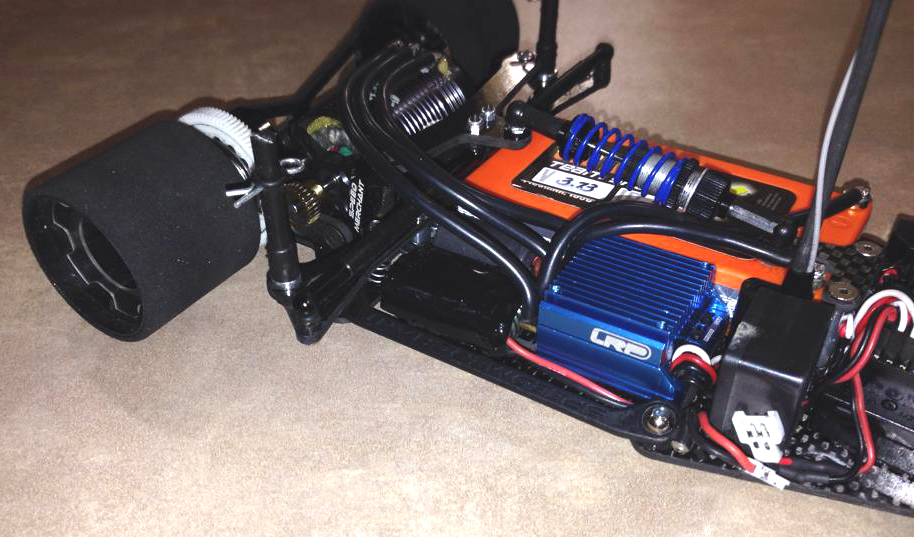
What is that thing?
What is that thing?
08-05-2014 | 08:13 AM
Tech Master
Joined: Jul 2011
Posts: 1,570
From: Kaohsiung City, Taiwan
I was curious about the new Rev.8 and went to the SpeedMerchant site...I found this pic of Josh Cyrul's Rev.8 with a mysterious black box in front of his ESC:
What is that thing?
What is that thing?
 I think it is a fan (kave beat me to it)
08-05-2014 | 08:54 AM
I think it is a fan (kave beat me to it)
08-05-2014 | 08:54 AM

A fan is always a good idea for mod, especially where you have 160+ track temps 
The rev8 mod 1/12, with Josh at the wheel was turning laps nearly 2s faster than Mod TC at the Nats
The rev8 mod 1/12, with Josh at the wheel was turning laps nearly 2s faster than Mod TC at the Nats

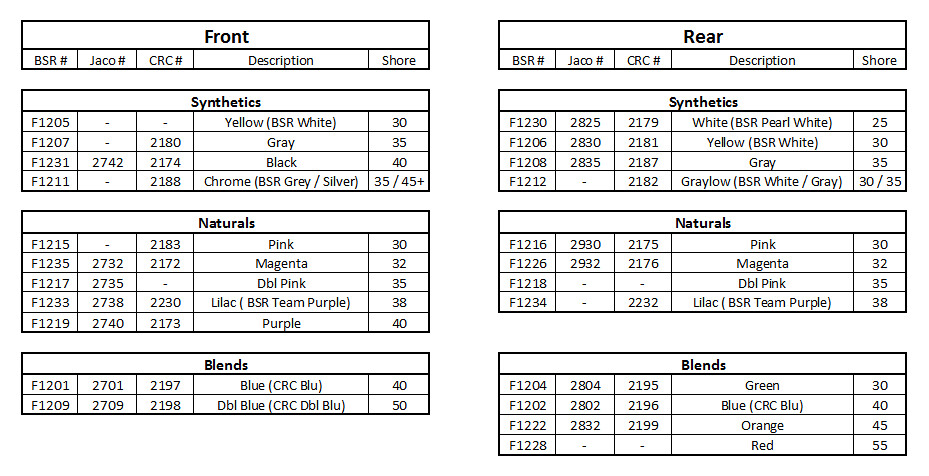
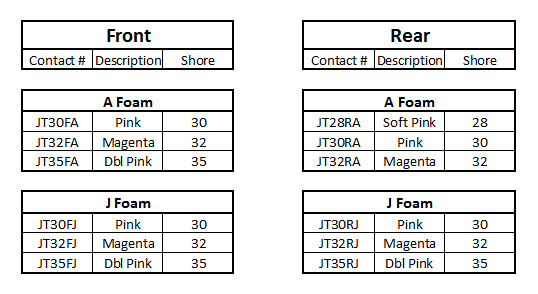

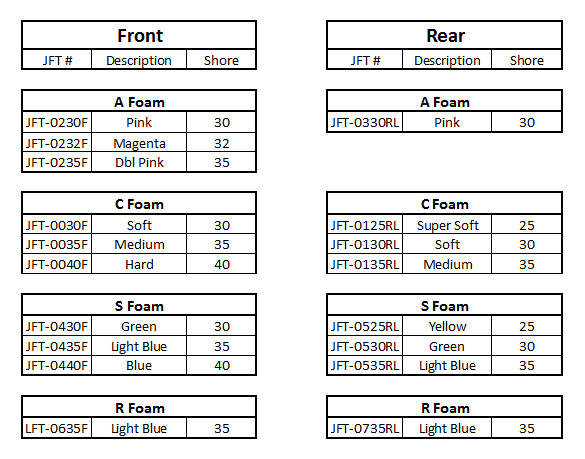


 08-05-2014 | 01:04 PM
Tech Fanatic
Joined: Jun 2005
Posts: 900
RedBullFixx - Thanks  . I really do appreciate a professional opinion on this topic, but that's all that he's provided. There wasn't any reasoning behind it nor did he comment on the differences in handling.
But really...Why do 1/12th designers disregard achieving perfect rear pod balance? Doesn't make much sense now does it.
Maybe, I'm just speculating here... The distance of 3 mm he used in his test was probably too much of an offset. With this offset and the weight of the motor could of caused the screws to generate elastic characteristics (spring effect). This is all just speculation.
. I really do appreciate a professional opinion on this topic, but that's all that he's provided. There wasn't any reasoning behind it nor did he comment on the differences in handling. But really...Why do 1/12th designers disregard achieving perfect rear pod balance? Doesn't make much sense now does it.
Maybe, I'm just speculating here... The distance of 3 mm he used in his test was probably too much of an offset. With this offset and the weight of the motor could of caused the screws to generate elastic characteristics (spring effect). This is all just speculation.
how does balancing of the main chassis work out with non balanced rear pod, as i thought id gotten mine pretty well even left to right with balancing pins, but when i used a corner weight rc scale station i was much heavier on left side, even when it was perfectly tweaked still was out.
is it possible to get it perfectly balanced to some degree??
is it possible to get it perfectly balanced to some degree??
ihmo
I would not recommend balancing chassis electronics with the rear pod connected, unless the rear pod is also balanced, which could be seen as pushing the ball up-hill to no benefit
Weight on the pod is spread across a solid axle, weight on the chassis is not
Any imbalance of the rear pod will further skew chassis balance, if one were to corner weight the car as a whole, or on balance pins
I've given up on pod balance, now preferring to just have the least weight on the pod as possible
Choose the tires your club mates run to start
Yokomo-3Racing offer a nice portable truer at a fair price
I would not recommend balancing chassis electronics with the rear pod connected, unless the rear pod is also balanced, which could be seen as pushing the ball up-hill to no benefit
Weight on the pod is spread across a solid axle, weight on the chassis is not
Any imbalance of the rear pod will further skew chassis balance, if one were to corner weight the car as a whole, or on balance pins
I've given up on pod balance, now preferring to just have the least weight on the pod as possible
Choose the tires your club mates run to start
Yokomo-3Racing offer a nice portable truer at a fair price
RedBull - thanks firstly for finding Mike's original post. After ten frustrating minutes I couldn't! Thanks secondly for pointing out the key difference between balancing the front and rear of the car, and how it should (not!) be done.
Each end of the car is sitting on three points. At the rear, those three points are solidly connected through the axle and the bottom pod plate. Generally speaking, all the weight inside those three points (the two tyres and the centre pivot) will even out over the there points giving an even weight distribution across all three. the comments about dynamic imbalance still apply, but balancing the car is a static event, not a dynamic one.
The situation with the main chassis is different. The three points are disconnected because the front tyres are sitting on two springs independently pivoted from the main chassis. The weight in the chassis will unevenly distribute itself across the front tyres because each can accommodate a different weight as it pivots independently from the main chassis.
If you take the pod off the car and balance the main chassis with all its elements fitted you will evenly distribute its load across the front axle. Ignore the rear pod - within the limits of the different motors' weight distribution the weight will be pretty much even across the rear tyres.
Now reconnect the chassis to the pod and set it up on the tweak screws using whatever method takes your fancy - tweak station or coin-drop test. If you do that and then put it on the corner-weight balances, you will find it is within a couple of percent from side to side on the front wheels. That's what I do and I get within 1% most of the time.
For this to be accurate you need tyre sizes exactly the same on each side of each axle. As they never are, there is always some imbalance. You don't stop halfway through a race to swop your tyres over, so don't sweat the chassis balance too much on the bench. HTH
08-05-2014 | 02:27 PM
Tech Initiate
Joined: Jun 2014
Posts: 29
Hi
Couple of questions.
How do you calculate the roll centre of the rear pod?
How does the centre of gravity of the rear pod affect the roll if it is off centre?
Is the system really connected by a pivot, this sounds silly but if the the side springs are sufficiently compressed i would say its no longer a freely moving pivot.
Interested in your views.
Marc
Couple of questions.
How do you calculate the roll centre of the rear pod?
How does the centre of gravity of the rear pod affect the roll if it is off centre?
Is the system really connected by a pivot, this sounds silly but if the the side springs are sufficiently compressed i would say its no longer a freely moving pivot.
Interested in your views.
Marc