


Boosted "Blinky" ESCs
 12-20-2016 | 08:48 AM
#31
Joined: Oct 2005
Posts: 2,710
From: St. Louis

Using a motortester to get them all 3 equal will help in a better running motor but is it illegal? Moving them to add timing is for sure illegal. In my opinion anything you change at the motor is illegal.
This is the rear of the speed passion motor:
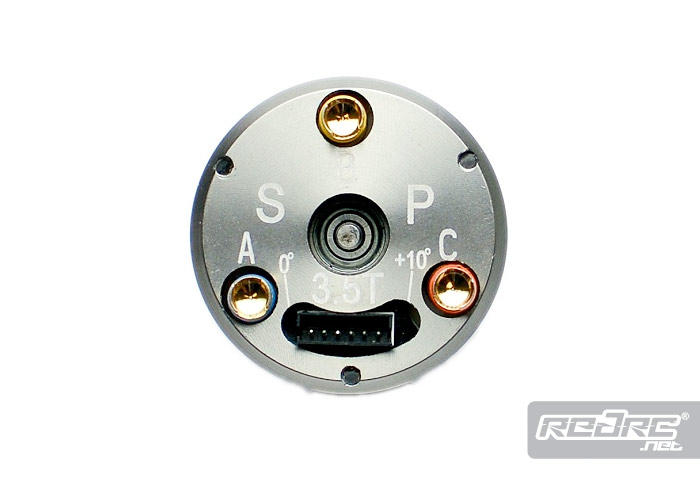
Some people did shave off the edges of the sensor connector so it did go a bit further into the rounding end of the hole in the backplate. I have seen one guy who milled the hole a bit wider to add more timing. And not to mention the 10 degree sensor PCB could be replaced by an optional 20 or even a 30 degree version. These had a differen color PCB but a black marker could do the trick....
For sure this was a bad choise to use as a stock motor.....
In my opinion running sensorless will remove a lot of options to cheat.
This is the rear of the speed passion motor:
Some people did shave off the edges of the sensor connector so it did go a bit further into the rounding end of the hole in the backplate. I have seen one guy who milled the hole a bit wider to add more timing. And not to mention the 10 degree sensor PCB could be replaced by an optional 20 or even a 30 degree version. These had a differen color PCB but a black marker could do the trick....
For sure this was a bad choise to use as a stock motor.....
In my opinion running sensorless will remove a lot of options to cheat.
Well, just to give you a little info, we no longer "adjust" them to get the matching readings. We found out that we could do that just by how each screw was tightened and retest.
In other words, there was no advantage to aligning the hall sensors.
Also, on your example, the motor would of been legal no matter what color the sensor board was. There is no rule against physical timing or even altering the physical timing. The rules are for dynamic timing within ESC's.
To me, the only way to get the "tuners" out of the motors is to seal them and do away with physical timing. The original "stock" motors never had adjustable timing, only mod did. But there was other factors like brushes, twisting, and springs that was able to "adjust". With brushless, you don't. So sealed to me is the only way to have a true spec motor race.
 12-20-2016 | 10:00 AM
#32

Tech Lord

Joined: Aug 2007
Posts: 14,051
From: Holland
What is the use of blinky if you can adjust timing on de motor? Zero timing does not mean 30 degrees timing on the motor.
That is why with this motor the max 10 dergees was alowed but not more but every degree more is an advantage.
The current ETS Muchmore motor has a fixed endbell which can be ordered as a separate part to mount it on a standard adjustable motor.
That is why with this motor the max 10 dergees was alowed but not more but every degree more is an advantage.
The current ETS Muchmore motor has a fixed endbell which can be ordered as a separate part to mount it on a standard adjustable motor.
12-20-2016 | 10:56 AM
#33

What is the use of blinky if you can adjust timing on de motor? Zero timing does not mean 30 degrees timing on the motor.
That is why with this motor the max 10 dergees was alowed but not more but every degree more is an advantage.
The current ETS Muchmore motor has a fixed endbell which can be ordered as a separate part to mount it on a standard adjustable motor.
That is why with this motor the max 10 dergees was alowed but not more but every degree more is an advantage.
The current ETS Muchmore motor has a fixed endbell which can be ordered as a separate part to mount it on a standard adjustable motor.
12-20-2016 | 11:09 AM
#34
Joined: Oct 2005
Posts: 2,710
From: St. Louis
What is the use of blinky if you can adjust timing on de motor? Zero timing does not mean 30 degrees timing on the motor.
That is why with this motor the max 10 dergees was alowed but not more but every degree more is an advantage.
The current ETS Muchmore motor has a fixed endbell which can be ordered as a separate part to mount it on a standard adjustable motor.
That is why with this motor the max 10 dergees was alowed but not more but every degree more is an advantage.
The current ETS Muchmore motor has a fixed endbell which can be ordered as a separate part to mount it on a standard adjustable motor.
The point of blinky is to stop the dynamic timing during acceleration.
Different motors have different ranges of timing also. Some also have a few degrees already set in the motor, so when it says 30 degrees on the can, it is actually 25-35 degrees, whichever way they preset the timing. Some motors only give you 10-20 degrees of timing to work with, others 40+. That is why I said the only true spec classes should use a sealed, non-adjustable motor handed out at events.
12-20-2016 | 12:01 PM
#35
Tech Lord
Joined: Aug 2007
Posts: 14,051
From: Holland
I agree that different motors have diffent timings, to be sure all are (arround) the same timing you have to use one brand, one model for everyone like the ETS does.
And that is why I say the sensorless setup is the best option to rule out tolerances and cheating on the sensors.
And that is why I say the sensorless setup is the best option to rule out tolerances and cheating on the sensors.
 12-20-2016 | 02:04 PM
#37

This is true but unfortunately I think the Trinity spec motor would be a good one , I'm sure their will some verances in the timing marks but probably not enough to make a night and day difference...
And can be a random # draw at big races
And can be a random # draw at big races

 12-20-2016 | 03:25 PM
#39
Sensorless ESCs are still capable of adding timing. They're also not regulated in the same way as sensored ones, since competitive racing almost exclusively uses sensored systems.
12-20-2016 | 03:45 PM
#40
Joined: Jul 2010
Posts: 2,741
Which makes complete sense, as you can run an approved unit, but who is to say the software is approved or hacked by some smart cookie to continue to blink even when some timing is introduced.
12-20-2016 | 08:35 PM
#41

Thanks. Assumed that was the case. So the "list" is not really what is used, it's the tech.
Which makes complete sense, as you can run an approved unit, but who is to say the software is approved or hacked by some smart cookie to continue to blink even when some timing is introduced.
Which makes complete sense, as you can run an approved unit, but who is to say the software is approved or hacked by some smart cookie to continue to blink even when some timing is introduced.
It seems their version of following the rules only means the ESC must show a blinking light, not why it blinks.
12-20-2016 | 08:45 PM
#42

Tech Master
Joined: Nov 2007
Posts: 1,554
From: Edmonton Ab
When hacking an esc making it blink usually involves changing one value in the code from a 0 to a 1. The hard part is decompiling the firmware that only takes a little time and computer knowledge. Once you know what chips are in it finding the language its code is written is fairly easy.
12-20-2016 | 10:46 PM
#44
Tech Lord
Joined: Aug 2007
Posts: 14,051
From: Holland
Still a lot of listed ESC's can run sensorless and connecting a programmer box can show the setting much easy.
12-20-2016 | 11:41 PM
#45