


 8Likes
Lap Timing Decoder
 02-08-2014 | 06:34 AM
#346



Myself being an electronics novice, I need to ask, would it be a huge design change to get longer loop lengths?
I could see potential interest from other forms of racing (ie. auto, motocycle, etc) if the loop could accomodate greater lengths and transponders could send greater distances.
I could see potential interest from other forms of racing (ie. auto, motocycle, etc) if the loop could accomodate greater lengths and transponders could send greater distances.
Increasing the transponder power requires a new output circuit, but the only technically challenging part of that is emissions compliance. This would, of course, require a new PC board.
 02-10-2014 | 01:25 PM
#347
Tech Apprentice
Joined: Jan 2013
Posts: 61
From: Schoonebeek
@notch johnson:
I have experienced in the Cano-design almost similar things: After sundown, the loop picks up a lot of environmental RF-signals. This is known from shortwave communications were sgnals travel much further during the night. Worldwide communications advantage from this fact. Normally you will not notice additional HF signals (around 5MHz) captured in the loop because the preamble-word needed to decode a valid transponder-ID is not met. The noise received from the sky after sundown has a random character. However I have added from the start of my experiments a monostabil multivibrator (1/2 74123 TTL) that is set to 100mS and controls a green LED by a transistor. The input is connected to the Valid-signal of the decoder. The LED blinks every time a car passes the loop. But also when environmental HF noise matches the set preamble word. To my surprice, after sundown the green LED is much more active compared to the situation during the day. Most passes of a car are still detected (they are send average every 3mS), but I still wonder whether others notice some degredation of sensitivity.
@notch: Could you try to start a test where the 11 - 12 hours of usage ends well before sundown to prevent the above explained to decrease the receiver sensitivty?
Thank you!
I have experienced in the Cano-design almost similar things: After sundown, the loop picks up a lot of environmental RF-signals. This is known from shortwave communications were sgnals travel much further during the night. Worldwide communications advantage from this fact. Normally you will not notice additional HF signals (around 5MHz) captured in the loop because the preamble-word needed to decode a valid transponder-ID is not met. The noise received from the sky after sundown has a random character. However I have added from the start of my experiments a monostabil multivibrator (1/2 74123 TTL) that is set to 100mS and controls a green LED by a transistor. The input is connected to the Valid-signal of the decoder. The LED blinks every time a car passes the loop. But also when environmental HF noise matches the set preamble word. To my surprice, after sundown the green LED is much more active compared to the situation during the day. Most passes of a car are still detected (they are send average every 3mS), but I still wonder whether others notice some degredation of sensitivity.
@notch: Could you try to start a test where the 11 - 12 hours of usage ends well before sundown to prevent the above explained to decrease the receiver sensitivty?
Thank you!
03-02-2014 | 10:05 AM
#348
Tech Rookie
Joined: Mar 2014
Posts: 7
Detection loop noise
Hey guys, I hope this isn't too off topic but I'm looking for some help and you'll seem like you might have my answers :-) (I hope!)
I just installed an indoor carpet track in my shop with an RC4 decoder. The coaxial run is approximately 30 ft long (copper shielded wire). The detection loop is 1 ft x 5 ft.
The noise level on the coaxial by itself is around 9 to 10. The noise level on the whole system with the detection loop connected is around 70 during the day and as it gets later in the evening sky rockets to about 150.
I have mounted the detection loop on a piece of cardboard and moved it around the room and up and down with no real difference in the noise floor.
During the day, the noise is not a big deal because the signal from the cars is close to 100 points over the noise. But by 7 to 8pm, I'm concerned that the signal to noise ratio will not be great enough to ensure accurate readings 100% of the time.
Is there any way to shield the loop, or anything else to minimize the noise introduced to the system?
Thanks a bunch for your help!
Shannon
I just installed an indoor carpet track in my shop with an RC4 decoder. The coaxial run is approximately 30 ft long (copper shielded wire). The detection loop is 1 ft x 5 ft.
The noise level on the coaxial by itself is around 9 to 10. The noise level on the whole system with the detection loop connected is around 70 during the day and as it gets later in the evening sky rockets to about 150.
I have mounted the detection loop on a piece of cardboard and moved it around the room and up and down with no real difference in the noise floor.
During the day, the noise is not a big deal because the signal from the cars is close to 100 points over the noise. But by 7 to 8pm, I'm concerned that the signal to noise ratio will not be great enough to ensure accurate readings 100% of the time.
Is there any way to shield the loop, or anything else to minimize the noise introduced to the system?
Thanks a bunch for your help!
Shannon
03-02-2014 | 10:18 AM
#349
Hey guys, I hope this isn't too off topic but I'm looking for some help and you'll seem like you might have my answers :-) (I hope!)
I just installed an indoor carpet track in my shop with an RC4 decoder. The coaxial run is approximately 30 ft long (copper shielded wire). The detection loop is 1 ft x 5 ft.
The noise level on the coaxial by itself is around 9 to 10. The noise level on the whole system with the detection loop connected is around 70 during the day and as it gets later in the evening sky rockets to about 150.
I have mounted the detection loop on a piece of cardboard and moved it around the room and up and down with no real difference in the noise floor.
During the day, the noise is not a big deal because the signal from the cars is close to 100 points over the noise. But by 7 to 8pm, I'm concerned that the signal to noise ratio will not be great enough to ensure accurate readings 100% of the time.
Is there any way to shield the loop, or anything else to minimize the noise introduced to the system?
Thanks a bunch for your help!
Shannon
I just installed an indoor carpet track in my shop with an RC4 decoder. The coaxial run is approximately 30 ft long (copper shielded wire). The detection loop is 1 ft x 5 ft.
The noise level on the coaxial by itself is around 9 to 10. The noise level on the whole system with the detection loop connected is around 70 during the day and as it gets later in the evening sky rockets to about 150.
I have mounted the detection loop on a piece of cardboard and moved it around the room and up and down with no real difference in the noise floor.
During the day, the noise is not a big deal because the signal from the cars is close to 100 points over the noise. But by 7 to 8pm, I'm concerned that the signal to noise ratio will not be great enough to ensure accurate readings 100% of the time.
Is there any way to shield the loop, or anything else to minimize the noise introduced to the system?
Thanks a bunch for your help!
Shannon
Don't be afraid to start a new thread to get help! There are many knowledgeable people here on RCTech, and I'm sure many will have good advice. But you may not reach those people on this particular thread.
Forgive me for pointing out the obvious, but have you asked MyLaps for advice? I'm curious to hear their response.
03-02-2014 | 10:43 AM
#350
Tech Rookie
Joined: Mar 2014
Posts: 7
Thanks Howard,
MyLaps response was basically to get the loop away from metal and devices conducting electricity. Given that I have moved it all around the confines of the room that it is in, I'm kinda stuck.
I asked them about any kind of gain settings (not squelch) and they weren't of much help there. One of the guys was going to their headquarters in Europe this weekend and he was going to ask the tech guys over there about it and let me know.
Thanks again,
Shannon
MyLaps response was basically to get the loop away from metal and devices conducting electricity. Given that I have moved it all around the confines of the room that it is in, I'm kinda stuck.
I asked them about any kind of gain settings (not squelch) and they weren't of much help there. One of the guys was going to their headquarters in Europe this weekend and he was going to ask the tech guys over there about it and let me know.
Thanks again,
Shannon

 04-07-2014 | 06:37 PM
#359
Tech Initiate
Joined: Apr 2014
Posts: 26
I was thinking about an RPi this before reading this thread. Great minds think alike. Im not a coder, but I would think a SDR receiver like the USB dongles found on ebay could work for decoding. I know some of them work for digital radio receiving on the ham bands for PSK31, etc.
04-07-2014 | 11:04 PM
#360
Tech Initiate
Joined: Jun 2013
Posts: 20
I was thinking about an RPi this before reading this thread. Great minds think alike. Im not a coder, but I would think a SDR receiver like the USB dongles found on ebay could work for decoding. I know some of them work for digital radio receiving on the ham bands for PSK31, etc.
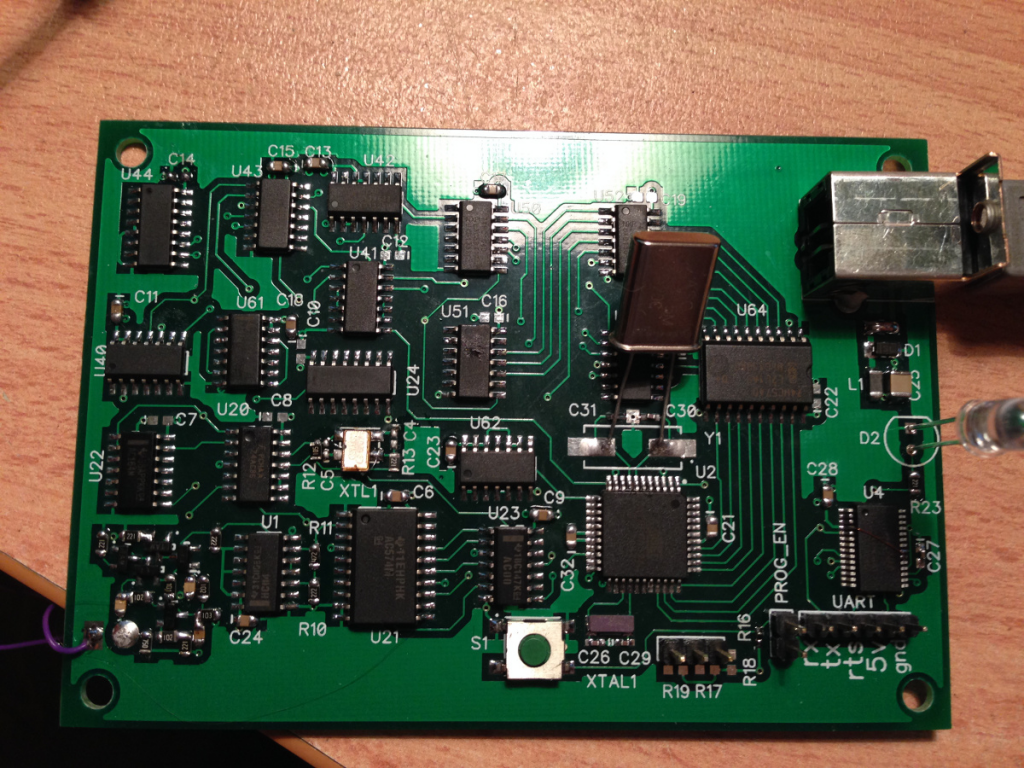
There are circuits in this thread which use a microcontroller to timestamp the data, these get good enough precision. Moving all decoding and timing to an FPGA (with averaging of multiple hits) gets both accuracy and precision even closer. Then there's the fancy analogue magic that AMB use (probably patented) that will get you the last bit of accuracy.
The Raspberry Pi is a great device but a normal operating system isn't going to get you accuracy or precision. You'll still need all of the decoding and timestamping to happen in a dedicated circuit.
Lastly many of the RTL SDR devices are designed as TV tuners (for DVB-T). These generally wont be able to tune low enough to get to 5Mhz-10Mhz. Even the HackRF (designed from the ground up as an SDR) isn't rated below 30Mhz.