


 1Likes
Break-in Dutch
 03-16-2015 | 09:34 AM
#31

Tech Lord

Joined: Aug 2007
Posts: 14,044
From: Holland

When the engine is fired up the piston will get more heat. This will give some permanent grow on the piston due the working of the copper molecules. So when even the pinch is totally gone after running one tank and let it cool down you must feel a pinch again. The amount of effect on it is determed on how much the manufacturer did give it a heat treatment.
We have tested some engines on the shape of the piston after using it for several times. Engines based on an aluminium sleeve did show a tiny expansion on the exhaust side (less than a micron), with brass sleeves we have not seen a measureable expansion.
Also a tight fit in the crankcase will keep the sleeve more round
We have tested some engines on the shape of the piston after using it for several times. Engines based on an aluminium sleeve did show a tiny expansion on the exhaust side (less than a micron), with brass sleeves we have not seen a measureable expansion.
Also a tight fit in the crankcase will keep the sleeve more round
 03-17-2015 | 03:35 AM
#32

Tech Elite
Joined: Dec 2004
Posts: 2,198
From: The Netherlands
Hahhahahahaha, you smartnose..
From now on you are not allowed to use my break-in machine anymore for free..even if you pay you are not allowed anymore...heee...even if you pay double you are not allowed anymore.
You are just a old dinosaur that cant handle change too fast...lol..

From now on you are not allowed to use my break-in machine anymore for free..even if you pay you are not allowed anymore...heee...even if you pay double you are not allowed anymore.
You are just a old dinosaur that cant handle change too fast...lol..
 03-17-2015 | 04:05 AM
#34
Tech Regular
Joined: Sep 2009
Posts: 398
From: Netherlands

Id tend to agree with you nitro dude. To me the force on the conrod is all wrong. A conrod isn't designed to take force pulling the piston down from the sleeve it's designed to be pushed down by the ignition cycle. I really don't see the point and it is bound to be a hugely expensive service! I think I'll stick to the tried and tested process of run in bench with propeller followed by on track.
03-17-2015 | 04:54 AM
#36
Tech Apprentice
Joined: Feb 2015
Posts: 52
Yeah, as you have expected our Pistons are a bit larger in size than the nitro engine pistons.  I took a picture for you from one of our smaler ones...
Thank you very much for your commentary of my concerns.
And yes, my Argumentation was based on feelings, I didn't spend the time to go over it in detail.
Oh yes, I definitely agree on that. I have a brand new engine at home and I still use the old becouse I don't take the time for breaking in the new one.
I took a picture for you from one of our smaler ones... Thank you very much for your commentary of my concerns.
And yes, my Argumentation was based on feelings, I didn't spend the time to go over it in detail.
Oh yes, I definitely agree on that. I have a brand new engine at home and I still use the old becouse I don't take the time for breaking in the new one.
Last edited by Millord; 03-17-2015 at 05:07 AM.
03-17-2015 | 05:05 AM
#37
Tech Regular
Joined: Sep 2009
Posts: 398
From: Netherlands
Yeah, as you have expected our Pistons are a bit larger in size than the nitro engine pistons. I took a Picture for you from one of our smaler ones...
Thank you very much for your commentary of my concerns.
And yes, my Argumentation was based on feelings, I didn't spend the time to go over it in detail.
Thank you very much for your commentary of my concerns.
And yes, my Argumentation was based on feelings, I didn't spend the time to go over it in detail.
Once been in the factory and design department of Stork engines, they also made big diesels, 620mm diameter pistons, really amazing. But only turning a couple of hundred rpm as i recall.
Engines are cool stuff..!
03-17-2015 | 05:24 AM
#38
Tech Apprentice
Joined: Feb 2015
Posts: 52
Yes, they are one of our competitors. They belong to Wärtsilä now.
I think they sell only medium speed engines, we are producing mostly high speed engines. I'm working in the "Big engines department" our engine has about 350l displacement. (20 Cylinder)
Sorry for OT...
I think they sell only medium speed engines, we are producing mostly high speed engines. I'm working in the "Big engines department" our engine has about 350l displacement. (20 Cylinder)
Sorry for OT...
03-17-2015 | 06:46 AM
#39


Is replacing the head button necessary or is removing just the glow plug enough?
What do you do with the crankcase plate, or is the crankcase compression not that significant?
Also, is there much particulate matter in the oil after 1 engine? is the material in suspension or does it settle with gravity(it almost seems like the run-in process is more burnishing than wearing in the surfaces?
03-17-2015 | 10:38 AM
#40
Tech Regular
Joined: Sep 2009
Posts: 398
From: Netherlands
An interesting approach, but I am curious what you need to do since the oil is incompressible, and a fixed amount in a container.
Is replacing the head button necessary or is removing just the glow plug enough?
What do you do with the crankcase plate, or is the crankcase compression not that significant?
Also, is there much particulate matter in the oil after 1 engine? is the material in suspension or does it settle with gravity(it almost seems like the run-in process is more burnishing than wearing in the surfaces?
Is replacing the head button necessary or is removing just the glow plug enough?
What do you do with the crankcase plate, or is the crankcase compression not that significant?
Also, is there much particulate matter in the oil after 1 engine? is the material in suspension or does it settle with gravity(it almost seems like the run-in process is more burnishing than wearing in the surfaces?
Here a movie where you can see all..!
| + YouTube Video | |
The particles will sink, the flow in the container is minimal.
After 1 engine i throw away the old oil and use new oil for the next engine and clean the container with brake cleaner, just to be sure.
Offcourse i checked the used oil and filtered it to see the amount of particles, it`s really not much...there is some on the bottom of the container, but really hard to find.
03-17-2015 | 10:56 AM
#42
Tech Apprentice
Joined: Feb 2015
Posts: 52
Of course, there are not much partikels. First, there ist not much material to remove and second, the material is removed in very very small steps. I would expect you will have a very fine powder, and no particals.
And I think the oil bath will remove the particals from the contact surfaces faster than a normal operation.
If you think about sharpening a knife on a stone, there is a lot of particals on the stone and on the knife. Now expect what happens, if you do that under water in a sink. Where do you expect more particals between blade and stone.
And I think the oil bath will remove the particals from the contact surfaces faster than a normal operation.
If you think about sharpening a knife on a stone, there is a lot of particals on the stone and on the knife. Now expect what happens, if you do that under water in a sink. Where do you expect more particals between blade and stone.
03-17-2015 | 12:34 PM
#43
Tech Lord
Joined: Aug 2007
Posts: 14,044
From: Holland
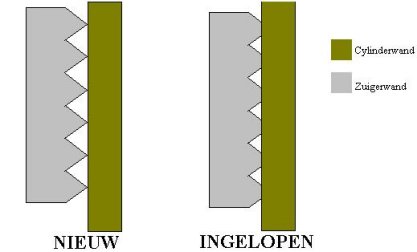
The piston is made on a lathe, if you have a fresh piston and you zoom in on the surface you will see the lines made by the toolbit on the lathe. This surface is ideal to use for the break-in
Zoom in on this pic:
http://www.euronet.nl/users/tooms/ftp/DSC_0024.jpg
you will see sthe small lines.....
With less oil and high rpm the tips of the rough surface of the piston will burn and snap off, that will create small noticeable particles. With lot of oil, a slow movement and a controled temperature the surface will be polished giving a dirt in the oil that small that it will not create scratches
Zoom in on this pic:
http://www.euronet.nl/users/tooms/ftp/DSC_0024.jpg
you will see sthe small lines.....
With less oil and high rpm the tips of the rough surface of the piston will burn and snap off, that will create small noticeable particles. With lot of oil, a slow movement and a controled temperature the surface will be polished giving a dirt in the oil that small that it will not create scratches
03-17-2015 | 08:03 PM
#44
burnishing is accomplished by rubbing 2 smooth surfaces, a harder surface on a softer one. there are very small amounts of plastic deformation to produce a more smooth surface, as opposed to polishing(or grinding) a surface with small particles which scratch the surface and remove material to improve the surface finish.
03-18-2015 | 01:55 AM
#45
Tech Addict
iTrader: (1)
Joined: Jul 2005
Posts: 536
From: MANILA,PHILIPPINES
this is a good idea all in all except that we here in asia will have to pay to ship the engine to you, pay for the service, then pay for the shipping again back to asia. that could be very costly especially from here philippines to holland and back.
cant we just buy the machine instead so that we can do it here in asia?like, one per country would be more feasible enough.
cant we just buy the machine instead so that we can do it here in asia?like, one per country would be more feasible enough.