


 8Likes
Lap Timing Decoder
 09-30-2013 | 06:38 AM
#301



Please let us know of the results of your experiments, if you decide to try.
 09-30-2013 | 07:45 AM
#302
Tech Apprentice
Joined: Jan 2013
Posts: 61
From: Schoonebeek
@Meag: Have you experiened the misses at evening-time, after sunset? I experience lots of interference at evening. During the daytime there is better decoding. I think the reason is the loop-amplifier is a broadband design, were only the resonance of the loop (L + C) is responsable for some filtering of shortwave radio_stations that come in after sunset. I have now noticed this for several times, not moving the loop and checking during daytime and nighttime. Tell me what you experience is.
Note: my hobbyroom (as well as the loop during tests) is at the second floor of our house. Possibly when the loop is at groundlevel, the above is less true...
Note: my hobbyroom (as well as the loop during tests) is at the second floor of our house. Possibly when the loop is at groundlevel, the above is less true...
09-30-2013 | 07:57 AM
#303
Tech Apprentice
Joined: Aug 2013
Posts: 52
@Meag: Have you experiened the misses at evening-time, after sunset? I experience lots of interference at evening. During the daytime there is better decoding. I think the reason is the loop-amplifier is a broadband design, were only the resonance of the loop (L + C) is responsable for some filtering of shortwave radio_stations that come in after sunset. I have now noticed this for several times, not moving the loop and checking during daytime and nighttime. Tell me what you experience is.
Note: my hobbyroom (as well as the loop during tests) is at the second floor of our house. Possibly when the loop is at groundlevel, the above is less true...
Note: my hobbyroom (as well as the loop during tests) is at the second floor of our house. Possibly when the loop is at groundlevel, the above is less true...
The only problem we have - is that i said prevously - on large track where loop length 6.5-7m we have many misses. And there is no difference between ambrc, amb rc4 hybrid, cano or paylaneg's chips - on small loop all works perfect, on large - we have problems.
09-30-2013 | 07:58 AM
#304
Tech Apprentice
Joined: Aug 2013
Posts: 52
It's worth a try. You will need to decrease the value of C1 in the loop amplifier. The correct value will vary with the size of the loop, and I can't say what that would be. As the loop size increases, it reaches a point where it simply can't be tuned high enough (5MHz). Also, the signal levels induced in the loop from the transponders will be lower, making operation sporadic.
Please let us know of the results of your experiments, if you decide to try.
Please let us know of the results of your experiments, if you decide to try.
I'll write as soon as i get results.
10-01-2013 | 05:26 AM
#305
@Meag: Have you experiened the misses at evening-time, after sunset? I experience lots of interference at evening. During the daytime there is better decoding. I think the reason is the loop-amplifier is a broadband design, were only the resonance of the loop (L + C) is responsable for some filtering of shortwave radio_stations that come in after sunset. I have now noticed this for several times, not moving the loop and checking during daytime and nighttime. Tell me what you experience is.
Note: my hobbyroom (as well as the loop during tests) is at the second floor of our house. Possibly when the loop is at groundlevel, the above is less true...
Note: my hobbyroom (as well as the loop during tests) is at the second floor of our house. Possibly when the loop is at groundlevel, the above is less true...
However, humidity normally increases after sunset, and if you are using a buried loop (which I DON'T recommend) then the loop tuning and sensitivity can be severely degraded.
10-02-2013 | 05:57 AM
#306
Tech Apprentice
Joined: Aug 2010
Posts: 58
Howard: Would you have any interest in going commercial with this? You have a design that clearly works and can be built for a fraction of the cost of a mylaps system. You and the other guys who have been working on this have done an incredible job, but constructing this system is still a bit beyond the capability of most RC hobbyists. If you were able to produce complete systems, I think you would sell quite well. As you've mentioned, the page views show there is clearly interest in an alternative transponder system. I know that the startup cost of doing a proper production run is nothing to sneeze at, but maybe a kickstarter project could amass enough funds to cover that?
Thank you for your efforts so far.
Thank you for your efforts so far.
10-02-2013 | 06:51 AM
#307
Howard: Would you have any interest in going commercial with this? You have a design that clearly works and can be built for a fraction of the cost of a mylaps system. You and the other guys who have been working on this have done an incredible job, but constructing this system is still a bit beyond the capability of most RC hobbyists. If you were able to produce complete systems, I think you would sell quite well. As you've mentioned, the page views show there is clearly interest in an alternative transponder system. I know that the startup cost of doing a proper production run is nothing to sneeze at, but maybe a kickstarter project could amass enough funds to cover that?
Thank you for your efforts so far.
Thank you for your efforts so far.
My preference would be to partner with someone to run the business, while I remain a technical consultant. I could sell rights to the entire design (all of which I have already provided free, except for software), or simply sell programmed microprocessors to someone who wanted to produce the decoder (which is essentially a way to pay and collect royalties without the bookkeeping). Buying/selling microprocessors has the advantage that there is no up-front cost for the design for the manufacturer. Buying/selling the design has the advantage that the software doesn't disappear if I get squashed by a bus.
One of the purposes of the thread was to find a partner or company (or several!) who would produce the design. I still hope that will happen.
10-02-2013 | 07:41 AM
#308
Tech Apprentice
Joined: Aug 2010
Posts: 58
10-02-2013 | 10:17 AM
#309
Tech Regular
iTrader: (6)
Joined: May 2011
Posts: 362
From: GreatWhiteNorth
I would think that one of the key factors in offering an alternative decoder is being able to have compatibility with the AMB/Mylaps decoders as they are so prevelent in the Rc world now. I believe Howard's design is currently compatible with all but the true Rc4 transponders, and even was reported working with the new MRT.
I would love to see this project move forward to the commercial step, but like many others, do not know the first thing about business concepts.
I appreciate all the hard work Howard and others have done to lift this project to what it is today, and sometime in the future would love to see an alternative to Mylaps.
Compitition is good right!!!
I would love to see this project move forward to the commercial step, but like many others, do not know the first thing about business concepts.
I appreciate all the hard work Howard and others have done to lift this project to what it is today, and sometime in the future would love to see an alternative to Mylaps.
Compitition is good right!!!
10-05-2013 | 08:07 AM
#310
Tech Initiate
Joined: Jun 2013
Posts: 20
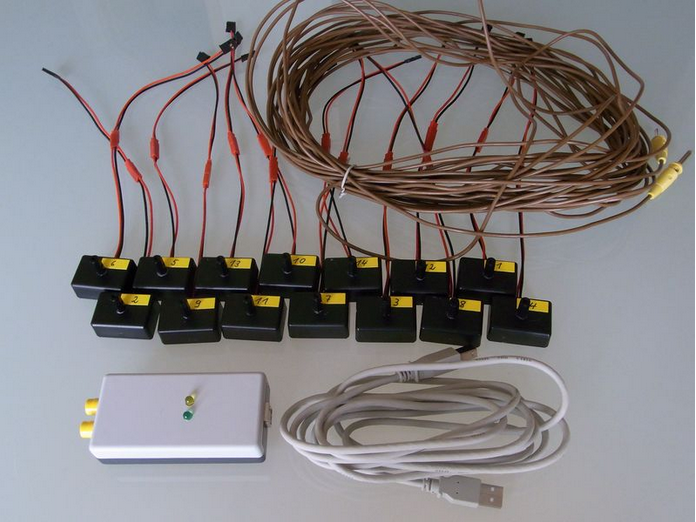
I never provided an update after we finished our summer camp, where I tested a preliminary transponder/decoder. My previous post has pictures of the decoder which used a Lattice CPLD, PIC 18F and a FT232RL cable.
We got it to work nicely with RC cars (under a wooden ramp) and with adult go-karts on a tarmac track. For the kart track we used some vinyl flooring (as found in bathrooms) as we couldn't bury the cables. The loops for both were made from wire stripped out of an old CAT5 cable.
Since then I have done a bit more work on the CPLD side and implemented the CRC checking in hardware. I have a few other ideas to test before next year and I want to get the whole decoder onto a PCB.
Attached is a picture of our high tech track control hut. It was sunny all week but decided to pour on race day. You can just about see the black coax trailing off and the brown vinyl flooring in the background.
We got it to work nicely with RC cars (under a wooden ramp) and with adult go-karts on a tarmac track. For the kart track we used some vinyl flooring (as found in bathrooms) as we couldn't bury the cables. The loops for both were made from wire stripped out of an old CAT5 cable.
Since then I have done a bit more work on the CPLD side and implemented the CRC checking in hardware. I have a few other ideas to test before next year and I want to get the whole decoder onto a PCB.
Attached is a picture of our high tech track control hut. It was sunny all week but decided to pour on race day. You can just about see the black coax trailing off and the brown vinyl flooring in the background.
10-06-2013 | 02:58 AM
#311
I never provided an update after we finished our summer camp, where I tested a preliminary transponder/decoder. My previous post has pictures of the decoder which used a Lattice CPLD, PIC 18F and a FT232RL cable.
We got it to work nicely with RC cars (under a wooden ramp) and with adult go-karts on a tarmac track. For the kart track we used some vinyl flooring (as found in bathrooms) as we couldn't bury the cables. The loops for both were made from wire stripped out of an old CAT5 cable.
Since then I have done a bit more work on the CPLD side and implemented the CRC checking in hardware. I have a few other ideas to test before next year and I want to get the whole decoder onto a PCB.
Attached is a picture of our high tech track control hut. It was sunny all week but decided to pour on race day. You can just about see the black coax trailing off and the brown vinyl flooring in the background.
We got it to work nicely with RC cars (under a wooden ramp) and with adult go-karts on a tarmac track. For the kart track we used some vinyl flooring (as found in bathrooms) as we couldn't bury the cables. The loops for both were made from wire stripped out of an old CAT5 cable.
Since then I have done a bit more work on the CPLD side and implemented the CRC checking in hardware. I have a few other ideas to test before next year and I want to get the whole decoder onto a PCB.
Attached is a picture of our high tech track control hut. It was sunny all week but decided to pour on race day. You can just about see the black coax trailing off and the brown vinyl flooring in the background.
How much interference are you encountering from the kart ignition systems?
And who had FTD?
10-06-2013 | 06:33 AM
#312
Tech Initiate
Joined: Jun 2013
Posts: 20
I think we had one case where a lap was missed but aside from this things were good. My code implemented an 8 bit CRC so incorrect detections should be improbable.
We only measure using the IOF! For RC cars we divide the young people into two groups and do team endurance racing, one lap each with total laps as the
measure. We try to tell them that accuracy is much more important than speed, but they don't always listen

In go-karting it was a close run thing between two of the leaders, a few hundredths of a second across a ~26 second lap. I'm working on getting the CPLD/FPGA to manage the race clock so that I can timestamp events coming out of the SPI and more accurately determine these small 1/100th second times.
10-06-2013 | 07:54 PM
#313

All on one board sounds like a good direction.
As long as the soldering isn't too intense, have you guys considered offering this as a kit with a board, programmed ICs, and a parts list?
Might be a good way to work through a beta phase and work out the bugs before investing toward production.
As long as the soldering isn't too intense, have you guys considered offering this as a kit with a board, programmed ICs, and a parts list?
Might be a good way to work through a beta phase and work out the bugs before investing toward production.
 10-07-2013 | 03:58 AM
#315