


 65Likes
Tune With Camber Links
 07-28-2012 | 08:02 PM
#991



The collars are used to adjust ride height only. As you tighten them, The spring rate will increase as springs are progressive. Your ride height will change also. If you need to crank the shock collars to increase spring rate and it brings you over your desired ride height, You need to go to the next step up in spring.
 07-28-2012 | 09:55 PM
#992
Joined: Mar 2011
Posts: 2,766
From: Houston
I was not comparing, merely mentioning it. There is plenty of data out there supporting the statement that rear NF slightly higher than front NF yields a smoother ride (except when heavy damping, say 70% of critical or more is used, then higher front NF is usually better). Are there other reasons to do it or other reasons to not do it? Sure but that doesn't change the theory or the data.
A person I learned a lot off of is a gentleman named Paul Yaw. We are both rotary engine people. When I first talked to him about 15 years ago, he got me thinking very differently. He has nothing to do with rc as far as I know. He makes what are probably the best fuel injectors in the world and has always taught that testing, not opinions or what others think, is what matters. I've also learned that lots of people who are supposed to be experts are really just passing on opinion to others with nothing to back it up and are wrong a surprising amount of time.
Fortunately with rc cars, you can try things out for yourself very easily so try it and draw your own conclusions. The good news is that if you disagree you can always go back to doing things your way. A gentleman Paul knows named Jim Susko is probably one of the smartest people when it comes to suspension tuning and geometry design and he's the one I've learned track car tuning from. Here's a quote from one of Paul's writings examining a Mazda Miata suspension spring rate compared to some Bilstein shocks for the same car.
"I have no real insight into their design approach, but it's hard to believe that both Mazda and Bilstein put serious effort into this and came up with the same ridiculous results."
"Fact is, almost all cars are built to a price point, and compromises have to be made. In my opinion Mazda made the right compromises and came up with a very cool car. And if the car was perfect none of us would have anything to play with right?"
If you'd like to read the full article complete with some test charts showing some neat spring rate information, check out his website at www.yawpower.com. Scroll down and read the post from October 20, 2010. It is actually quite applicable to this thread.
07-30-2012 | 07:41 AM
#993
 Understanding Dual-Spring Physics
@fredswain, et al.
I've spent the past month "rebooting" my setup mindset with great results. My SC10 is the best it's ever been, I've started winning races, and I have a sense of confidence to tweak according to the specific demands of each track. I appreciate your having shared so much of your experience and mindset.
Where I still have some difficulty, due to the choice to go against the grain slightly, is finding matched sets of springs, since I'm using the Proline Powerstroke shocks and their dual-spring setup. I've found a base set of front/back top/bottom springs that are very balanced for my weight distribution, but anytime I sense the need to move to slightly stiffer/softer springs, the move isn't as simple as one would guess based on the spring rate chart published by Proline.
http://prolineracing.com/images/howt...SpringRate.pdf
For starters, I don't understand how Proline calculated their combined rates. I'm going to contact them for a bit of insight there. Maybe someone on this thread can chime in with an explanation. My approach was to navigate the chart diagonally from the softest pair up to the stiffest, but as indicated by the numbers, this often leads to a softer top with a stiffer bottom, which could leave the first stage of compression almost entirely used, depending on ride height and spring collars.
Basically, I've found that dialing in dual springs is extremely complex. Moving to a softer/stiffer top or bottom spring alone doesn't always lead to the effect on balance that I'd anticipate and I'm having to switch to entirely different sets of springs - often times switching from a stiffer top to a stiffer bottom to regain balance. I guess the tradeoff for trying to use the dual setup is more tuning ability *if* you know how to tune with it.
I'm wondering if you have any particular experience, or general guidelines, to offer for a dual-spring setup. It may just be a matter of me investing lots more time with the kit to find additional combinations, but I'd think there'd be a logical way to read the chart and calculate combined spring rates (or a better way to interpret the numbers on my part) which would simplify the process to some extent.
Any thoughts appreciated.
I've spent the past month "rebooting" my setup mindset with great results. My SC10 is the best it's ever been, I've started winning races, and I have a sense of confidence to tweak according to the specific demands of each track. I appreciate your having shared so much of your experience and mindset.
Where I still have some difficulty, due to the choice to go against the grain slightly, is finding matched sets of springs, since I'm using the Proline Powerstroke shocks and their dual-spring setup. I've found a base set of front/back top/bottom springs that are very balanced for my weight distribution, but anytime I sense the need to move to slightly stiffer/softer springs, the move isn't as simple as one would guess based on the spring rate chart published by Proline.
http://prolineracing.com/images/howt...SpringRate.pdf
For starters, I don't understand how Proline calculated their combined rates. I'm going to contact them for a bit of insight there. Maybe someone on this thread can chime in with an explanation. My approach was to navigate the chart diagonally from the softest pair up to the stiffest, but as indicated by the numbers, this often leads to a softer top with a stiffer bottom, which could leave the first stage of compression almost entirely used, depending on ride height and spring collars.
Basically, I've found that dialing in dual springs is extremely complex. Moving to a softer/stiffer top or bottom spring alone doesn't always lead to the effect on balance that I'd anticipate and I'm having to switch to entirely different sets of springs - often times switching from a stiffer top to a stiffer bottom to regain balance. I guess the tradeoff for trying to use the dual setup is more tuning ability *if* you know how to tune with it.
I'm wondering if you have any particular experience, or general guidelines, to offer for a dual-spring setup. It may just be a matter of me investing lots more time with the kit to find additional combinations, but I'd think there'd be a logical way to read the chart and calculate combined spring rates (or a better way to interpret the numbers on my part) which would simplify the process to some extent.
Any thoughts appreciated.
07-30-2012 | 09:47 AM
#995
Joined: May 2010
Posts: 3,846
@fredswain, et al.
I've spent the past month "rebooting" my setup mindset with great results. My SC10 is the best it's ever been, I've started winning races, and I have a sense of confidence to tweak according to the specific demands of each track. I appreciate your having shared so much of your experience and mindset.
Where I still have some difficulty, due to the choice to go against the grain slightly, is finding matched sets of springs, since I'm using the Proline Powerstroke shocks and their dual-spring setup. I've found a base set of front/back top/bottom springs that are very balanced for my weight distribution, but anytime I sense the need to move to slightly stiffer/softer springs, the move isn't as simple as one would guess based on the spring rate chart published by Proline.
http://prolineracing.com/images/howt...SpringRate.pdf
For starters, I don't understand how Proline calculated their combined rates. I'm going to contact them for a bit of insight there. Maybe someone on this thread can chime in with an explanation. My approach was to navigate the chart diagonally from the softest pair up to the stiffest, but as indicated by the numbers, this often leads to a softer top with a stiffer bottom, which could leave the first stage of compression almost entirely used, depending on ride height and spring collars.
Basically, I've found that dialing in dual springs is extremely complex. Moving to a softer/stiffer top or bottom spring alone doesn't always lead to the effect on balance that I'd anticipate and I'm having to switch to entirely different sets of springs - often times switching from a stiffer top to a stiffer bottom to regain balance. I guess the tradeoff for trying to use the dual setup is more tuning ability *if* you know how to tune with it.
I'm wondering if you have any particular experience, or general guidelines, to offer for a dual-spring setup. It may just be a matter of me investing lots more time with the kit to find additional combinations, but I'd think there'd be a logical way to read the chart and calculate combined spring rates (or a better way to interpret the numbers on my part) which would simplify the process to some extent.
Any thoughts appreciated.
I've spent the past month "rebooting" my setup mindset with great results. My SC10 is the best it's ever been, I've started winning races, and I have a sense of confidence to tweak according to the specific demands of each track. I appreciate your having shared so much of your experience and mindset.
Where I still have some difficulty, due to the choice to go against the grain slightly, is finding matched sets of springs, since I'm using the Proline Powerstroke shocks and their dual-spring setup. I've found a base set of front/back top/bottom springs that are very balanced for my weight distribution, but anytime I sense the need to move to slightly stiffer/softer springs, the move isn't as simple as one would guess based on the spring rate chart published by Proline.
http://prolineracing.com/images/howt...SpringRate.pdf
For starters, I don't understand how Proline calculated their combined rates. I'm going to contact them for a bit of insight there. Maybe someone on this thread can chime in with an explanation. My approach was to navigate the chart diagonally from the softest pair up to the stiffest, but as indicated by the numbers, this often leads to a softer top with a stiffer bottom, which could leave the first stage of compression almost entirely used, depending on ride height and spring collars.
Basically, I've found that dialing in dual springs is extremely complex. Moving to a softer/stiffer top or bottom spring alone doesn't always lead to the effect on balance that I'd anticipate and I'm having to switch to entirely different sets of springs - often times switching from a stiffer top to a stiffer bottom to regain balance. I guess the tradeoff for trying to use the dual setup is more tuning ability *if* you know how to tune with it.
I'm wondering if you have any particular experience, or general guidelines, to offer for a dual-spring setup. It may just be a matter of me investing lots more time with the kit to find additional combinations, but I'd think there'd be a logical way to read the chart and calculate combined spring rates (or a better way to interpret the numbers on my part) which would simplify the process to some extent.
Any thoughts appreciated.
Last edited by Jonny5; 07-30-2012 at 09:47 PM. Reason: bad memory...
07-30-2012 | 11:10 AM
#996
@Jonny5 - Thanks, I'd run across this formula before, and you've confirmed it.
The one aspect that complicates the matter even further, is that the crossover sleeve that sits between the top/bottom sleeves is longer on one end, towards the smaller (primary) spring by default. With that sleeve being longer towards the preload nut, the amount of travel before the secondary rate kicks in is very short - even less as preload increases. This is where I've run into issues in scenarios where I've raised the ride height to the point where the secondary spring rate kicks in with very little dampening.
The tinkering I now have in mind is:
1) Reversing the sleeve to increase the travel on the primary to see if this provides a more lenient path try different combinations.
2) Reversing the sleeve and moving to a stiffer small spring, softer large spring - with the goal being a softer early and mid dampening phase, and a stiff final stage.
I should probably move this to a dedicated topic, but since it was born of Fred's theory I thought I'd at least mention it here with some relevance.
The one aspect that complicates the matter even further, is that the crossover sleeve that sits between the top/bottom sleeves is longer on one end, towards the smaller (primary) spring by default. With that sleeve being longer towards the preload nut, the amount of travel before the secondary rate kicks in is very short - even less as preload increases. This is where I've run into issues in scenarios where I've raised the ride height to the point where the secondary spring rate kicks in with very little dampening.
The tinkering I now have in mind is:
1) Reversing the sleeve to increase the travel on the primary to see if this provides a more lenient path try different combinations.
2) Reversing the sleeve and moving to a stiffer small spring, softer large spring - with the goal being a softer early and mid dampening phase, and a stiff final stage.
I should probably move this to a dedicated topic, but since it was born of Fred's theory I thought I'd at least mention it here with some relevance.
07-30-2012 | 10:03 PM
#997
Joined: May 2010
Posts: 3,846
@Jonny5 - Thanks, I'd run across this formula before, and you've confirmed it.
The one aspect that complicates the matter even further, is that the crossover sleeve that sits between the top/bottom sleeves is longer on one end, towards the smaller (primary) spring by default. With that sleeve being longer towards the preload nut, the amount of travel before the secondary rate kicks in is very short - even less as preload increases. This is where I've run into issues in scenarios where I've raised the ride height to the point where the secondary spring rate kicks in with very little dampening.
The tinkering I now have in mind is:
1) Reversing the sleeve to increase the travel on the primary to see if this provides a more lenient path try different combinations.
2) Reversing the sleeve and moving to a stiffer small spring, softer large spring - with the goal being a softer early and mid dampening phase, and a stiff final stage.
I should probably move this to a dedicated topic, but since it was born of Fred's theory I thought I'd at least mention it here with some relevance.
The one aspect that complicates the matter even further, is that the crossover sleeve that sits between the top/bottom sleeves is longer on one end, towards the smaller (primary) spring by default. With that sleeve being longer towards the preload nut, the amount of travel before the secondary rate kicks in is very short - even less as preload increases. This is where I've run into issues in scenarios where I've raised the ride height to the point where the secondary spring rate kicks in with very little dampening.
The tinkering I now have in mind is:
1) Reversing the sleeve to increase the travel on the primary to see if this provides a more lenient path try different combinations.
2) Reversing the sleeve and moving to a stiffer small spring, softer large spring - with the goal being a softer early and mid dampening phase, and a stiff final stage.
I should probably move this to a dedicated topic, but since it was born of Fred's theory I thought I'd at least mention it here with some relevance.
 07-31-2012 | 01:26 AM
#998
Tech Initiate
iTrader: (1)
Joined: May 2010
Posts: 32
Thanks Fred and everyone else that contributed, this was the best thread I've probably read to date! I can't wait to get back in town to try this as I've learned alot in the past couple days reading all 67 pages. Just from reading through, I've learned more about my truck than the past 3 years of racing and tuning with no systematic method. Great stuff guys!
07-31-2012 | 06:37 AM
#999

This very issue is why I really don't mess with the dual spring setup. What you need is a secondary collar that is threaded on the shock body (think of a preload nut that is small enough to fit inside the spring, but large enough to securely stop the coil slider). If you had this secondary collar, than ufine tuning the point at which your primary spring kicks in would be very simple and easy to do. In this case you would want the lower spring to be the heavier of the two- this would yield a soft, compliant initial to midrange spring rate, and a firm rate when approaching full compression. As of yet, no one makes a shock that can effectively accomplish this type of setup. Almost justifying a small cnc machine for my basement.
07-31-2012 | 07:11 AM
#1000
Joined: May 2010
Posts: 3,846
That's kind of the point of it. In the full size trucks we used this type of setup to achieve a softer rate near ride height and droop travel, which helped in rough track conditions. Then in cornering and jump landings the lower spring would act on its own to help with body roll and bottom out on jump landings. However, we also had position sensitive damping that was infinitely adjustable. Not the case in rc, so a dual spring setup doesn't appeal to me for this application. You can acheive a desired spring rate with a simgle spring. If you're never going to use the lower spring on its own at any point in the travel to get it firmer at some point, its useless IMO
07-31-2012 | 10:11 AM
#1001

The new Team C SC and stadium trucks use dual springs! I am working on a good base setting before i start playing with it. out of the box the primary spring is too soft.
This along with 2 stage pistons should be a killer setup!
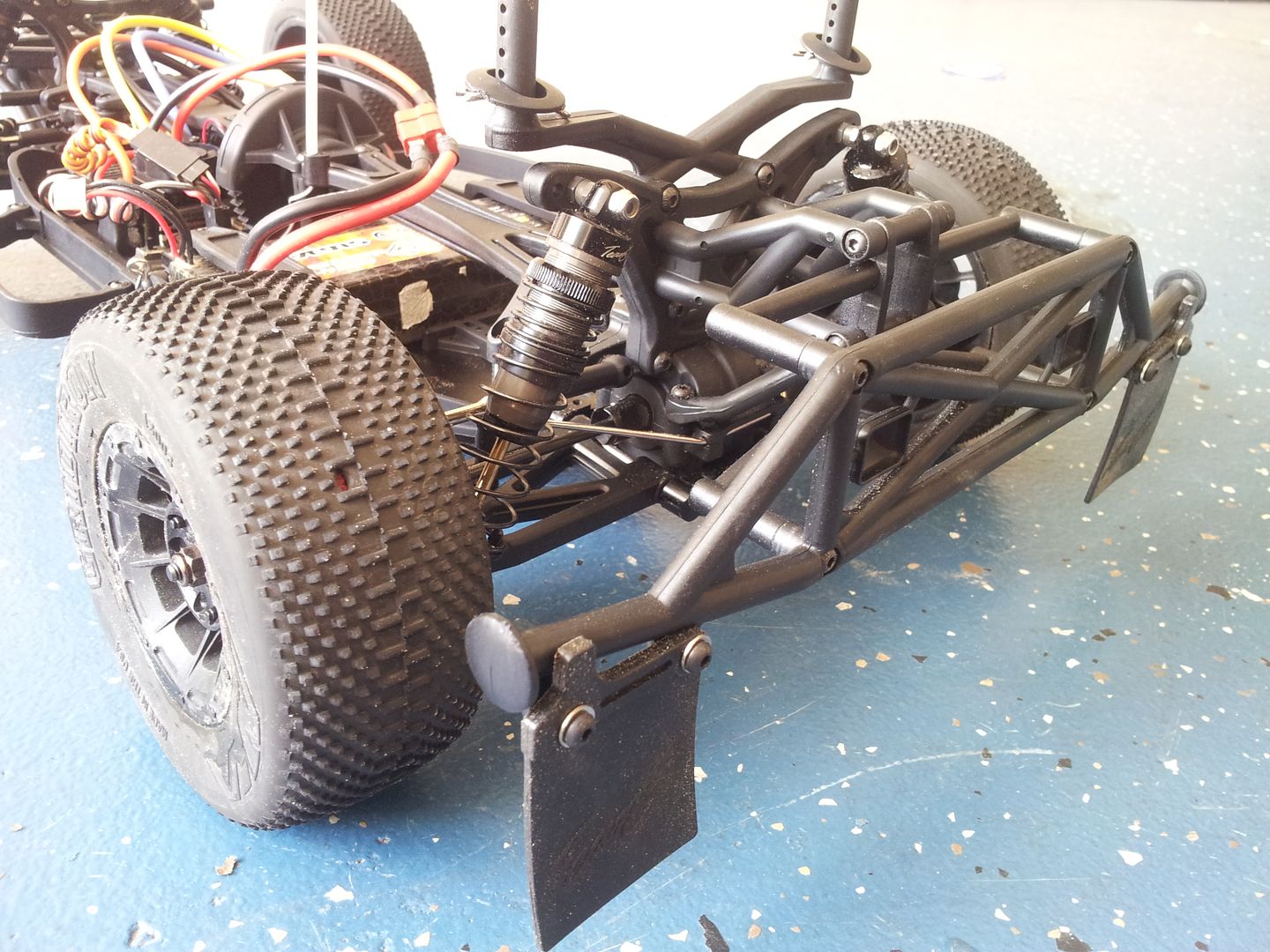
This along with 2 stage pistons should be a killer setup!
07-31-2012 | 10:17 AM
#1002
Tech Initiate
iTrader: (5)
Joined: Jan 2012
Posts: 40
From: California
Ok, so I had it right earlier, but was second guessing myself. The formula to calculate a dual spring rate is (a x b)/(a + b). So, for example we have a 10 and a 20 lb spring. (10x20)/(10+20) is 200/30= 6.67lb/in. Seems odd that the combined rate is less than the effective rate of each spring individually, but that's how it works.
This is why a longer spring that is wound exactly the same as a shorter one will be softer. Each coil deflects the same amount for a given load, but you have more coils on the longer spring so your total deflection is greater.
Using your example above and applying 10 pounds of force, you get the 1 inch from the 10 lbs/in spring and 0.5 inches for the 20 lbs/in spring for a total of 1.5 inches which you correctly calculated as 6.67 lbs/in.
Where dual rate springs react differently that simply using a single spring is when the softer spring exceeds its ability to compress linearly (overly simplified: it gets flattened and can't compress anymore), then any additional force is only compressing the stiffer spring. In the 10/20 lbs/in example you get 6.67 lbs/in until the 10 lb spring fully compresses, then you get 20 lbs/in. It is not quite that linear in the real world, but this should give you an understanding of what is going on.
-Chocula
07-31-2012 | 10:53 AM
#1004
Joined: May 2010
Posts: 3,846
For simplicity sake, assume you have two 10 lb/in springs. Assuming you apply a 10 force to one of the springs, it will compress 1 inch. Now stack them, and apply that same 10 lb force. The bottom spring now has 10 additional pounds on it so it compresses 1 inch. The top spring also has 10 additional pounds of force on it so it compresses 1 inch. This means your stack compressed 2 inches from 10 pounds of force which is a 5 lb/in equivalent.
This is why a longer spring that is wound exactly the same as a shorter one will be softer. Each coil deflects the same amount for a given load, but you have more coils on the longer spring so your total deflection is greater.
Using your example above and applying 10 pounds of force, you get the 1 inch from the 10 lbs/in spring and 0.5 inches for the 20 lbs/in spring for a total of 1.5 inches which you correctly calculated as 6.67 lbs/in.
Where dual rate springs react differently that simply using a single spring is when the softer spring exceeds its ability to compress linearly (overly simplified: it gets flattened and can't compress anymore), then any additional force is only compressing the stiffer spring. In the 10/20 lbs/in example you get 6.67 lbs/in until the 10 lb spring fully compresses, then you get 20 lbs/in. It is not quite that linear in the real world, but this should give you an understanding of what is going on.
-Chocula
This is why a longer spring that is wound exactly the same as a shorter one will be softer. Each coil deflects the same amount for a given load, but you have more coils on the longer spring so your total deflection is greater.
Using your example above and applying 10 pounds of force, you get the 1 inch from the 10 lbs/in spring and 0.5 inches for the 20 lbs/in spring for a total of 1.5 inches which you correctly calculated as 6.67 lbs/in.
Where dual rate springs react differently that simply using a single spring is when the softer spring exceeds its ability to compress linearly (overly simplified: it gets flattened and can't compress anymore), then any additional force is only compressing the stiffer spring. In the 10/20 lbs/in example you get 6.67 lbs/in until the 10 lb spring fully compresses, then you get 20 lbs/in. It is not quite that linear in the real world, but this should give you an understanding of what is going on.
-Chocula
From the dual spring sets that I have seen, they are making the upper spring heavier than the lower, essentially negating the possible benefits of the upper spring coilbinding and working on the lower spring alone. That's why I don't see the advantage to it in this application- yet. The ones I had were from Pro line, maybe they changed them or someone else will come up with something better. Either way, until a true position sensitive damping method is created that is consistent to setup and use, I don't think there's an advantage to it as the sudden transition to a firmer rate will drastically unbalance your damping characteristics at that point in the suspension travel as the car will be oversprung for the available damping.
07-31-2012 | 10:59 AM
#1005
That make sense but if you think about it what we have now sucks anyway!!
My pistons offer initial pack and hard pack on compression and quicker rebound, I bet some combo will work! I have the system just need to apply it and play around. once i get a good base tune i can start playing with the dual springs and see what happens! In RC you dont know unless you try!
My pistons offer initial pack and hard pack on compression and quicker rebound, I bet some combo will work! I have the system just need to apply it and play around. once i get a good base tune i can start playing with the dual springs and see what happens! In RC you dont know unless you try!

