


 6Likes
Supercharged nitro engine
 07-04-2018 | 05:37 AM
#16

Tech Lord

Joined: Aug 2007
Posts: 14,045
From: Holland

I always had the idea to try a kind of propellor in the bore of the crankshaft I even made a tool for it to make the blades but in a 1st atempt my machine was not solid enough....
The RB innovations does work but not as a turbo but as a mixture pump, videos shows a much better acceleration.
The RB innovations does work but not as a turbo but as a mixture pump, videos shows a much better acceleration.
 09-22-2018 | 11:39 PM
#18

Yes, I know bolt-on superchargers for nitro engines don't work, at least not well enough to justify the extra complexity. I'm just pondering something.
Nitro engines are designed so the exhaust port opens before the transfer ports do, to release exhaust pressure so exhaust doesn't blow down through the transfer ports and block inflow of fresh air and fuel. The side-effect of this is the exhaust port also closes after the transfer ports do, reducing the engine's compression, even with a tuned pipe on the exhaust to "bounce" the escaping fuel and air back into the cylinder before the ascending piston seals off the exhaust port.
But what if you engineered a nitro engine specifically to work as well as possible with a supercharger? If the crankcase were sufficiently pressurized by a supercharger, you wouldn't have to worry as much about exhaust blowing down through the transfer ports, so you could have an exhaust port that opens at the same time as the transfer ports, or even opens *later* than the transfer ports. (the exhaust port could be made wider to compensate for not being as tall, so it would still have the same flow-rate.) That would mean the transfer ports could stay open after the exhaust port closes, and the intake valve on the crankshaft could be adjusted to stay open for longer while the transfer ports are open, which would allow the supercharger to actually pressurize the combustion chamber properly.
Thoughts?
Nitro engines are designed so the exhaust port opens before the transfer ports do, to release exhaust pressure so exhaust doesn't blow down through the transfer ports and block inflow of fresh air and fuel. The side-effect of this is the exhaust port also closes after the transfer ports do, reducing the engine's compression, even with a tuned pipe on the exhaust to "bounce" the escaping fuel and air back into the cylinder before the ascending piston seals off the exhaust port.
But what if you engineered a nitro engine specifically to work as well as possible with a supercharger? If the crankcase were sufficiently pressurized by a supercharger, you wouldn't have to worry as much about exhaust blowing down through the transfer ports, so you could have an exhaust port that opens at the same time as the transfer ports, or even opens *later* than the transfer ports. (the exhaust port could be made wider to compensate for not being as tall, so it would still have the same flow-rate.) That would mean the transfer ports could stay open after the exhaust port closes, and the intake valve on the crankshaft could be adjusted to stay open for longer while the transfer ports are open, which would allow the supercharger to actually pressurize the combustion chamber properly.
Thoughts?
Many people around the world have tried and no one got any positive results, as far as I know.
09-23-2018 | 06:49 AM
#19

Thread Starter
Joined: Mar 2014
Posts: 8,054
From: Virginia, Near DC, USA
It would require a rubber seal with a spring around it to keep the seal clamped against the crankshaft as the seal wears-down, but that's hardly impossible. Every automobile engine already has seals like that. Also, a vacuum chamber ahead of the front bearing could be added, with a hose connecting it to the intake side of the supercharger, to recapture oil leaking past the front bearing.
If your test engines couldn't rev-up enough to reach the minimum RPM of your tuned pipes, then you needed pipes tuned lower. The power increase from turbocharging and supercharging is most evident in the mid-RPM range, so the vehicle could be geared higher and wouldn't require an engine (or pipe) that revs to the moon to generate power. It would be roughly equivalent to adapting a touring car to run on a truck engine nowadays.
Would all that work be worth the added complexity? Probably not, I mean you can always just install the aforementioned truck engine to get the same effect. But as a pure engineering exercise I think it could be made to work, if the will existed to do so.
If your test engines couldn't rev-up enough to reach the minimum RPM of your tuned pipes, then you needed pipes tuned lower. The power increase from turbocharging and supercharging is most evident in the mid-RPM range, so the vehicle could be geared higher and wouldn't require an engine (or pipe) that revs to the moon to generate power. It would be roughly equivalent to adapting a touring car to run on a truck engine nowadays.
Would all that work be worth the added complexity? Probably not, I mean you can always just install the aforementioned truck engine to get the same effect. But as a pure engineering exercise I think it could be made to work, if the will existed to do so.
09-23-2018 | 08:18 PM
#21
It would require a rubber seal with a spring around it to keep the seal clamped against the crankshaft as the seal wears-down, but that's hardly impossible. Every automobile engine already has seals like that. Also, a vacuum chamber ahead of the front bearing could be added, with a hose connecting it to the intake side of the supercharger, to recapture oil leaking past the front bearing.
If your test engines couldn't rev-up enough to reach the minimum RPM of your tuned pipes, then you needed pipes tuned lower. The power increase from turbocharging and supercharging is most evident in the mid-RPM range, so the vehicle could be geared higher and wouldn't require an engine (or pipe) that revs to the moon to generate power. It would be roughly equivalent to adapting a touring car to run on a truck engine nowadays.
Would all that work be worth the added complexity? Probably not, I mean you can always just install the aforementioned truck engine to get the same effect. But as a pure engineering exercise I think it could be made to work, if the will existed to do so.
If your test engines couldn't rev-up enough to reach the minimum RPM of your tuned pipes, then you needed pipes tuned lower. The power increase from turbocharging and supercharging is most evident in the mid-RPM range, so the vehicle could be geared higher and wouldn't require an engine (or pipe) that revs to the moon to generate power. It would be roughly equivalent to adapting a touring car to run on a truck engine nowadays.
Would all that work be worth the added complexity? Probably not, I mean you can always just install the aforementioned truck engine to get the same effect. But as a pure engineering exercise I think it could be made to work, if the will existed to do so.
You have valid point.
So little we know about those engines.
Are you talking from real knolowladge and expirience, or just use logics?
BTW, for the record, offset carburetor I made 10 years before Novarossi did. This is very well known fact here. Novarossi Vir-tus.21 page 7
Last edited by EdwardN; 09-24-2018 at 12:09 AM. Reason: Adding fact
09-27-2018 | 08:44 AM
#22

Hence why OS went 4 stroke route, made it easier. I know I posted up a pic earlier of the FS-120S but here is some more to stoke the fire.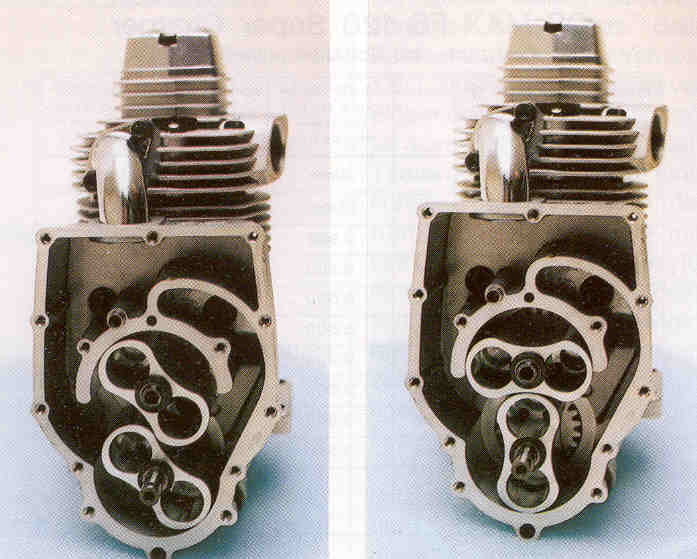

And here is a review:
OS FS-120 Surpass SP
And here is a review:
OS FS-120 Surpass SP
03-17-2019 | 06:00 PM
#23
Tech Initiate
Joined: Nov 2017
Posts: 32
I just discovered this thread and it’s pretty entertaining to read. I’ve always wanted to attempt something like you were talking about. I even went as far as to buy a keychain turbo (not a supercharger but close enough) but it was never going to make boost so I gave up. I think this summer when I’m not so busy with school I might try to draw something up in cad. If you designed it right you could 3d print a turbine and make a centrifugal supercharger. Maybe I’ll try that on my magnum xl-52 four stroke
03-17-2019 | 08:33 PM
#24
Thread Starter
Joined: Mar 2014
Posts: 8,054
From: Virginia, Near DC, USA
Partly experience and partly logic. I have owned turbocharged cars before, and I've done work on them to get more horsepower, which involved learning about the ways in which supercharged/turbocharged engines operate differently than naturally-aspirated engines. I extrapolated from that experience and tried to apply my knowledge to our little nitro engines.
Do you have a picture? The link to the Novarossi website doesn't work anymore.
BTW, for the record, offset carburetor I made 10 years before Novarossi did. This is very well known fact here. Novarossi Vir-tus.21 page 7
03-17-2019 | 08:38 PM
#25
Thread Starter
Joined: Mar 2014
Posts: 8,054
From: Virginia, Near DC, USA
Hence why OS went 4 stroke route, made it easier. I know I posted up a pic earlier of the FS-120S but here is some more to stoke the fire.
And here is a review:
OS FS-120 Surpass SP
And here is a review:
OS FS-120 Surpass SP
03-17-2019 | 08:47 PM
#26
Thread Starter
Joined: Mar 2014
Posts: 8,054
From: Virginia, Near DC, USA
I just discovered this thread and it’s pretty entertaining to read. I’ve always wanted to attempt something like you were talking about. I even went as far as to buy a keychain turbo (not a supercharger but close enough) but it was never going to make boost so I gave up. I think this summer when I’m not so busy with school I might try to draw something up in cad. If you designed it right you could 3d print a turbine and make a centrifugal supercharger. Maybe I’ll try that on my magnum xl-52 four stroke
In the meantime, you'll want to find some way to measure airflow so you can see how much air the engine pulls-in when it's naturally-aspirated, so you have some idea how much air your supercharger setup needs to be able to move. As a guideline, your supercharger setup will need to be able to pump 150% as much air as the engine intakes naturally, to generate 7.5psi/0.5bar/0.5atm of positive pressure inside the engine; if it can't pump that much additional air into the engine, the engine will probably experience a net power loss from driving the supercharger. You'll also need to move the carburetor upstream of the supercharger to avoid the additional complexity of needing a pressurized box surrounding the carburetor and a fuel tank capable of retaining the same additional pressure without leaking everywhere.
Unless you happen to have all the right equipment sitting in your garage, you're looking at months of occasional work to make this prototype. Best to start on the easy bits now.
03-18-2019 | 12:13 AM
#27
Tech Lord
Joined: Aug 2007
Posts: 14,045
From: Holland
I know that is an unwanted reaction but with the hint you easilly could find pics...
VIR-TUS.21 Onroad - NOVAROSSI WORLD
03-18-2019 | 09:10 AM
#28
Tech Initiate
iTrader: (4)
Joined: Jan 2004
Posts: 32
From: NYC
You have valid point.
So little we know about those engines.
Are you talking from real knolowladge and expirience, or just use logics?
BTW, for the record, offset carburetor I made 10 years before Novarossi did. This is very well known fact here. Novarossi Vir-tus.21 page 7
Don't know if this link will work: https://worldwide.espacenet.com/publ...=&locale=en_EP
03-18-2019 | 07:16 PM
#29
Tech Initiate
iTrader: (4)
Joined: Jan 2004
Posts: 32
From: NYC
Saw your original post. My point was that Edward invented this almost 20 years ago and Novarossi ripped it off. Maybe they didn't know, it's just interesting that they successfully filed a patent for something that was already on the market. Edward doesn't know who I am but I met him and his son at the Winternats around 2001/2002 and knew that everything he came up with was 100% original and new.
03-19-2019 | 12:41 AM
#30
Tech Lord
Joined: Aug 2007
Posts: 14,045
From: Holland
Novarossi was very busy to design engines different from standard like their weird bearings and indeed the offset carb. The offset carb is a solution to get the intake hole of the crankshaft in line with the crankpin which should give more balance in the crankshaft. We customers want to see improvements and so going outside the standard and giving it an interesting story will push people to buy the engine. And with patented designs no other can copy it with which you can make your own prices like the impossible bearing of the Virtus with a retail price of arround 115 dollar (!!!)
Look at their latest model:
MEPHISTO.21 ONROAD - NOVAROSSI WORLD
It is using the normal 14.5x26x6 bearing and a normal carburator.The cheaper OS, LM and Picco engines were getting more interesting for the market, not only with their prices but also performance wise which seems to me the reason to go back to normal designs with the result of lower prices du easier and more mass manufacturing and most of all with that, more satisfied customers.,
Look at their latest model:
MEPHISTO.21 ONROAD - NOVAROSSI WORLD
It is using the normal 14.5x26x6 bearing and a normal carburator.The cheaper OS, LM and Picco engines were getting more interesting for the market, not only with their prices but also performance wise which seems to me the reason to go back to normal designs with the result of lower prices du easier and more mass manufacturing and most of all with that, more satisfied customers.,