


Brushless reverse rotation
 12-15-2012 | 02:19 PM
#1
 Brushless reverse rotation
The novak brushless speed controls have the option for reverse rotation in the setup sheet. Is the performance the same as running it in forward? I would think with it being a sensored motor that the esc compensates for the timing. It does say in the sheet there is no boost when motor rotation is reversed but that's no big deal.
Thanks
Nick
Thanks
Nick


 12-16-2012 | 03:07 AM
#4

The novak brushless speed controls have the option for reverse rotation in the setup sheet. Is the performance the same as running it in forward? I would think with it being a sensored motor that the esc compensates for the timing. It does say in the sheet there is no boost when motor rotation is reversed but that's no big deal.
Thanks
Nick
Thanks
Nick
Novak marks their zero advance point as "N" for neutral on some motors, and 30 degrees on others. Novak's 30 degrees is the same as other manufacturer's 0 degrees. (This has to do with the electrical characteristics of brushless motors.)
By the way, you can use the reverse rotation feature (or simply full reverse, for that matter) on Novak ESCs to find the zero advance point on motors like the SS that don't have any markings for it. Rotate the end bell until the RPM is equal at full forward and full reverse. A tachometer is handy for this, but most people (especially those with some musical talent!) can get close enough by just listening to the pitch of the motor.
EDIT: SEE POST #11 FOR CORRECTION TO THE ABOVE ITEMS!
With the motor timing set correctly, the performance will be identical in either direction.
Last edited by howardcano; 12-18-2012 at 10:52 AM.
12-16-2012 | 06:58 AM
#6
I'd try it first before spending time working on the transmission.
12-16-2012 | 11:07 AM
#7
Tech Champion

Joined: Oct 2007
Posts: 7,341
N is 30 degrees at least for all 1/10 Novaks. Has been mentioned several times by Novak representatives.
Last edited by Dave H; 12-16-2012 at 01:01 PM.
12-16-2012 | 07:42 PM
#8
ESCs for sensorless motors monitor the voltage of the undriven winding for the zero-crossing point, then delay 30 degrees after it is detected before commutating to the next drive pattern for the windings. Sensored motors are designed so the sensor output changes nominally at this point, so that the software on a sensored ESC doesn't need to calculate or time this delay.
Novak calls this point 30 degrees for the reason above. They also call it "neutral", because it is the point in rotation where commutation can occur that will result in the motor having the same free-running same speed in either direction, just like on a brushed motor set at 0 degrees.
There are many sources on the internet that describe the operation of brushless motors, and explain the 30 degree delay. Here's one example:
http://www.atmel.com/Images/doc7658.pdf
See sections 2.1, 2.2, 2.3, and 3.
EDIT: SEE POST #11 FOR CORRECTION!
Last edited by howardcano; 12-18-2012 at 10:49 AM. Reason: Added Atmel reference.
12-17-2012 | 07:39 PM
#9
Tech Champion
Joined: Oct 2007
Posts: 7,341
That is correct, except that it is not 30 degrees of timing advance. It is zero advance. Setting the timing to "N" on a Novak motor will make the sensor output change exactly 30 degrees (or as close as can be labeled) away from where the back-EMF on the undriven winding reaches zero (known as the "zero-crossing" point) and where the back-EMF of the energized windings is at a maximum. Other manufacturers call this the 0 degree point, because it is the place where commutation would take place on a brushed motor set at 0 degrees timing.
ESCs for sensorless motors monitor the voltage of the undriven winding for the zero-crossing point, then delay 30 degrees after it is detected before commutating to the next drive pattern for the windings. Sensored motors are designed so the sensor output changes nominally at this point, so that the software on a sensored ESC doesn't need to calculate or time this delay.
Novak calls this point 30 degrees for the reason above. They also call it "neutral", because it is the point in rotation where commutation can occur that will result in the motor having the same free-running same speed in either direction, just like on a brushed motor set at 0 degrees.
There are many sources on the internet that describe the operation of brushless motors, and explain the 30 degree delay. Here's one example:
http://www.atmel.com/Images/doc7658.pdf
See sections 2.1, 2.2, 2.3, and 3.
ESCs for sensorless motors monitor the voltage of the undriven winding for the zero-crossing point, then delay 30 degrees after it is detected before commutating to the next drive pattern for the windings. Sensored motors are designed so the sensor output changes nominally at this point, so that the software on a sensored ESC doesn't need to calculate or time this delay.
Novak calls this point 30 degrees for the reason above. They also call it "neutral", because it is the point in rotation where commutation can occur that will result in the motor having the same free-running same speed in either direction, just like on a brushed motor set at 0 degrees.
There are many sources on the internet that describe the operation of brushless motors, and explain the 30 degree delay. Here's one example:
http://www.atmel.com/Images/doc7658.pdf
See sections 2.1, 2.2, 2.3, and 3.
To adjust a Ballistic motor to 0° of physical motor timing, simply loosen the three flat head screws on the back bearing cap and rotate the cap to align the sensor harness connector with the middle solder tab as described above.
The Ballistics I have appear to be about 30 degrees advanced from this notice. Which is in agreement with other info on their site and elsewhere.
As I read it the article you originally linked explains that the back EMF zero crossing point of the coil is 30 degrees from the zero timing point. It’s the sensorless motor that requires the correction, not the sensored. I don’t see any info on timing advance of a sensored motor like a Novak. Or any discussion of advance timing.
I’ll need to take a look at your latest link at a later time.
Cheers
12-18-2012 | 10:47 AM
#11
So how did I arrive at my erroneous conclusion? Grab a cup of coffee...
When I got my first Novak motor, an SS, there were no markings for timing. I wanted to find and label the position for zero timing advance, so I used the same method that one would use for brushed motors: adjust the endbell so that the motor's no-load speed is identical in either direction. The Novak ESC I used had both full reverse and the option to change the motor rotation, which made this simple. I got the results I was expecting. I was happy.
When I got a Ballistic, I used the same method, but got the same speed in both directions with the endbell set to the 30 degree (or "N") mark. Since I was familiar with brushless motors, and have designed hardware and software for both sensored and sensorless ESCs, I made the great leap of faith that Novak simply marked the zero timing advance point as 30 degrees since that is its position from the zero-crossing point of the back EMF. But I didn't look to see what was going on, I just made an assumption.
Our discussion here finally prompted me (after all these years with Novak motors and ESCs!) to actually look at the signals and voltages on the motor with an oscilloscope. Indeed, the zero timing advance point is where you have described it, and 30 degrees really is 30 degrees in normal rotation. So, how could the motor speed be the same in either direction, when 30 degrees of timing advance in one direction would be 30 degrees RETARDED in the other direction?
Well, it appears that Novak has played a slick trick, using the fact that there are 6 commutation states per revolution, each lasting 60 degrees out of 360 degrees total per revolution. The commutation states are not the same in the reverse direction, but are shifted by one state, giving 60 degrees of advance. Thus, the 30 degree advance endbell setting in normal rotation (which is 30 degrees retarded in the opposite direction) gives a net result of 30 degrees of advance (60 advanced - 30 retarded) in the opposite direction. This, in combination with setting the motors to (nominally) 30 degrees from the factory, means that the rotation can be quickly selected on the ESC and result in the same motor speed with no adjustments required on the motor timing or gear ratio. That makes things pretty easy for the average user! And it's probably the reason for the "N" marking at 30 degrees.
So that's where I made my error. Yes, zero timing advance will give the same speed in either direction. But ANY timing setting, as long as it is correct for the direction of rotation, will also do that. The 30 degree point just happens to be a magic spot where software can turn "flip" the timing from retarded to advanced, at the same value, with virtually no effort and no motor adjustments. (By "virtually no effort", I mean that it is a simple matter of incrementing or decrementing a pointer for a lookup table.)
Now I have to go clean up a few of my posts!
So we have now arrived, in circuitous fashion, back at the original question: Given the appropriate timing settings, why would a Novak motor not give identical performance in either direction? The construction appears symmetrical, to my eyes at least. I haven't noticed any skewing of the stator or other things that might be used to favor operation in one direction over the other. Do you have any ideas? I sent Charlie at Novak a message asking this question, and will post his reply.
Last edited by howardcano; 12-18-2012 at 11:13 AM.
12-18-2012 | 02:36 PM
#12
Here's more interesting info:
My curiousity got the better of me, and I opened up a box containing a new Trinity D3.5 that I'm getting for Christmas. (Yes, I am a bad boy.) My testing of the D3.5 revealed that the 0 degree setting on it is actually 30 degrees advance! I did a quick search here on RCTech, and some posts indicate that this has been confirmed by Trinity. I could find no information on the Trinity web site, and nothing in the instructions for the motor mentions this.
So it turns out that different manufacturers do use a different reference point for the labeling for the timing adjustment. I simply named the wrong manufacturer!
It makes me wonder if whoever did the labeling for the D3.5 used a Novak ESC and the same procedure as I did to determine the endbell position for 0 degrees advance, and arrived at the same incorrect result.
EDIT: I just checked a Tekin Redline motor. The 0 degree marking on the Redline is also actually 30 degrees advanced! The lesson is: trust no one. Measure timing yourself to find the actual value.
My curiousity got the better of me, and I opened up a box containing a new Trinity D3.5 that I'm getting for Christmas. (Yes, I am a bad boy.) My testing of the D3.5 revealed that the 0 degree setting on it is actually 30 degrees advance! I did a quick search here on RCTech, and some posts indicate that this has been confirmed by Trinity. I could find no information on the Trinity web site, and nothing in the instructions for the motor mentions this.
So it turns out that different manufacturers do use a different reference point for the labeling for the timing adjustment. I simply named the wrong manufacturer!
It makes me wonder if whoever did the labeling for the D3.5 used a Novak ESC and the same procedure as I did to determine the endbell position for 0 degrees advance, and arrived at the same incorrect result.
EDIT: I just checked a Tekin Redline motor. The 0 degree marking on the Redline is also actually 30 degrees advanced! The lesson is: trust no one. Measure timing yourself to find the actual value.
Last edited by howardcano; 12-19-2012 at 06:13 AM.
 12-19-2012 | 09:16 AM
#14
As I mentioned in a previous post, if the motor is already set to the "N" or 30 degree mark, then no change in motor timing or gear ratio is needed.
For other endbell positions in reverse rotation, the timing is "flipped" around the "N" or 30 degree mark. For instance, 45 degrees advance in normal rotation becomes 15 degrees advance in reverse rotation, and 15 degrees advance in normal rotation becomes 45 degrees in reverse rotation.
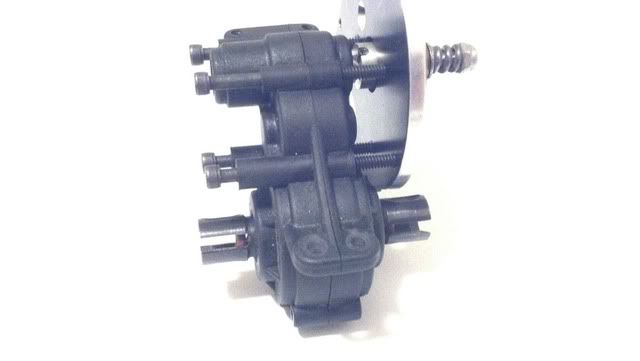
So, if you haven't finished modifying the transmission, you can save yourself the effort. Or, if you're having fun doing it, then by all means continue! I'd be interested in seeing it if you decide to finish it.
Last edited by howardcano; 12-19-2012 at 09:38 AM.
12-21-2012 | 06:23 AM
#15
Started with a 3/8x1 inch block of delrin.
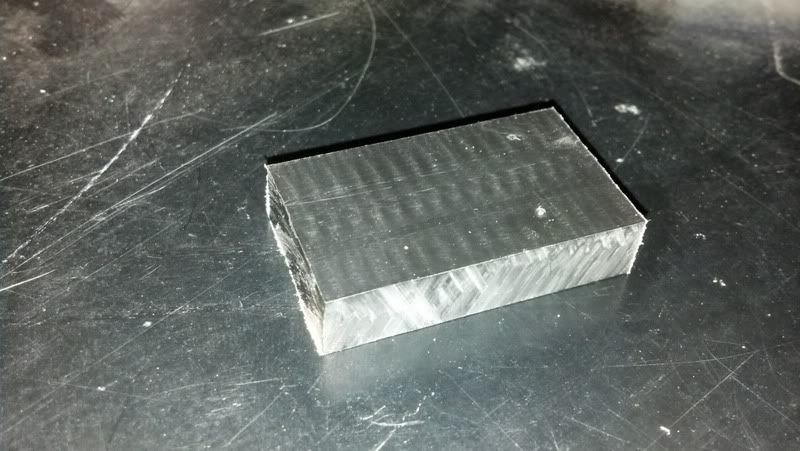
A few hours of mill time later I had a spacer.

And installed.
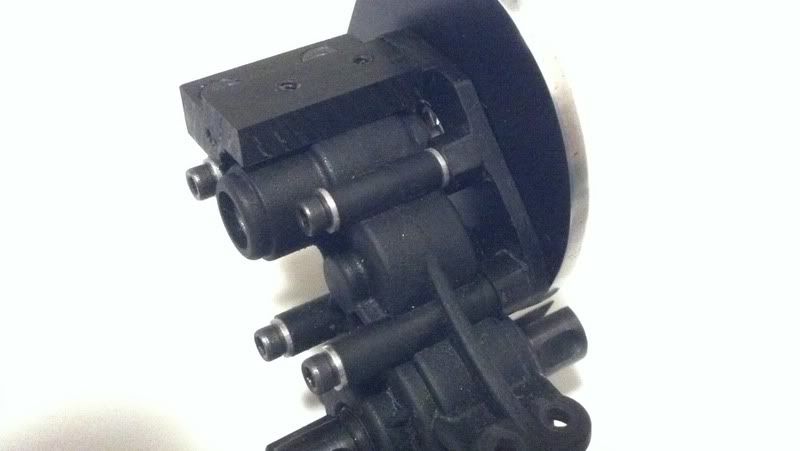
Still need to cut off the extra length of the screws and plug the old hole for the shaft.
If I had more time to mess with it I would have tried it the other way to see how it went. However the novak race is in a couple weeks and there is no track close to try it out at before hand.
Nick
A few hours of mill time later I had a spacer.
And installed.
Still need to cut off the extra length of the screws and plug the old hole for the shaft.
If I had more time to mess with it I would have tried it the other way to see how it went. However the novak race is in a couple weeks and there is no track close to try it out at before hand.
Nick