


limiting micro servo voltage
 08-22-2012 | 01:43 AM
#1
 limiting micro servo voltage
I want to run some 5v micro servos off of my rx8 bec but it seems to be overvolting them. Could i perhaps install a resistor on the power wire? If so what should I use, resistors i belive are mostly rated by ohms so im kinda in the dark on that whole thing. Better option maybe?
 08-22-2012 | 02:28 AM
#2

Use rectifier diodes, each one drops the voltage.3 or .4 volts at all times & will only work in one direction. A resistor will only drop the voltage while under a load putting the full voltage on your servo anytime it is at rest.
 08-22-2012 | 11:06 AM
#5
both are Radio Shack
1N4004 Micro 1-Amp Rectifier Diode
Model: 1N4004 | Catalog #: 276-1103
$1.19
These should work for larger low amp servos
Model: 1N5402 | Catalog #: 276-1143
3-Amp Diodes
Price:
$1.69
Some of the newer high draw servos may pull too many amps for these diodes.
Just make sure they are NOT Zener diodes.
08-22-2012 | 06:26 PM
#8
Tech Champion

Joined: Oct 2007
Posts: 7,341
Note diodes have polarity, hooked up backwards they will darn near block all power, very little current will get through.
P.S. I never remember which way, always have to measure them.


Hopefully this image from Wikipedia will help, believe this shows the correct forward polarity direction:
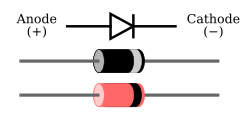
Last edited by Dave H; 08-22-2012 at 06:39 PM.
08-22-2012 | 08:25 PM
#9
That's the problem, the changing power use causes changes in current, which then changes the resistor voltage drop. A diode voltage drop will change a little with power and current, but much less than a resistor.
Note diodes have polarity, hooked up backwards they will darn near block all power, very little current will get through.
P.S. I never remember which way, always have to measure them.
Hopefully this image from Wikipedia will help, believe this shows the correct forward polarity direction:
Note diodes have polarity, hooked up backwards they will darn near block all power, very little current will get through.
P.S. I never remember which way, always have to measure them.
Hopefully this image from Wikipedia will help, believe this shows the correct forward polarity direction:
+1 Thanks Dave, got busy & could not get back.
Yes with the servo at rest but powered the voltage will rise to almost the full supplied voltage, while with the diode the voltage will always be reduced a set amount & you can run several in series to lower it to the desired amount.
We use 2 or 3 on our 2 cell lipo reeiver packs when running 1 cell cars. In fact our associated 12 e's came with 2 in the wiring harness back in 1979 or 80.
08-22-2012 | 09:15 PM
#10
Tech Champion
Joined: Oct 2007
Posts: 7,341
No problem Tom, we’re all pulling together. Good point about using as many as needed in series to get the desired voltage.
More slightly off topic chatter, have 80’s radios that use diodes in harnesses for the old wiper arm-resistor speedo deals. One of my first RC creations was a rotary switched diode ladder & relay box for adjustable voltage shutoff for discharging ni-cads, 4, 6, & 7 cells, with light bulbs. (Also used tinted turn signal bulbs unlike the naked ones most used, oh boy was I hi-tech
 )
)
On topic point being, diodes are very useful inexpensive devices that in many cases are fairly easy to use for a variety of hobby electrical needs.
Cheers
More slightly off topic chatter, have 80’s radios that use diodes in harnesses for the old wiper arm-resistor speedo deals. One of my first RC creations was a rotary switched diode ladder & relay box for adjustable voltage shutoff for discharging ni-cads, 4, 6, & 7 cells, with light bulbs. (Also used tinted turn signal bulbs unlike the naked ones most used, oh boy was I hi-tech
)On topic point being, diodes are very useful inexpensive devices that in many cases are fairly easy to use for a variety of hobby electrical needs.
Cheers
Currently Active Users Viewing This Thread: 1 (0 members and 1 guests)
