


Best light controller for on road car
 03-17-2024 | 02:20 PM
#1
Thread Starter
Tech Apprentice
Joined: Jan 2024
Posts: 57
 Best light controller for on road car
I need a full function light controller and I'm looking for both a high end option (the best I can get) and a budget option (one that will do the job).
I need:
I would like to be able to:
Opinions on the best overall option, and best budget option? Thanks.
I need:
- Headlight
- Reverse
- Front & rear blinker
- Rear brake
- Rear marker (on when headlight is)
I would like to be able to:
- Control modes from radio
- Set the blinkers to hazard light independently of other modes (or effectively so)
- Have the brake and reverse work from radio without turn signals working (or while they are in hazard mode)
- Mode where turn signals sync to steering and everything else normal operation (least important mode to me)
Opinions on the best overall option, and best budget option? Thanks.
 03-18-2024 | 07:26 AM
#2

Joined: Mar 2011
Posts: 6,410
From: Austin,TX
I use cheap sacrificial servos to make for my light controllers, here's a demo:
https://www.youtube.com/watch?v=p_34oSUgtGs
https://www.youtube.com/watch?v=p_34oSUgtGs
03-18-2024 | 09:42 AM
#3
Thread Starter
Tech Apprentice
Joined: Jan 2024
Posts: 57
I use cheap sacrificial servos to make for my light controllers, here's a demo:
https://www.youtube.com/watch?v=p_34oSUgtGs
https://www.youtube.com/watch?v=p_34oSUgtGs
I would consider making my own light controller with a microcontroller or SBC and a level shifter or driver/amplifier of some kind, but just a Pi Zero and one of the widely available level converter boards (and the wires between them) is a little more space than I would ideally like to use. It is a very tempting idea though since it would give me full control over the functions.
edit: Thinking about it I already started on a project like that over 20 years ago, was going to make a light controller for a helicopter. Got as far as breadboard.
Last edited by RCscale; 03-18-2024 at 01:43 PM.
03-18-2024 | 01:22 PM
#4

I built a module based on a small microcontroller. Has 2 PWM inputs (2 channels), 4 separate MOSFET-driven outputs and two WS2812 (or similar) outputs. I don't have a picture of the current version that integrates an additional 5V buck converter for the LED strings, but here's an earlier rev with dual 6V regulators for the other 4 channels.
Video of example in use: https://youtu.be/tlSBbWml3F8
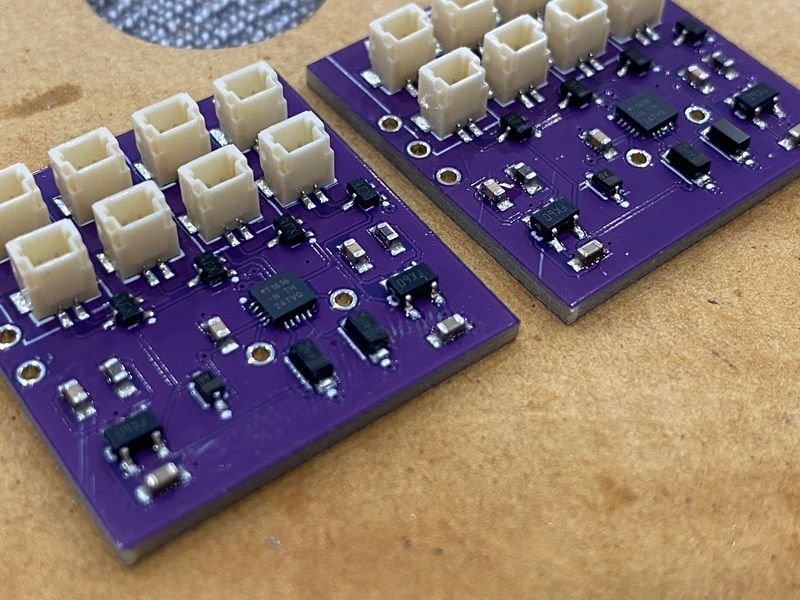
Video of example in use: https://youtu.be/tlSBbWml3F8
03-19-2024 | 06:02 PM
#5
Thread Starter
Tech Apprentice
Joined: Jan 2024
Posts: 57
I built a module based on a small microcontroller. Has 2 PWM inputs (2 channels), 4 separate MOSFET-driven outputs and two WS2812 (or similar) outputs. I don't have a picture of the current version that integrates an additional 5V buck converter for the LED strings, but here's an earlier rev with dual 6V regulators for the other 4 channels.
Video of example in use: https://youtu.be/tlSBbWml3F8
Video of example in use: https://youtu.be/tlSBbWml3F8
I have two bodies coming and I thought about using one to make a police car. Something like this could be very helpful. Also using Sbus for control might open up some options.
I was thinking an ESP32 might be a nice chip to use for the WiFi interface. Allow total control over modes from a web app.
03-20-2024 | 03:45 AM
#6
Very nice. Where does it stand now, got a Github? Thought about selling on Tindie or something?
I have two bodies coming and I thought about using one to make a police car. Something like this could be very helpful. Also using Sbus for control might open up some options.
I was thinking an ESP32 might be a nice chip to use for the WiFi interface. Allow total control over modes from a web app.
I have two bodies coming and I thought about using one to make a police car. Something like this could be very helpful. Also using Sbus for control might open up some options.
I was thinking an ESP32 might be a nice chip to use for the WiFi interface. Allow total control over modes from a web app.
My original thinking was to just read the steering/throttle outputs and blink/shine/flash accordingly. I've got code that makes the headlights brighten a bit as the "alternator" (ie: throttle) spools up

The F1 safety car leveraged two independent channels on a 6-channel radio to control the patterns.

Currently Active Users Viewing This Thread: 1 (0 members and 1 guests)
