


 33Likes
17.5t Motor comparison using only dyno data
 06-04-2018 | 01:53 PM
#1


 17.5t Motor comparison using only dyno data
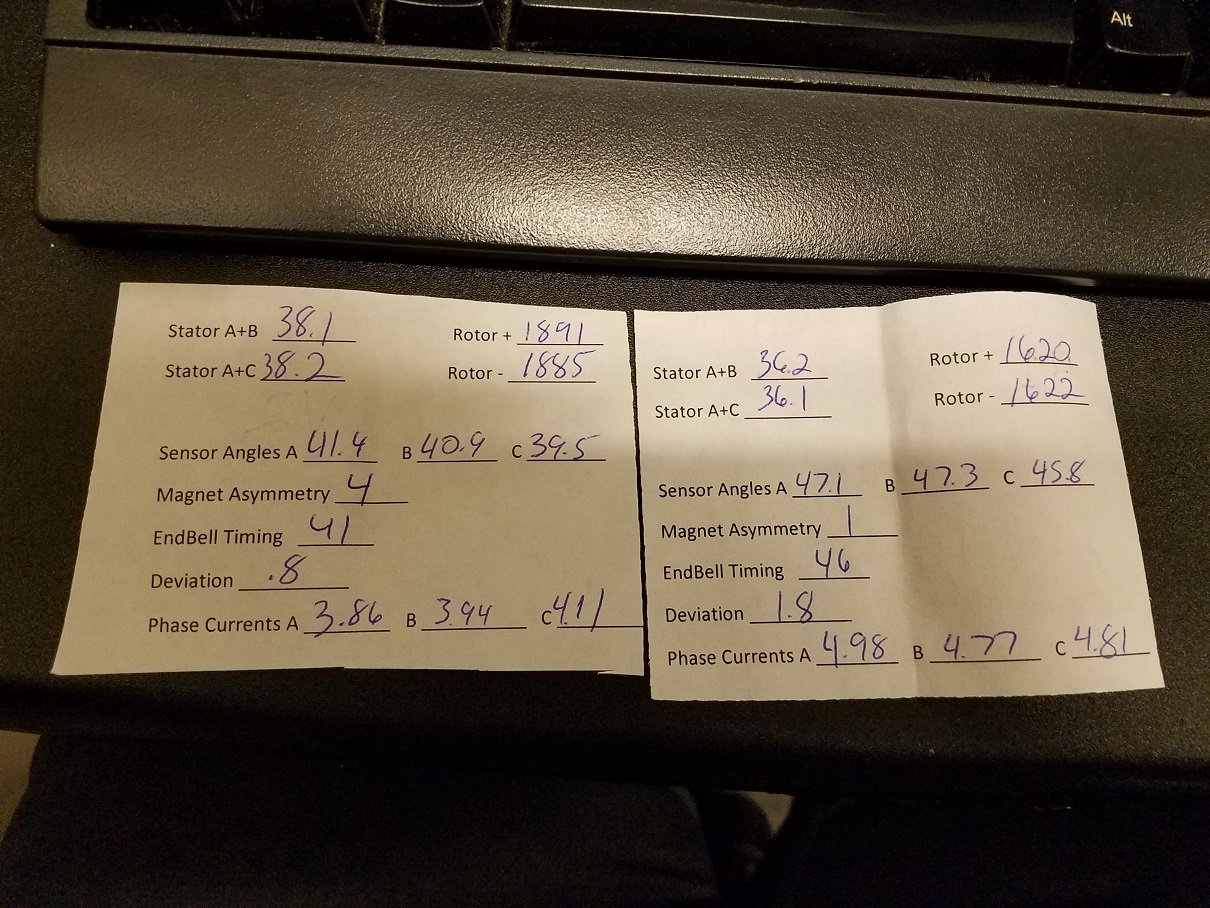
I recently got two motors from Rotor Ron and both have been tuned by him and I saw some interesting differences between the two motors. And strictly based on the numbers here, I wanted to pick everyones brain as to what motor you consider to be the better one of the two and why would you pick that one? I am pretty new to the whole dyno tuned motor theme so it would be nice to get some input from others who have experience tuning motors using similar data.


 06-04-2018 | 04:19 PM
#3
I'm just wondering based on the RPM and torque/rotor numbers. This is assuming the ideal timing numbers for each motor were set during the dyno session. These are Ron's numbers that he included with each motor.
06-04-2018 | 04:21 PM
#4
Tech Regular
Joined: Aug 2015
Posts: 340
From: United States
From what I read, Rotor Ron sets the timing of each motor for optimal power. The 41 is the better motor, it has an edge in rpm, efficiency, more watts and uses less amps than the 46 motor.
Best regards,
Brian
Best regards,
Brian
 06-04-2018 | 05:18 PM
#6

Rotor on the left looks to be cheater... Is that a mod rotor?
stator on the right is better.
Timing board on the left is better.
Basically these motors couldn't be any more different -- ignore the timing
stator on the right is better.
Timing board on the left is better.
Basically these motors couldn't be any more different -- ignore the timing
06-04-2018 | 05:31 PM
#7

i'm gonna say the one on the left is trinity punisher and one on right is either: V16 R1 or V3R fantom. whatever is on the left clearly has a rotor that is not legal for ROAR spec racing.
i really have no idea how he comes up with the timing numbers. seems like motor on left still has some performance in it. it is at 74% efficiency at it's power peak while motor on right is 66% at max power. what would motor on left look like with more timing?
i really have no idea how he comes up with the timing numbers. seems like motor on left still has some performance in it. it is at 74% efficiency at it's power peak while motor on right is 66% at max power. what would motor on left look like with more timing?
06-04-2018 | 05:32 PM
#8
Thank you for the input so far fellas
 06-05-2018 | 10:36 AM
#9

Anyone got a nice breakdown of what each field on the sheets shown mean and how to use them for tuning?
So what do you guys look for as far as an overall since of "power" and what parts of the dyno sheet do you look at for a given RPM for a given track?
so for example, running on a short track, lots of 180s so you want torque. Same example in reverse, etc.
funny thing is if the motor on the left is the one I think it is, sounds like the common timing range is like 46 to 48 degrees.
So what do you guys look for as far as an overall since of "power" and what parts of the dyno sheet do you look at for a given RPM for a given track?
so for example, running on a short track, lots of 180s so you want torque. Same example in reverse, etc.
funny thing is if the motor on the left is the one I think it is, sounds like the common timing range is like 46 to 48 degrees.
06-06-2018 | 08:57 PM
#10

With most motors and timing, you get to a point where torque and power are somewhat optimized. There's a fairly narrow band of timing that will shift the power band up or down in the RPM range on a specific motor. It's within this narrow range, you shift the timing based on the track. More timing when you spend more time high in the RPM range and vice versa.
That being said, I'd say the left motor will perform better. Torque is about the same through the RPM range listed and the left one has more power at same RPM points except for the very top end. Generally the motor with more power over most of the RPM range will perform better. But it's very dependent on your track layout. If it was an oval track, the right motor would probably be better.
Then you have to figure out gearing. Way too many variables to figure out on paper. Check your lap times and make adjustments from there.
That being said, I'd say the left motor will perform better. Torque is about the same through the RPM range listed and the left one has more power at same RPM points except for the very top end. Generally the motor with more power over most of the RPM range will perform better. But it's very dependent on your track layout. If it was an oval track, the right motor would probably be better.
Then you have to figure out gearing. Way too many variables to figure out on paper. Check your lap times and make adjustments from there.
06-07-2018 | 04:56 AM
#11

The motor set at 41* appears to be stronger. Assuming Ron knows what he is doing, it would get worse with more timing. Likewise, the other motor would get worse with less.
Timing is meant set optimally for each motor. How a motor runs at a given timing setting is not a measure of it's capability. That's why timing is adjustable. As racers, we only care about how are motors run at their best.
Timing is meant set optimally for each motor. How a motor runs at a given timing setting is not a measure of it's capability. That's why timing is adjustable. As racers, we only care about how are motors run at their best.
06-07-2018 | 07:57 AM
#12
The motor set at 41* appears to be stronger. Assuming Ron knows what he is doing, it would get worse with more timing. Likewise, the other motor would get worse with less.
Timing is meant set optimally for each motor. How a motor runs at a given timing setting is not a measure of it's capability. That's why timing is adjustable. As racers, we only care about how are motors run at their best.
Timing is meant set optimally for each motor. How a motor runs at a given timing setting is not a measure of it's capability. That's why timing is adjustable. As racers, we only care about how are motors run at their best.
Its looking like the left one is taking the lead! Both will be tried but I'm actually really pleased with these results so far. I will say the left motor is much cheaper.
06-07-2018 | 08:21 AM
#14
Well since we have had some good feedback here on the blind data sheets above I'll reveal the motors
The motor on the left is the Maclan Team Edition v2 17.5 with nothing added to it
The motor on the right is the Wurks r1 v16 17.5 with every option possible (aluminum screws, aluminum timing ring and upgraded bearings)
The motor on the left is the Maclan Team Edition v2 17.5 with nothing added to it
The motor on the right is the Wurks r1 v16 17.5 with every option possible (aluminum screws, aluminum timing ring and upgraded bearings)
06-08-2018 | 03:14 AM
#15

Tech Regular
Joined: Aug 2010
Posts: 383
I only have a motor analyser that checks KV, volts, amps and RPM under no load. I am thinking of building a full motor dyno to get some power/efficiency graphs under load to compare my motors.
The issue I wonder if people could help me with is regarding increasing timing. I increased the timing by 1 degree at a time on my 17.5 motor, checking the actual timing on the motor analyser. I then took readings in the table below.

Obviously as the timing increased so did the KV and the amps. I know this is under no load but amps and KV just keep going up as you increase the timing. If the motor was under load would you see a point where additional timing yielded no increase in KV and only an increase in amps? Is this how you would set the timing using a dyno and where the motor is at max power? Also how is the motor efficiency calculated?
From testing on track, 52 degrees seemed to give the best performance and the motor was coming off around 80C on a very warm day. With the motor analyser it all feels like guess work and I'm not sure if I am running too much timing and hence not getting the maximum power from my motor. My current method is to set the timing so the unloaded motor pulls 6A and then fine tune timing and gearing on track according to lap time and temperature. Would using a Dyno let me set my motor to it's maximum power and then simply tune gearing on track?
The manufacturer said this particular motor is at peak power at 65W with 51 degrees of timing and will be around 6A. I saw an improvement in lap times at 52 degrees at 7A which is higher than the manufacturer's recommendation. Is this for saftey margin so they don't provide settings that blow the motor? Is it correct to simply keep cranking on timing and tune gearing to keep temps below 80C?
The issue I wonder if people could help me with is regarding increasing timing. I increased the timing by 1 degree at a time on my 17.5 motor, checking the actual timing on the motor analyser. I then took readings in the table below.
Obviously as the timing increased so did the KV and the amps. I know this is under no load but amps and KV just keep going up as you increase the timing. If the motor was under load would you see a point where additional timing yielded no increase in KV and only an increase in amps? Is this how you would set the timing using a dyno and where the motor is at max power? Also how is the motor efficiency calculated?
From testing on track, 52 degrees seemed to give the best performance and the motor was coming off around 80C on a very warm day. With the motor analyser it all feels like guess work and I'm not sure if I am running too much timing and hence not getting the maximum power from my motor. My current method is to set the timing so the unloaded motor pulls 6A and then fine tune timing and gearing on track according to lap time and temperature. Would using a Dyno let me set my motor to it's maximum power and then simply tune gearing on track?
The manufacturer said this particular motor is at peak power at 65W with 51 degrees of timing and will be around 6A. I saw an improvement in lap times at 52 degrees at 7A which is higher than the manufacturer's recommendation. Is this for saftey margin so they don't provide settings that blow the motor? Is it correct to simply keep cranking on timing and tune gearing to keep temps below 80C?