


 5Likes
Going to replace gears in my Savox Servo
 02-18-2020 | 05:24 AM
#1

 Going to replace gears in my Savox Servo
So I bought a brand new Savox SB-2263MG for my 410.2. I got 1 practice out of it and the next practice, made it about 3 laps. Had a run-in with an 1/8 scale but everything seemed fine. Then out of no where the steering went out. Parked the car for the night and ran other vehicles. Finally got it home and it was obvious that something in the servo went out (plastic horn was still in tact.) I decided to open it up and see what was wrong. I ended up coming to the conclusion that 1 of the gears that are fused together, came apart. The smaller gear came loose from the bigger, flat gold gear. So they are still connected somehow but the free-spin, when they shouldn't be. Hard to explain. So I decided to try to replace the gears. Has anyone done this? I haven't seen too much on here about people doing this. I was just really shocked as the servo motor seems to be fine, none of the gears are stripped and the plastic horn is still fine.
I included a pic for reference. The circled gear was the one that failed. And the 2 pieces now spin independently. So in theory, replacing the gear should work, right? Hopefully, as I am happy to spend $15 rather than another $90 for a servo that didn't last 2 practices.
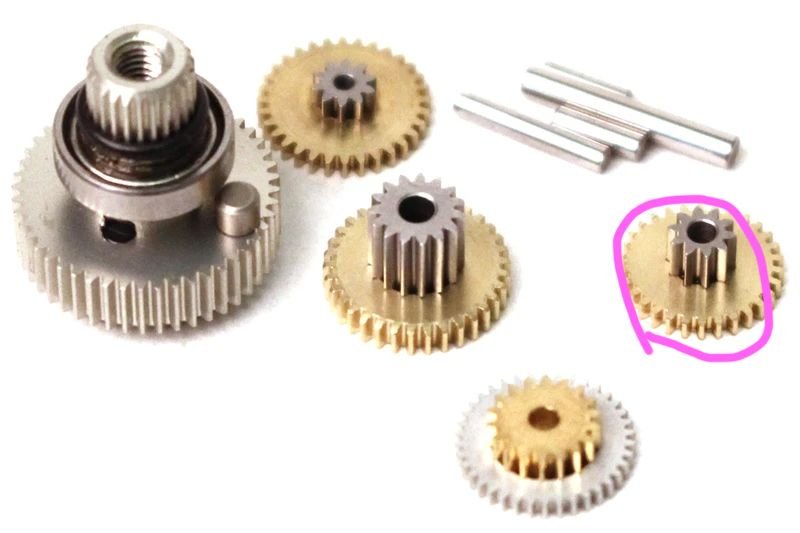
I included a pic for reference. The circled gear was the one that failed. And the 2 pieces now spin independently. So in theory, replacing the gear should work, right? Hopefully, as I am happy to spend $15 rather than another $90 for a servo that didn't last 2 practices.

 02-18-2020 | 06:08 AM
#3
Ok so this doesn't seem uncommon then? I always assumed that when a servo goes, the gears strip or something electronically burns out. I just thought it was odd that the gears that were fused together, busted. But hopefully it's as good as new w/ the rebuild kit.
02-18-2020 | 08:13 AM
#4

Ive heard of people adding a drop of CA to those type of gears on some servos to add some strength to that bond.
I was going to try that next time one of my servos needs a gear set and I put in new gears that don't have any grease on them.
But yeah other than that replacing gear sets are easy for any one to do, just be careful and make sure everything is aligned. Shouldn't be a big deal.
I was going to try that next time one of my servos needs a gear set and I put in new gears that don't have any grease on them.
But yeah other than that replacing gear sets are easy for any one to do, just be careful and make sure everything is aligned. Shouldn't be a big deal.

 02-19-2020 | 08:11 AM
#7
I run Savox in most of my vehicles. This was 1 of the 2 Savox units that Tekno had listed as recommended equipment. I was a little shocked that I had issues so quickly, but maybe just a freak deal. Hoping the replacement gears fix it and I get some good life out of it. If not, I'll start taking suggestions for what to replace it with. Thanks.
02-19-2020 | 08:22 AM
#8
Joined: Mar 2011
Posts: 6,410
From: Austin,TX
It's not a matter of "IF" just a matter of "WHEN" your servo gears will strip, given enough time and use, every servo I have owned has worn the gears over time, usually you can feel slop starting to form before they actually strip, but in your case with a brand new servo it was a factor of having too fast of a servo unfortunately... yes many racers will swear that having a fast servo is worth the risk, but generally they are very clean drivers and will be less likely to strip a servo simply because they almost never wreck. For a sportsman level driver, I would start with a 0.12 sec/60° servo, then as your skills progress with fewer wrecks, then it may be worth considering a faster servo later, or simply keep your current servo as a backup for when your skills progress to having fewer wrecks down the road.
Which servo is right for me?
***UPDATE***
Not sure if this will help, maybe reducing the steering speed on your radio might yield the same effect, not sure how slow to get your 0.07 servo down to 0.12, but this "might" help reduce your chances of stripping gears.... just a guess assuming it's linear... 0.07 / 0.12 = 58% which is where I would set the steering speed to start out with.
Which servo is right for me?
***UPDATE***
Not sure if this will help, maybe reducing the steering speed on your radio might yield the same effect, not sure how slow to get your 0.07 servo down to 0.12, but this "might" help reduce your chances of stripping gears.... just a guess assuming it's linear... 0.07 / 0.12 = 58% which is where I would set the steering speed to start out with.
Last edited by billdelong; 02-19-2020 at 08:42 AM.
02-19-2020 | 06:17 PM
#9
Oh and a servo saver is a great idea BUT those SEXY aluminum servo horns are badass and make you faster LOL!!!!
02-20-2020 | 05:06 AM
#10
Not at all .. When you do replace the gears replace all of them not just the ones you think are bad. If your cheep like I am save the ones you take out sometimes they come in handy in a pinch
Oh and a servo saver is a great idea BUT those SEXY aluminum servo horns are badass and make you faster LOL!!!!
Oh and a servo saver is a great idea BUT those SEXY aluminum servo horns are badass and make you faster LOL!!!!
I should be clear, this is a 13.5 car so I really don't want to add anything else to the car. And I don't blow through servos or anything. I was just shocked that this one broke so quickly and nothing was damaged aside from the 1 gear that was 2 materials fused together. Hopefully after this, I'm good for a while. I have had reasonable life out of all of my Savox in my other vehicles, so this might've just been a freak thing.
02-04-2025 | 11:37 AM
#12
Tech Rookie
Joined: May 2024
Posts: 2
Just a little bit on the servos speed thing.
normally the fastest servo and the highest torque are normally the same servo with a different "gear" ratio. To achieve the higher torque the load that can be applied to the final gear is higher, however the failure will normally occur at the lowest surface area to torque ratio (which may not be the final gear), Ironically the faster servo passes less load back through the gears and by theory should be the tougher, but that weak point can't be determined by the stats on the box
normally the fastest servo and the highest torque are normally the same servo with a different "gear" ratio. To achieve the higher torque the load that can be applied to the final gear is higher, however the failure will normally occur at the lowest surface area to torque ratio (which may not be the final gear), Ironically the faster servo passes less load back through the gears and by theory should be the tougher, but that weak point can't be determined by the stats on the box
Currently Active Users Viewing This Thread: 1 (0 members and 1 guests)
