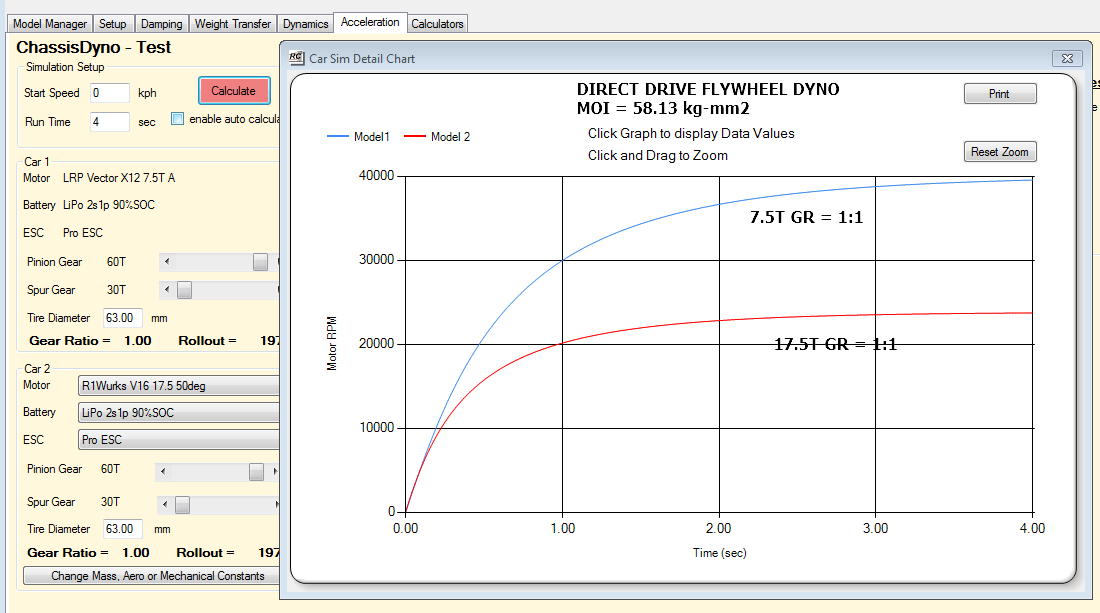
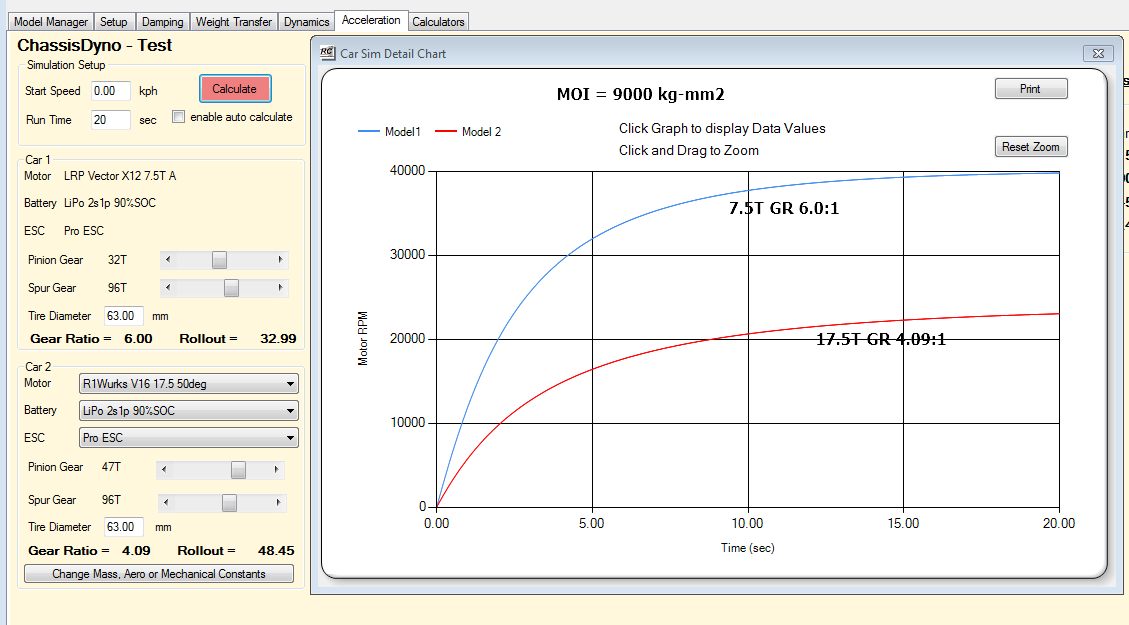
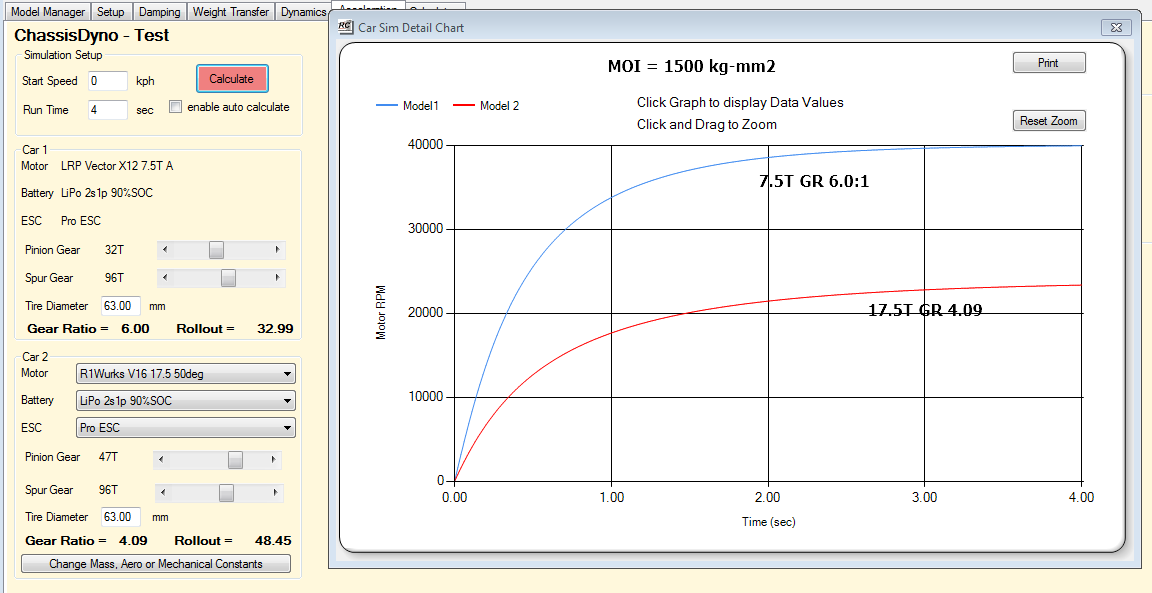
Couple things. You want to target the Mass Moment of Inertia (MMI) not just the Mass. The MMI is what determines how much resistive load the motor must accelerate. Yes mass is part of it but the equation to calculate MMI for a solid cylinder is 1/2 * mass * radius squared. The radius squared term has a big impact. I shoot for a spin up time of 2-4 seconds which is similar to what you see on track. So to answer your question about your current set up with a MMI of .009 kg-m2 (9000 kg-mm2) I would say yes that is too high. I ran some simulations using a 7.5T and 17.5T motor to compare your current setup to one with 1500 kg-mm2 which is what I would recommend. There are three graphs below. The last one shows the setup I currently use with my modified MD2 flywheel dyno.
According to the sims your rig will take 15-20 seconds to reach constant speed. IMO that is too long. Repeated runs will cause motor heating which will affect comparative results. Also if you are using a battery as a power source it will lose enough charge after a few runs to affect repeatability. It will also take a lot of energy to slow down the dyno so I wouldn't use the motor to do this.
In my setup I use a 50hz variable frequency sample rate and the Serial port baud rate of 115200. I can easily do 10 consecutive runs on a 2S Lipo with near zero effect on repeatability.
Hope this helps.
Sim of your current setup with MMI of 9000
Your setup with MMI of 1500
My modified MD2 Motor Dyno with 50mm dia Flywheel