Hello Scott,
Impressive works :-)
For your study about the piston hole size and the number of holes (page 25 of RC ShockdynoTest), my personal study points out also on the piston thickness.
Thin piston works as a diaphragm and thick piston gives more pressure loss through hole and more impact speed damping. In reality when your piston thickness is 2.5mm against a hole diameter of 1.2mm, that's not negligible and the piston thickness must be take in account for the study.
I also calculated theoretical reynolds number, for different pistons with multiple holes but the same flow area.
Increasing the number of holes while maintaining the same flow area (ie multiple of small holes VS two big holes) while give you turbulent mode (reynolds number >2000) at smaller speed, giving you more pack.
For exemple with the same flow area :
low speed damping (3 holes piston 1.1mm ; 1.1mm ; 1.2mm) = low speed damping (2 holes piston 1.4mm ; 1.4mm) (note that holes don't need to be all at the same diameter)
but
impact speed dampening(3 holes piston 1.1mm ; 1.1mm ; 1.2mm) > impact speed dampening(2 holes piston 1.4mm ; 1.4mm)
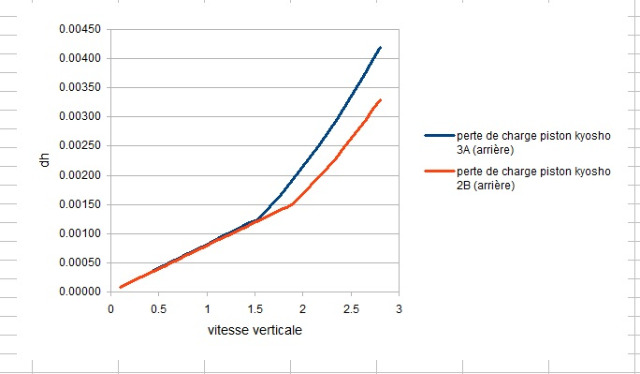
Hole diameter plays a role as it's use to calculate the hydraulic diameter for calculating the pressure loss
To sum up :
Impact speed depends on the thickness and the hole diameter
Low speed dampening depend on the flow aera (ie hole diameter and number of hole)
I made my theoretical study with Excel, and verify it in practice :-)
my two cent