


solar power
 10-05-2008, 08:25 PM
#16


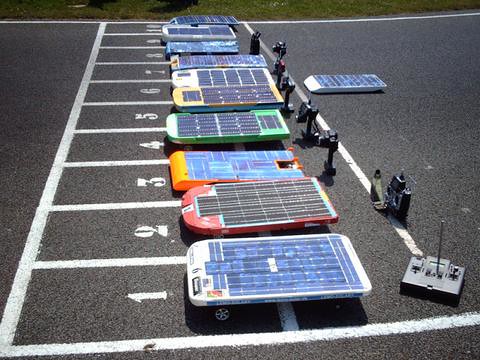
Just thought I would let all the electric roadies see my new project car. Yes making a solar R/C Car is possible, just need to put some thought into it to make it fast like mine.
This car is completely solar powered and drives in excess of 20mph(30kph). I built the car to the Solar R/C Cup rules.
Since Solar R/C Cup is not held in the U.S. I thought by posting my car others would be interested in competing Summer 2009 in the U.S. This would be a relatively cheap project for any High School, College or individual to take on. It took only 10 hours of build time for my car and my budget was under $400 for everything including the Castle ESC and Spektrum RX.
Video of my Car: More Video at my YouTube Channel
http://www.youtube.com/watch?v=1GGUpOY7Li8
 10-05-2008, 08:26 PM
#17
 10-06-2008, 06:38 AM
#19
Really? How big of a panel? 10W?
Most of the Solar Cup Cars have 25W panels, but the size is restricted to about 18" x 21" in area.
Most of the Solar Cup Cars have 25W panels, but the size is restricted to about 18" x 21" in area.
10-06-2008, 12:48 PM
#20
Tech Elite

iTrader: (1)

Join Date: Mar 2007
Location: Bristol, England, United Kingdom
Posts: 4,857
Trader Rating: 1 (100%+)
I'm sure I could rig my Piccoo Z to be solar powered.
a simpler option would be charge your 12v lead acid for your charger via a solar panel.
a simpler option would be charge your 12v lead acid for your charger via a solar panel.
10-06-2008, 01:25 PM
#21
Using a panel to charge your Lead Acid is a more common approach that airplane and heli guys use for field boxes to make their complete setup lighter. A 18AH Lead acid battery weighs about 13# and the panel only about 3#, This saves about 10~15# in extra weight from using a larger battery. Unless these guys like flying in the rain, it almost ensures that their battery never goes dead during a day of flight. A
I skip all the mess of batteries and just built a car to run with no batteries or gas, just bright clean sunshine.
I skip all the mess of batteries and just built a car to run with no batteries or gas, just bright clean sunshine.
10-06-2008, 01:52 PM
#22

Just thought I would let all the electric roadies see my new project car. Yes making a solar R/C Car is possible, just need to put some thought into it to make it fast like mine.
This car is completely solar powered and drives in excess of 20mph(30kph). I built the car to the Solar R/C Cup rules.
Since Solar R/C Cup is not held in the U.S. I thought by posting my car others would be interested in competing Summer 2009 in the U.S. This would be a relatively cheap project for any High School, College or individual to take on. It took only 10 hours of build time for my car and my budget was under $400 for everything including the Castle ESC and Spektrum RX.
Video of my Car: More Video at my YouTube Channel
http://www.youtube.com/watch?v=1GGUpOY7Li8
 10-06-2008, 01:58 PM
#23

very cool! do you happen to have some pics of it, without the shell, like how you wired it?
10-06-2008, 02:03 PM
#24
Considering it is only an 800mah and the charger out puts .5amps and needs a 12V input it does the job. The panel is about 2 decimeters across. The solar panel puts out between 11-13 volts, but on one real sunny day I got it up to 14.5v. It puts out around 1-1.5 amps.
10-06-2008, 02:58 PM
#25
I'll have to post some close shots. The car is built like a model airplane, so if you need to adjust it or service a part, just pop it off and take it to the bench. I made it that way to prevent breaking the solar cells.
10-06-2008, 03:11 PM
#26
Tech Elite
iTrader: (2)

Join Date: Jan 2008
Location: Colorado, USA, The land of the free and the home of the brave!
Posts: 2,880
Trader Rating: 2 (100%+)
Video of 2006 Solar R/C Cup.
http://www.youtube.com/watch?v=WmVhK7cn8RQ
http://www.youtube.com/watch?v=WmVhK7cn8RQ

And, if there is ample lighting (and you use photovoltaic cells, of course) you may be able to run inside as well.
Of course, it would be cool if they were fast too.
 10-06-2008, 04:24 PM
#27


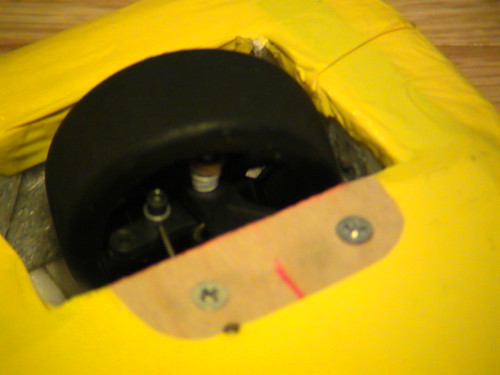
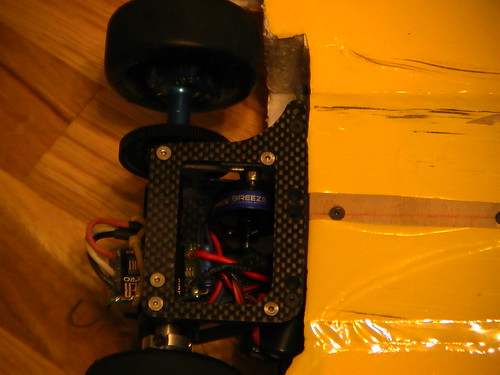
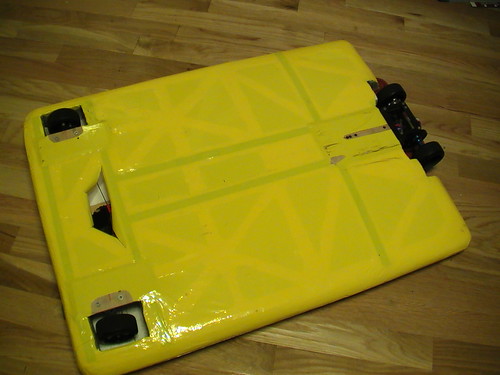
Yes there are some cracked solar cells. The car got airborne from some strong gust and landed on its lid. Even with the October sun hanging low and two destroyed cells I was able to clock the car at 33KPH (21mph). I wished I would have brought my pinion set with me and I could have tired for a little faster.
In general the Chassis of the car is the Solar Panel, everything else attaches to the car. As many will noticed, I used off the shelf RC10 pan car parts to build this car. The motor us "Uber" small compared to a 540 Brushless, but all I care is 1/8" shaft, and bolts into the pod. The car is EPS foam that I hollowed out and added voids. Then in some places added carbon fiber spar/strips. I had to route a 24" sevo extension into the frame before MonoKote was applied. The steering linkage gave me the most head ache as how to develope a system that can be adjustible and can be unconnected from the servo or the steering knuckle. The Suspension setup can only be adjusted while removed from the car. two screws and the wheels pop out for service. I am using one shock for the trailing action of the pod and one dampner tube to control roll. The POD is where all the electronis are installed. The rear pod is attached to a T-Plate by two screws. Removed the screw/nut from the 'T' tabs of the Tplate and the POD and electronics can be serviced.
Last edited by trailranger; 10-06-2008 at 07:56 PM.
10-06-2008, 06:29 PM
#28
Tech Elite
iTrader: (2)
Join Date: Jan 2008
Location: Colorado, USA, The land of the free and the home of the brave!
Posts: 2,880
Trader Rating: 2 (100%+)
Have you ever tried an outrunner and perhaps an 1/18th scale base (m18/micro rs4?)
Also, have you tried a small " back up " lipo that could be perhaps charged by the panels whilst the car is running a secondary source as the sun fades/car accelerates faster?
Also, have you tried a small " back up " lipo that could be perhaps charged by the panels whilst the car is running a secondary source as the sun fades/car accelerates faster?
10-06-2008, 07:38 PM
#29
My first motor looked like a golden mamba inrunner and the KV was 2100. Withh only 3A starting power, the ESC was having problems making the 2100KV turn and catch the feedback to start the next power phase. Ontop of that, with Low KV motors, it takes a higher current to obtain the "Sweet" spot for efficiency.
I switched motors and the car came to life and lost over 100g of weight. The inrunner had a IO (Waste Current) of 0.65A and the new Outrunner had an IO of 0.3A. The reduction in IO gave the motor 15% more power to playwith and 10% mass reduction played into making the car go faster.

