


 2Likes
Tekno Conversions Thread
 08-04-2008, 02:21 PM
#1


 Tekno Conversions Thread
Hi all,
Just thought we'd put a thread here to answer any questions and provide support for our 1/8th scale brushless conversions. Post pics, setups, race results, etc. Anything Tekno RC related
Thanks.
Just thought we'd put a thread here to answer any questions and provide support for our 1/8th scale brushless conversions. Post pics, setups, race results, etc. Anything Tekno RC related
Thanks.
Last edited by Muggydude; 07-06-2011 at 02:17 PM.
 08-04-2008, 03:39 PM
#2

Sweet... A place to communicate with others that have the new Tekno V3 kits.
I have been running my kits (mostly at a race track) for a few weeks now with great success, so if anyone needs help setting up their new conversion or any other set-up advice, please let me know.
There is a wealth of brushless knowledge to be had at the Impakt RC website. Check out the FAQ page on battery/motor choices.
Tekno RC is located and tests on the west coast. This is where a large number of RC manufacturers reside and probably due to this, the west coast has a large number of fast drivers and race tracks. Tekno is dedicated to the racing scene and is an active participant at many races. I think the products Tekno is making are the most practical racing platforms available to us 1/8th electric crowd.
These kits have been racing in major events like the Proline Nitro Max Challenge (rough track!) and JBRL series races that run in California.
Tekno will offer and show a TON of support to anyone needing help with his products, as he likes to hear any feedback.
Thanks again and good luck with your conversions!!!
I have been running my kits (mostly at a race track) for a few weeks now with great success, so if anyone needs help setting up their new conversion or any other set-up advice, please let me know.
There is a wealth of brushless knowledge to be had at the Impakt RC website. Check out the FAQ page on battery/motor choices.
Tekno RC is located and tests on the west coast. This is where a large number of RC manufacturers reside and probably due to this, the west coast has a large number of fast drivers and race tracks. Tekno is dedicated to the racing scene and is an active participant at many races. I think the products Tekno is making are the most practical racing platforms available to us 1/8th electric crowd.
These kits have been racing in major events like the Proline Nitro Max Challenge (rough track!) and JBRL series races that run in California.
Tekno will offer and show a TON of support to anyone needing help with his products, as he likes to hear any feedback.
Thanks again and good luck with your conversions!!!
08-04-2008, 08:50 PM
#3
BTW,
Here's a link to the kits we are discussing here:
http://www.impaktrc.com/advanced_sea...words=tekno+v3
And a lot of other brushless 1/8th scale related stuff:
http://www.impaktrc.com/index.php?cPath=238
http://www.impaktrc.com/index.php?cPath=186_292
Here's a link to the kits we are discussing here:
http://www.impaktrc.com/advanced_sea...words=tekno+v3
And a lot of other brushless 1/8th scale related stuff:
http://www.impaktrc.com/index.php?cPath=238
http://www.impaktrc.com/index.php?cPath=186_292
08-05-2008, 02:00 PM
#4

Why does this setup use a clutch? Seems counter productive with an electric motor and also requires mechanical brakes.
08-05-2008, 02:50 PM
#5
We've heard this question a lot. We know it seems weird, but you have to try it to really see and feel the benefits. Here is a response from another forum (edited for context):
------------
I'd like to take this opportunity and address the many questions about the clutch and clutch bell setup being used in our conversion.
We were intent on building the fastest 1/8th scale brushless vehicles around. Believing that if it's fast at the track, it'll be fast most everywhere. After looking at some current direct drive setups and having been into 1/10 scale electric truck racing back in the day, we saw a need for better traction. Add brushless motors and lipo battery packs to the mix and you have a considerable issue.
Drawing on years of nitro racing and tuning, we noticed the gas cars didn't want to spin around as much. The clutch system didn't only keep the engine from stalling, it aided in the traction and power delivery. We decided a clutch system like that would also benefit an electric vehicle in exactly the same way. The only difference is the motor can't stall.
A centrifugal clutch is different than a 'slipper' or friction clutch. Slippers only slip when the input power exceeds the friction force being applied between the plates. So, a slipper doesn't slip at low RPM, but rather only at high RPM or high power input. Contrast that with a clutch bell setup where it slips at low RPM and engages at higher RPM and higher power input. The systems are nearly complete opposites in how they deliver power. As a result, the driving profile and characteristics are different and the centrifugal clutch system is better suited for larger vehicles as proven by the absence of slipper clutches on 1/8 scale vehicles. Through testing we found that the clutch works best when the shoes are flipped over in the leading position. This is because with an electric motor that doesn't stall, we don't need to wait until we build 1-3000 RPM to build power. When set up like this, the clutch engages quickly, but still provides all of the benefits of a centrifugal clutch. The obvious benefits are easing the stress between the drivetrain and motor and of course better traction.
A lot of ESC's have power limiting features, why not just use that?
Yes, this is true. However, the ESC has no physical connection to the vehicle whereas a clutch can still respond to the driving conditions. This is handy say, when you are on throttle trying to land a jump. It will subtly respond to bumps and ruts as the loads on the tires change.
What about the added weight and rotational mass? This is a valid question. While the difference could be measured with equipment, it simply hasn't been an issue. Again, there is so much power and torque in these motors that the added rotational mass is negligible. We've never been in the situation where we needed more power than what the system could deliver. On the flip side, one could argue that mid-range punch may be enhanced with the addition of the extra weight. Nitro clutches are even heavier and nitro cars don't have trouble getting around the track.
What about clutch wear and clutch bearings?
Great question. Our clutch shoes have lasted well over 8 months of hard running. As long as you are running them in the leading position, there should be no issues. Bearings will fail eventually and should be replaced every 2 to 3 months or as necessary, but we can assure you it's absolutely nothing like if you were running a nitro. There is no fuel and oil for the dirt to stick to and foul things up. Additionally, the clutch isn't 'dragging' like it is on a nitro, which is evident in how long the clutch shoes and bearings are lasting.
What about wasted power due to slippage?
This is an issue whether you run a 'slipper' clutch or a centrifugal clutch. Any clutch system will have some wasted power. Which one wastes more under normal use would be hard to measure. Of course you could run the centrifugal clutch below it's engagement point for a whole pack and say it wastes more power and generates more heat, but how much fun would that be
Why not use motor brakes, they're just as powerful or more powerful than mechanical brakes?
Putting the front/rear brake bias ability aside, mechanical brakes are easier on the motor and ESC resulting in less heat. Subsequently, they are easier on the drivetrain as well. Mechanical brakes are just as reliable and some say more predictable than motor braking. Adding the front/rear bias back in and you have a cool operating system that can out-handle motor brakes alone.
So the clutch system is actually quite a difference compared to direct drive. We realize it's new and people are comfortable with how it's been done for all these years. The results were so good that we have basically staked the future of our company and our reputation on using a clutch and clutch bell in an electric car. How it goes from here is anyone's guess, but the race results don't lie. We hope it becomes the new norm.
Thanks for reading and please let us know if there are any questions.
--------------
To sum up - cooler operating temps, smoother power delivery, true front/rear brake bias, better jumping and handling (no drag brake), less wear on drivetrain and motor bearings.
Recently we've discovered another benefit. We have yet to wear out a clutch bell. We have hundreds, maybe close to a thousand test hours on our systems now and still have not had to replace a clutch bell. We are running the stock steel gears, no need to switch to plastic and risk stripping a gear during a race. Contrast that with the wear that some people have experienced using pinion gears.
All that aside, you can still use our kits with pinion gears if you have absolutely no interest in the clutch system.
, but you have to try it to really see and feel the benefits. Here is a response from another forum (edited for context):------------
I'd like to take this opportunity and address the many questions about the clutch and clutch bell setup being used in our conversion.
We were intent on building the fastest 1/8th scale brushless vehicles around. Believing that if it's fast at the track, it'll be fast most everywhere. After looking at some current direct drive setups and having been into 1/10 scale electric truck racing back in the day, we saw a need for better traction. Add brushless motors and lipo battery packs to the mix and you have a considerable issue.
Drawing on years of nitro racing and tuning, we noticed the gas cars didn't want to spin around as much. The clutch system didn't only keep the engine from stalling, it aided in the traction and power delivery. We decided a clutch system like that would also benefit an electric vehicle in exactly the same way. The only difference is the motor can't stall.
A centrifugal clutch is different than a 'slipper' or friction clutch. Slippers only slip when the input power exceeds the friction force being applied between the plates. So, a slipper doesn't slip at low RPM, but rather only at high RPM or high power input. Contrast that with a clutch bell setup where it slips at low RPM and engages at higher RPM and higher power input. The systems are nearly complete opposites in how they deliver power. As a result, the driving profile and characteristics are different and the centrifugal clutch system is better suited for larger vehicles as proven by the absence of slipper clutches on 1/8 scale vehicles. Through testing we found that the clutch works best when the shoes are flipped over in the leading position. This is because with an electric motor that doesn't stall, we don't need to wait until we build 1-3000 RPM to build power. When set up like this, the clutch engages quickly, but still provides all of the benefits of a centrifugal clutch. The obvious benefits are easing the stress between the drivetrain and motor and of course better traction.
A lot of ESC's have power limiting features, why not just use that?
Yes, this is true. However, the ESC has no physical connection to the vehicle whereas a clutch can still respond to the driving conditions. This is handy say, when you are on throttle trying to land a jump. It will subtly respond to bumps and ruts as the loads on the tires change.
What about the added weight and rotational mass? This is a valid question. While the difference could be measured with equipment, it simply hasn't been an issue. Again, there is so much power and torque in these motors that the added rotational mass is negligible. We've never been in the situation where we needed more power than what the system could deliver. On the flip side, one could argue that mid-range punch may be enhanced with the addition of the extra weight. Nitro clutches are even heavier and nitro cars don't have trouble getting around the track.
What about clutch wear and clutch bearings?
Great question. Our clutch shoes have lasted well over 8 months of hard running. As long as you are running them in the leading position, there should be no issues. Bearings will fail eventually and should be replaced every 2 to 3 months or as necessary, but we can assure you it's absolutely nothing like if you were running a nitro. There is no fuel and oil for the dirt to stick to and foul things up. Additionally, the clutch isn't 'dragging' like it is on a nitro, which is evident in how long the clutch shoes and bearings are lasting.
What about wasted power due to slippage?
This is an issue whether you run a 'slipper' clutch or a centrifugal clutch. Any clutch system will have some wasted power. Which one wastes more under normal use would be hard to measure. Of course you could run the centrifugal clutch below it's engagement point for a whole pack and say it wastes more power and generates more heat, but how much fun would that be
Why not use motor brakes, they're just as powerful or more powerful than mechanical brakes?
Putting the front/rear brake bias ability aside, mechanical brakes are easier on the motor and ESC resulting in less heat. Subsequently, they are easier on the drivetrain as well. Mechanical brakes are just as reliable and some say more predictable than motor braking. Adding the front/rear bias back in and you have a cool operating system that can out-handle motor brakes alone.
So the clutch system is actually quite a difference compared to direct drive. We realize it's new and people are comfortable with how it's been done for all these years. The results were so good that we have basically staked the future of our company and our reputation on using a clutch and clutch bell in an electric car. How it goes from here is anyone's guess, but the race results don't lie. We hope it becomes the new norm.
Thanks for reading and please let us know if there are any questions.
--------------
To sum up - cooler operating temps, smoother power delivery, true front/rear brake bias, better jumping and handling (no drag brake), less wear on drivetrain and motor bearings.
Recently we've discovered another benefit. We have yet to wear out a clutch bell. We have hundreds, maybe close to a thousand test hours on our systems now and still have not had to replace a clutch bell. We are running the stock steel gears, no need to switch to plastic and risk stripping a gear during a race. Contrast that with the wear that some people have experienced using pinion gears.
All that aside, you can still use our kits with pinion gears if you have absolutely no interest in the clutch system.
08-06-2008, 06:34 AM
#6

I have a few questions:
1. What are the maximum battery dimensions that can fit in the Losi 8ight Buggy, 8ight-T, and the RC8 conversion?
2. is there an tray system being considered that better protects the batteries from side impacts?
3. Any pics of your conversions running hardcased lipos to see how this is being done?
4. Can finned motors be used, or do they all need to be smooth canned style?
5. any reps from the big race organizations approach you guys about the future of the class as far as rules etc?
6. When can we see some pics of an RC8 conversion
1. What are the maximum battery dimensions that can fit in the Losi 8ight Buggy, 8ight-T, and the RC8 conversion?
2. is there an tray system being considered that better protects the batteries from side impacts?
3. Any pics of your conversions running hardcased lipos to see how this is being done?
4. Can finned motors be used, or do they all need to be smooth canned style?
5. any reps from the big race organizations approach you guys about the future of the class as far as rules etc?
6. When can we see some pics of an RC8 conversion
08-06-2008, 02:14 PM
#7
Tech Adept
Personally I cant wait to get mine set up. IMO the problems with the mmm and all the other esc's will be for nothing with this conversion. I'm not a electronics expert but if you take motor brake and drag brake out of the equation and only need an esc that will take you forward thats a huge plus. I just wish they had one for the MBX5 so I wouldnt have to get a new roller.
08-06-2008, 06:51 PM
#8

How about someone who has one of these posting some pics? I've only seen the Tekno promo pics.
08-06-2008, 10:04 PM
#9
I have a few questions:
1. What are the maximum battery dimensions that can fit in the Losi 8ight Buggy, 8ight-T, and the RC8 conversion?
2. is there an tray system being considered that better protects the batteries from side impacts?
3. Any pics of your conversions running hardcased lipos to see how this is being done?
4. Can finned motors be used, or do they all need to be smooth canned style?
5. any reps from the big race organizations approach you guys about the future of the class as far as rules etc?
6. When can we see some pics of an RC8 conversion
1. What are the maximum battery dimensions that can fit in the Losi 8ight Buggy, 8ight-T, and the RC8 conversion?
2. is there an tray system being considered that better protects the batteries from side impacts?
3. Any pics of your conversions running hardcased lipos to see how this is being done?
4. Can finned motors be used, or do they all need to be smooth canned style?
5. any reps from the big race organizations approach you guys about the future of the class as far as rules etc?
6. When can we see some pics of an RC8 conversion
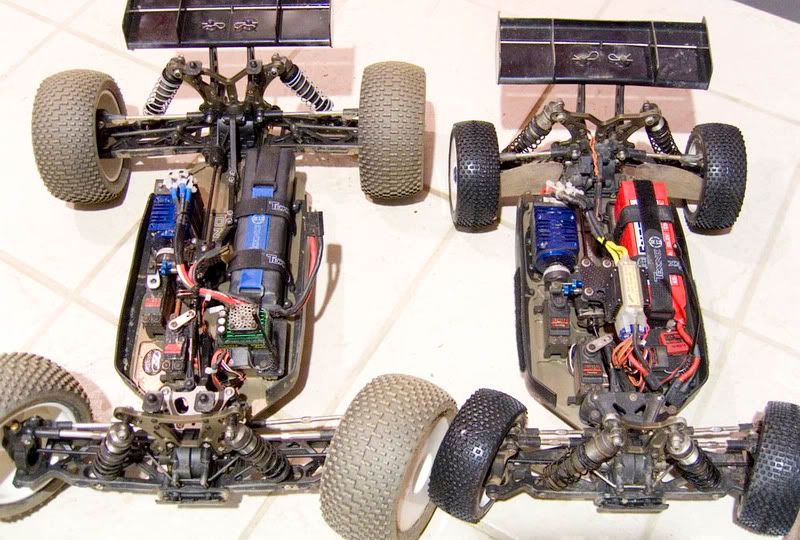
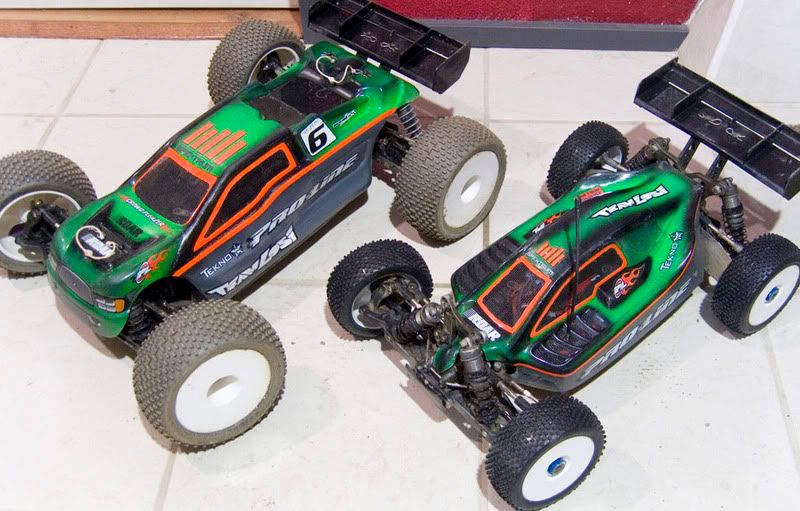
1. It's 50mm wide x 150 long. And you can cut the rear border off to accommodate longer packs. I did this for a Zippy 190mm long pack, than I ran an extra strap around the long battery pack. Without cutting, you can almost fit a 170mm pack in there, because the packs aren't perfectly squared off at the ends. And thanks to these rounded ends, they still fit the length well. Can't exceed 50mm on the width though. And the height is only limited by what can fit under the body (about 50mm for most batteries) and is different for different bodies.
2. Side impakts have never been an issue in all of our testing. The mud guards are tall and strong enough to keep anything from entering the battery area from the side. And the three strap system keeps the battery WAY more secure than a one strap system (I've run both).
3. No one on our team has run hard case lipo's yet (I think hard case rules should NOT apply to our large batteries, but this is another issue for debate). Tekno can let you know if they fit for sure because he has access to these items to test fit for you. I imagine the 3 strap system will provide the best support for this "stacked" battery configuration though.
4. This one is hard for me because I am currently running a square can motor. However, the fins don't matter if you want to instal them in to the Tekno motor mount. They come in three sizes to accommodate various motor diameters (even the finned ones). Just check your motor for dimensions and get the right mount for that diameter.
5. I have approached and discussed this with many pro's and factory guys. So has Tekno (even more so). I talk to them all whenever I see them at a race (witch can be often here in So Cal.). I get mixed feedback about our segment of the hobby. However when talking to The Drake about what he thought of the future for us and he was surprisingly optimistic. He said he thought nitro would always be around and electric wouldn't replace it, but he knew it was up and coming FAST. He knows it will play a major role in the future of our hobby and so do most of the factory people.
6. Tekno will have to send you pictures of these. He's become quite partial to racing his RC8 prototype conversion and loves the way that car drives.
I hope this helps out!
 08-06-2008, 10:27 PM
#11
I have a few questions:
1. What are the maximum battery dimensions that can fit in the Losi 8ight Buggy, 8ight-T, and the RC8 conversion?
2. is there an tray system being considered that better protects the batteries from side impacts?
3. Any pics of your conversions running hardcased lipos to see how this is being done?
4. Can finned motors be used, or do they all need to be smooth canned style?
5. any reps from the big race organizations approach you guys about the future of the class as far as rules etc?
6. When can we see some pics of an RC8 conversion
1. What are the maximum battery dimensions that can fit in the Losi 8ight Buggy, 8ight-T, and the RC8 conversion?
2. is there an tray system being considered that better protects the batteries from side impacts?
3. Any pics of your conversions running hardcased lipos to see how this is being done?
4. Can finned motors be used, or do they all need to be smooth canned style?
5. any reps from the big race organizations approach you guys about the future of the class as far as rules etc?
6. When can we see some pics of an RC8 conversion
2. Side impacts have never been an issue. The mud guards protect them in the event of a side impact.
3. For hardcased lipos, just stack them as Marzac suggests. You could put some 2-sided tape in between them so they don't scrape against each other. There is clearance to fit two of them in the tray and still not push the body up (your body may vary, but we haven't had any issues).
4. Choose the 44mm mount for finned Neu, or Hacker CL motors. It's a perfect fit for the finned Neus, while the Hacker isn't quite as snug but still fits fine.
5. We have talked to many pros and many companies about the future of the class. We hope to be a major player, we'll see
6. We were at the track today with the RC8 production sample. Not sure what it is about this car, but it just drives great. We should have some pics up in a couple weeks. We were hoping to have them available already, but manufacturing was delayed a couple weeks (we'll blame the Olympics)
08-06-2008, 10:33 PM
#12
Almost anything will fit in our truggy conversion. See the post above for info on how to fit a 190mm pack in the truggies.
08-06-2008, 10:48 PM
#13

I have never race off road nitro, so I have no experience with tuning the clutch oir changing clutch springs, etc. Which is why I'd prefer to run direct drive with a pinion gear, but I have a couple questions about both.
First, I heard that the long shank pinion gears put extra stress on the front motor bearings because it sits so far on the shaft... is this true?
And my second question is, is it hard to tune the clutch or change springs or whatever in it. I don't even know the parts it consists of. But if I plan to start racing would it be fairly straight forward about how to change parts of the clutch to suite your driving style or track?
I just need to head over to ARC to meet with you guys and see your set ups... I am in San Diego too, so I can't really complain about the drive (although I wish I can
  ) since its probably the same for us. I just need to wait for my MMM ESC's to finally come. At the moment, I only have two trucks running (rc18 and CRT.5... both brushless), so its not even worth going there with two trucks and one I can't even drive on the track since its too small. My Revo and 8ight are both ESCless...
  What days do you guys usually go to practice at the track as well? I think Matthew Armeni told me on Wednesdays...?
Let me know. Thanks.
First, I heard that the long shank pinion gears put extra stress on the front motor bearings because it sits so far on the shaft... is this true?
And my second question is, is it hard to tune the clutch or change springs or whatever in it. I don't even know the parts it consists of.
But if I plan to start racing would it be fairly straight forward about how to change parts of the clutch to suite your driving style or track?I just need to head over to ARC to meet with you guys and see your set ups...
I am in San Diego too, so I can't really complain about the drive (although I wish I can ) since its probably the same for us. I just need to wait for my MMM ESC's to finally come. At the moment, I only have two trucks running (rc18 and CRT.5... both brushless), so its not even worth going there with two trucks and one I can't even drive on the track since its too small. My Revo and 8ight are both ESCless... What days do you guys usually go to practice at the track as well? I think Matthew Armeni told me on Wednesdays...?Let me know. Thanks.
08-06-2008, 11:02 PM
#14
I have never race off road nitro, so I have no experience with tuning the clutch oir changing clutch springs, etc. Which is why I'd prefer to run direct drive with a pinion gear, but I have a couple questions about both.
First, I heard that the long shank pinion gears put extra stress on the front motor bearings because it sits so far on the shaft... is this true?
And my second question is, is it hard to tune the clutch or change springs or whatever in it. I don't even know the parts it consists of. But if I plan to start racing would it be fairly straight forward about how to change parts of the clutch to suite your driving style or track?
I just need to head over to ARC to meet with you guys and see your set ups... I am in San Diego too, so I can't really complain about the drive (although I wish I can ) since its probably the same for us. I just need to wait for my MMM ESC's to finally come. At the moment, I only have two trucks running (rc18 and CRT.5... both brushless), so its not even worth going there with two trucks and one I can't even drive on the track since its too small. My Revo and 8ight are both ESCless... What days do you guys usually go to practice at the track as well? I think Matthew Armeni told me on Wednesdays...?
Let me know. Thanks.
First, I heard that the long shank pinion gears put extra stress on the front motor bearings because it sits so far on the shaft... is this true?
And my second question is, is it hard to tune the clutch or change springs or whatever in it. I don't even know the parts it consists of.
But if I plan to start racing would it be fairly straight forward about how to change parts of the clutch to suite your driving style or track?I just need to head over to ARC to meet with you guys and see your set ups...
I am in San Diego too, so I can't really complain about the drive (although I wish I can ) since its probably the same for us. I just need to wait for my MMM ESC's to finally come. At the moment, I only have two trucks running (rc18 and CRT.5... both brushless), so its not even worth going there with two trucks and one I can't even drive on the track since its too small. My Revo and 8ight are both ESCless... What days do you guys usually go to practice at the track as well? I think Matthew Armeni told me on Wednesdays...?Let me know. Thanks.
In general, direct drive will put more stress on the bearings than a clutch system will since the braking is done mechanically instead of with the motor. For reference though, our clutch system sits farther out on the shaft than our long shank pinions do and we've not experienced any premature bearing failure. We still replace our motor bearings because of dust though. Our conversions have extra bracing to prevent flex in the motor area as well. All that said, long shank pinions will put more stress on the motor bearings than a standard pinion, but not more than the clutch system for reasons stated above.
It is very easy to tune the clutch if needed. The clutch shoes and spring that are included in the kit have been chosen for optimum engagement. The spring is real light so the shoes grab quickly. You can also take the spring off altogether for a hybrid clutch/direct drive feel. The clutch assembly is pretty straight forward and is very easy to work on. Since the motor can be removed with 4 quick screws, it's easy to get at what you need in this area. Out of the box, the clutch system is dialed. We rarely change anything on it since the shoes seem to last forever and get better with wear, seriously. Add the programming features of your ESC into the mix and you can tune even more. That is what we do. We set the clutch up and then tune the ESC for the track conditions.
We are at the track every Wednesday for testing and practice and we try to race as often as we can on Saturdays. Not sure when we'll be able to race again, but we'll be there next Wednesday. Give us a call at the shop to confirm next week and we'll see you out there. You can see all of the stuff we've been doing lately. We can show you our RC8, X2, and MBX5T conversions as well
Take it easy.
08-07-2008, 12:06 AM
#15
Tech Apprentice
Can a 170mm long batt. can fit in the 8ight buggy teknorc with tray mods? (Zippy -R)